• Home
  • Products
  • Join Now!
  • Renew
  • About Us
  • Member Login

Coach-Net

~ Travel and Adventure Blog

Coach-Net

Monthly Archives: October 2021

Fall For These Majestic Waterfalls In Tennessee On Your Next Road Trip

26 Tuesday Oct 2021

Posted by Coach-Net in Travel Destinations

≈ 2 Comments

Tags

Road Trip Destination, RV Camping, RV Safety, RV travel, Tennessee Road Trip, Travel Tips

“There’s no better place to find yourself than sitting by a waterfall and listening to its music.”

― Roland R Kemler

With over 500 waterfalls, many located in the eastern part of the state, Tennessee is a perfect place for RVers to camp near and scout out these natural wonders. So the next time your RV travels take you through the land of country music, barbecue, whiskey, and more, be sure to step away from the bustling cities.  Instead, stay awhile at these parks and explore some of the state’s most amazing majestic waterfalls.

Fall Creek Falls

Fall Creek Falls State Park

Located between Spencer and Pikeville, Fall Creek Falls State Park is a paradise of more than 20,000 acres featuring cascades, gorges, waterfalls, and streams. One of the highest waterfalls in the eastern United States at 256 feet, Fall Creek Falls is the namesake of the state park and its most famous waterfall. Visitors can access this sheer-drop waterfall and other waterfalls like Piney Falls, Cane Creek Falls, and Cane Creek Cascades utilizing the park’s almost 50 miles of hiking trails. 

RVers wanting to stay a while and explore more of Fall Creek Falls State Park’s hidden treasures have five separate camping areas to choose from within the park. Other fun activities include rock climbing, a treetop agility course known as the Canopy Challenge Course, boating, interpretive programs, biking, fishing, swimming, birding, and golf.

Ruby Falls

Ruby Falls

The vacation destination Lookout Mountain, just minutes from downtown Chattanooga, has a few gems to experience above and below the surface. Ruby Falls is a 145-foot high waterfall located 1,120 feet beneath the mountain. Soon after the accidental discovery of the falls in the 1930s, the cavern became a tourist destination. Today, folks from all over the world flock to see the tallest and deepest underground waterfall open to the public in the United States.

The tour of Ruby Falls lasts about an hour. It takes ticket-holders 260 feet down in a glass-front elevator to the cavern trail that winds around unique cave formations leading up to the thundering falls. The cavern stays a consistent 60 degrees Fahrenheit throughout the year so bring a sweater if that sounds chilly.

While RV parking is available, it is limited, and the drive up the mountain is rather steep. However, there are RV parks located in and around Chattanooga.

Burgess Falls

Burgess Falls State Park

Burgess Falls State Park in Sparta, Tennessee, is a day-use park known for its many outdoor activities (like hiking, fishing, and bird watching) set to the backdrop of dense forests, rocky cliffs, and the Falling Water River. Now a designated Tennessee State Natural Area, the river and surrounding land served various purposes through the ages, including hunting grounds for Native Americans and a hydroelectric power source for nearby Cookeville.

Perhaps the most sought-after features of the park are its four waterfalls. The River Trail on the Service Loop Road leads to the top of the waterfalls cascading down from over 250 feet into a large pool, the most spectacular one being the Burgess Falls. This waterfall plunges more than 130 feet into the gorge.

Foster Falls

South Cumberland State Park

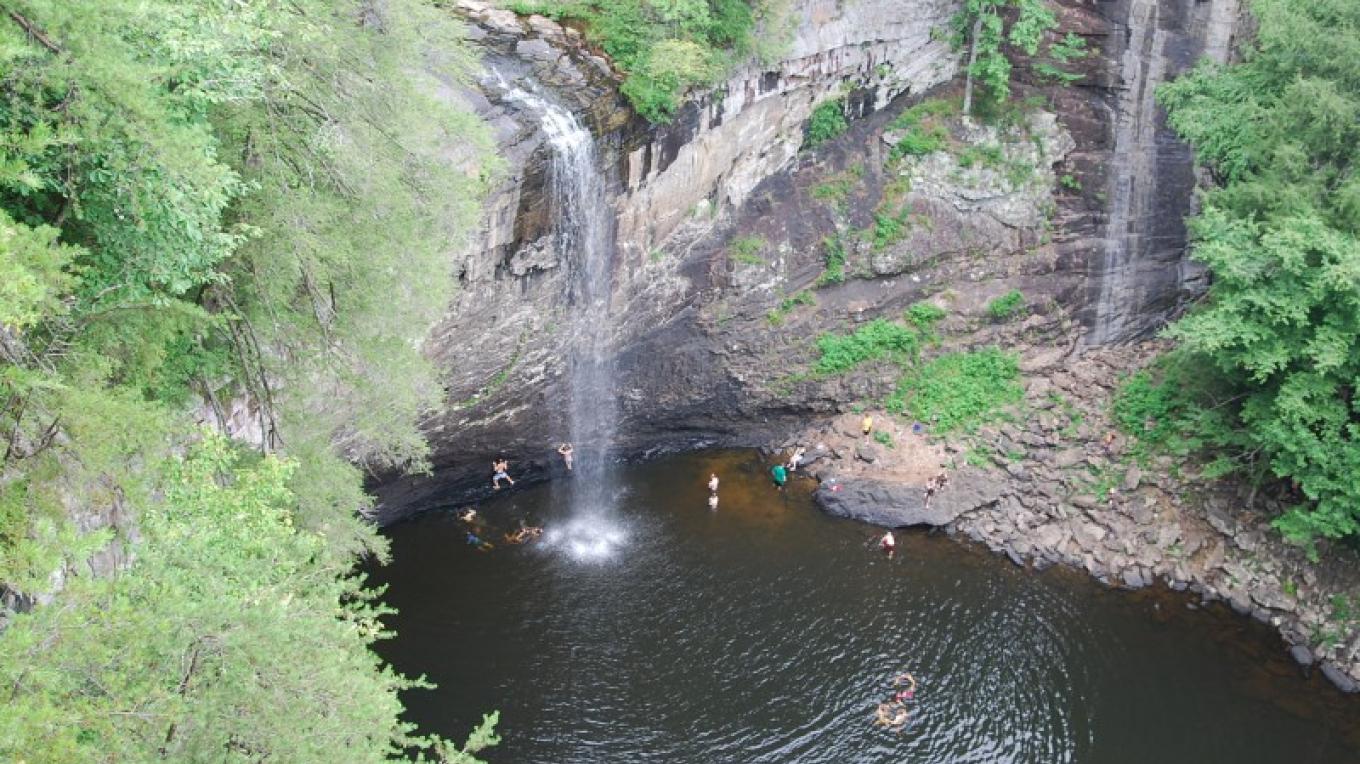
Day-use visitors and overnight campers can get up close and personal to the Foster Falls in South Cumberland State Park. Beginning at the Foster Falls Visitor Center in Sequatchie, Tennessee, a moderately challenging hike leads to the waterfall that drops from 60 feet into a gorge. The refreshing water is perfect for swimming year-round, save winter. 

South Cumberland State Park offers all kinds of outdoor activities, including hiking, hunting, cave tours, rock climbing, fishing, interpretive programs and events, wildlife viewing, and primitive tent and RV camping.

Cummins Falls

Cummins Falls State Park

Another popular swimming hole is in Cummins Falls State Park. This day-use park can be found nine miles north of Cookeville on the Blackburn Fork State Scenic River.

The Cummins Falls drops down from a height of 75 feet. The first portion of the falls plunges 50 feet into a shallow pool, and the second portion cascades 25 feet into a larger, deeper pool.  Any visitor wanting  to enter the gorge or visit the base of the waterfall must now obtain a permit from the park.

A Word of Caution Regarding Waterfalls

Not to strip away the fun of waterfalls, but venturing to one of these natural beauties comes with a word of caution. Trauma surgeon Jonas Karlsson, MD, offers advice based on his experiences treating patients with fatal or nearly fatal injuries around waterfalls.

1. Wear sturdy hiking shoes or boots.

2. Stay on developed trails. Do not stray from observation decks and platforms.

3. Pay attention to warning signs and rules posted near waterfalls.

4. Never climb on or around waterfalls.

5. Never jump off waterfalls or dive into plunge pools.

6. Supervise children and pets carefully.

7. Never play in the stream or river above a waterfall, or try to take photos at the top of a waterfall.

-Gathered from Waterfall Safety

Waterfalls Aren’t the Only Thing You Can Fall For…

Fall for the protection, security, and peace of mind that Coach-Net’s Premier Motorized Plan brings to RVers everywhere. You can rest easy knowing that Coach-Net has you covered with its 24/7, all-inclusive roadside assistance, Concierge Services, Global Emergency Travel Services, Tire Discounts, Camping Discounts, and so much more. When you sign up for our roadside assistance program before you set off, you’ll have the help you need whenever you need it. So get Coach-Net and get on with your Tennessee waterfall adventures!


About The Author: Natalie Henley

Levi Henley and his wife, Natalie, have been full-time RVers for over 5 years. They have also been Coach-Net customers for the same amount of time.  They travel and workcamp around the U.S. in their 26-foot Itasca Sunstar motorhome with their two cats.  They write for multiple RV-related publications and recently co-wrote “Seasonal Workamping for a Living: How We Did It.” You can follow their adventures on the road at henleyshappytrails.com 

RV Protect

Mike S. ~ “I am very pleased I chose Coach-Net! When I needed you, you were there for me!”

Share this with your friends:

  • Share on Facebook (Opens in new window) Facebook
  • Share on X (Opens in new window) X
  • Share on Pinterest (Opens in new window) Pinterest
  • Print (Opens in new window) Print
  • Email a link to a friend (Opens in new window) Email
  • More
  • Share on Reddit (Opens in new window) Reddit
  • Share on Tumblr (Opens in new window) Tumblr

Like this:

Like Loading...

Great Gifts that RVers Will Love

19 Tuesday Oct 2021

Posted by Coach-Net in Tips & Tricks

≈ Leave a comment

Tags

Gifts For RVers, RV cooking, RV gadgets, RV Pro Tips, RV Tips, RV travel

Looking for a gift for your favorite RV traveler that won’t break the bank or overextend payload? All the gifts on this list match three important requirements: they are small, lightweight, and relatively inexpensive.

Black Diamond Spot 350 Headlamp: Provides hands-free light while working under your rig or checking on your campsite after dark. Available in red, black, blue, and aqua.

Motorola Talkabout 200 2 Way Radio: Relying on cell phones to help your partner park the trailer? That doesn’t always work in remote areas. A pair of rechargeable walkie talkies can really come in handy, and it’s a good idea to purchase a set that isn’t just a kids’ toy. 

Kidde Code One Fire Extinguisher: Most RVs come equipped with a single fire extinguisher. Double your safety factor by keeping an extra one at the other end of your rig.

Adventure Medical Kits Mountain Series Hike Medical Kit: This model is compact, weighs less than 8 ounces, and is extremely well organized. The sections open like flower petals, making it easy to find what you need when every moment counts.

Ambient Weather Temperature/Humidity Monitor: The Ambient monitor will take readings from sensors that you place in three different areas of your RV, as well as providing information about the temperature and humidity outdoors. Critical for avoiding interior condensation and keeping pets safe.

SUAOKI Solar LED Lamp: The SUAOKI lamp is extremely lightweight, collapsible, and can be charged by USB as well as the solar panel.

Keurig K-Mini Coffee Maker: This single serve coffee maker is less than 5 inches wide to maximize your counter space.

Plastic Bag Holder: Hangs from a hook, lightweight, and keeps all those plastic grocery bags corralled. Available in a variety of fun fabric options.

RV Devotional Book: Need some grace while on the road? Grace on a Rambling Road: Devotions for RV Travelers includes 60 entries that connect the Scriptures with stories of life on the road, mediations on nature, prayers, and life applications.

Sky Jo Game: Sky Jo is easy to learn and quick to play. Perfect for ages 7 and up on those rainy days.

Mainstays Oversized Picnic Blanket: This useful and fun 60’ x 70’ blanket has a waterproof exterior and folds up to form a carrying bag with attached handles and pocket. Vibrant colors and big enough for family outings.

Duraflame Fatwood Fire Starters: These are designed to work with wood or charcoal.

Fun Outdoor Tablecloth: Ready to replace that ratty old tablecloth? This one comes in a fun camping themed pattern. Plastic clips will help keep everything secure on those windy days.

  • Clamps


*From time-to-time, we have guest bloggers post on our site. The views, opinions and positions expressed within these guest posts are those of the authors. Coach-Net did not receive compensation for this post.


About the Author: Nancy Bell Kimsey is a lifelong outdoor enthusiast whose hiking and camping experiences have ranged from backpacking and family tent camping to adventuring in a fiberglass travel trailer. She moved to North Carolina to attend Wake Forest University and remained in the Tar Heel State throughout her career as an educator. She is a contributing writer for several camping publications and the author of Grace on a Rambling Road: Devotions for RV Travelers.

Nancy Bell Kimsey
RV Protect

Martina N. ~ “Friendly and fast service! Highly recommended especially for new RV owners!”

Share this with your friends:

  • Share on Facebook (Opens in new window) Facebook
  • Share on X (Opens in new window) X
  • Share on Pinterest (Opens in new window) Pinterest
  • Print (Opens in new window) Print
  • Email a link to a friend (Opens in new window) Email
  • More
  • Share on Reddit (Opens in new window) Reddit
  • Share on Tumblr (Opens in new window) Tumblr

Like this:

Like Loading...

Camping With Coach-Net: Brooke At Lake Lewisville

06 Wednesday Oct 2021

Posted by Coach-Net in We Love It. We Live It.

≈ Leave a comment

Tags

Camping With Coach-Net, camping with kids, camping with pets, RV Camping, RV travel

Brooke is one of our awesome Inside Account Executives! She, her husband and 3 daughters were able to take a long weekend together in Rosie the Airstream for the first time on Lake Lewisville. They fished, road bikes, and spent time with friends who came along! Here’s her experience!


My family and I went camping on Lake Lewisville this spring, and it was our first time to enjoy the company Airstream, Rosie. It was a great location for our family since we have 3 little girls that love to be out in nature and there was a perfect tree for them to climb, lots of room to play, and even a little play area for them to enjoy. It was only about 45 minutes from our house but it still seemed like we were out in the “woods” which was perfect.

We were able to head out and set up the Airstream Friday afternoon and enjoyed a nice, long weekend and back to our normal week relaxed and refreshed.

My husband and I rented an RV a couple of summers ago, so this wasn’t our first time out camping. We went to San Marcos with the RV we rented from Outdoorsy and it was a great experience. It was so nice to enjoy some time away from “city life” and get out away from it all to relax with friends and family.

This camping experience was great for our girls. The only time they came inside the Airstream was to sleep. The stayed outside and enjoyed bike riding, riding their scooters, playing with friends, roasting s’mores, and a million other things! Including playing in the mud 😊

Setup & take down was super easy. We didn’t face any “challenges” which made the trip even more enjoyable.

We are already discussing our next trip; we just must decide where we would like to go next. We love going to the river down in San Marcos, so that is top of our list. The campsite is always so nice, clean, and the people are super friendly.

We are still new to the RVing experience but can’t wait to continue enjoying the experience, meeting new people, and exploring new places.


RV Protect

Dickie N. ~ “You had us on the road within two hours on Christmas day! The follow up by Coach-Net to assure we were taken care of was great! Thank you!”

Share this with your friends:

  • Share on Facebook (Opens in new window) Facebook
  • Share on X (Opens in new window) X
  • Share on Pinterest (Opens in new window) Pinterest
  • Print (Opens in new window) Print
  • Email a link to a friend (Opens in new window) Email
  • More
  • Share on Reddit (Opens in new window) Reddit
  • Share on Tumblr (Opens in new window) Tumblr

Like this:

Like Loading...

Saved in Vinton, Louisiana

06 Wednesday Oct 2021

Posted by Coach-Net in The Great Outdoors

≈ 2 Comments

Tags

Coach-Net Blog, RV breakdown, RV Life, RV Roadside Assistance, RV travel, Travel Tips

It had been a long couple of months. In the midst of the COVID pandemic, our family had inadvertently turned what was supposed to be a 4 week road trip into an entire summer on the road. We ended up circling the United States on our journey, making our way as far east from California as Washington DC. It had been a summer filled with some incredible adventures, and time well spent considering summer activities back in California were largely suspended. Having just spent some extended time in the south and in New Orleans, our family was en route west to California from Louisiana. We had hoped to make it as far as Austin, Texas during our long drive that day.

Cruising along Interstate 10, my husband noticed a tow truck in his side mirror, flashing his lights. We slowed a bit, and the tow truck driver pulled alongside us, pointing towards the rear of our Coachmen Mirada motorhome. We’d had people flag us down a couple times in our travels, and always for storage compartment door having inadvertently flung open. We knew that would be highly uncommon while cruising straight at highway speeds, but decided to pull off the highway at the next exit to take a better look. After pulling off into a gas station in Vinton, Louisiana, we realized what the helpful tow truck driver had been point to. One of our rear dualie tires on the right side of the coach was flat.

Just like that, we found ourselves stranded on the border of Louisiana and Texas in 110° heat. Justin took a few laps around the RV, and I began calling for roadside assistance. 

It was hot. The kids were grumpy. We were seemingly in the middle of nowhere. (No offense to the wonderful people of Vinton, Louisiana. It’s obviously not “nowhere” to you, but in that moment, it felt that way to us!)

Thankfully, our family had multiple avenues to explore in terms of finding assistance. We had roadside assistance coverage through AAA and State Farm for our personal auto, and figured we had our bases covered. Out of habit, we pursued the same channels we’d have used if our Honda Odyssey had gotten a flat, with Justin calling AAA while I called State Farm.

Trying to get RV roadside assistance through automobile channels was a terrible idea. Even trying to get the State Farm and AAA agents to properly identify the vehicle make and model in their systems was a process, and it became clear they had no frame of reference on how to support us. As we sat on the phone frustrated, Justin noticed the sticker on our windshield for Coach-Net. Having just bought the Mirada earlier in the year with one year of Coach-Net roadside included, we hadn’t yet used roadside assistance, and had completely forgotten about it as an option.

Right out of the gate with Coach-Net, it was clear this was a different experience. The Coach-Net agent was both helpful and friendly, immediately identifying both our coach and tire size, and promptly began working to identify an available mobile repair technician in the area to assist. 

While Justin was on the phone with Coach-Net, I wandered the area around the gas station. As luck would have it, I discovered a sign literally right across the street from the gas station that read “RV Park 500ft” with an arrow pointing right. I headed over to investigate, and stumbled upon our border oasis, complete with 50A hookups and an outdoor pool with not only one, but TWO waterslides. It was almost as if it magically appeared just for us that day!

We pulled out of the gas station and crawled our way to the RV park, feeling blessed to hook up and get both A/C units cranking while we waited for the repair tech. In the sweltering humid heat of the southern summer, this pool was like a mirage for the kids and I, who immediately jumped in to cool off.

Being in rural Louisiana in the height of summer, it took a few hours to find a local tire shop with the right tire and an available tech to change the flat roadsides (or poolside, as it were). We were back up and running with our new tire not long after the tech arrived, but the kids were having so much fun at the pool by then that we decided to stay put and enjoy our spot in Vinton, continuing on our journey to Austin the next morning. DOUBLE WATER SLIDES FOR THE WIN!

Vinton, Louisiana will live forever in family lore following our detour. If there’s anything our time on the road has taught our family, it’s that sometimes the unexpected adventures are the most memorable!


About The Author: Allison Gagnon

The Gagnon family is a fun-loving, adventure-seeking, outdoor-exploring, RV-obsessed family of six. They are on a quest to visit all 63 National Parks in the United States, and have a passion for exploring the country’s natural treasures and adventuring with their four children while they are still young. These adventures are made possible, in part, via travel in their 36-foot Coachmen Mirada motorhome. Having already visited 52 National Parks, they’ve found a sweet spot in the delicate balance between living a full, and sometimes, hectic life at home and finding respite in outdoor adventures with every chance they get. You can follow along on their journey at www.gagnonsgone.com. 


RV Protect

Martina N. ~ “Friendly and fast service! Highly recommended especially for new RV owners!”

Share this with your friends:

  • Share on Facebook (Opens in new window) Facebook
  • Share on X (Opens in new window) X
  • Share on Pinterest (Opens in new window) Pinterest
  • Print (Opens in new window) Print
  • Email a link to a friend (Opens in new window) Email
  • More
  • Share on Reddit (Opens in new window) Reddit
  • Share on Tumblr (Opens in new window) Tumblr

Like this:

Like Loading...

House Batteries-Storage, Maintenance, and New Technology

06 Wednesday Oct 2021

Posted by Coach-Net in Tech Tips

≈ 11 Comments

Tags

RV Batteries, RV Camping, RV House Battery, RV Maintenance, RV Tips

We have written several articles about deep cycle batteries commonly called house batteries and produced numerous videos over the years so you might be saying, “Ok, we get it already!” However, in the last couple of years, there have been several new battery companies that came into the market, new technology with not only the standard lead-acid and AGM but also Lithium-Ion models as well.

Buying a Good Battery

When I first started in the industry in 1983 at Winnebago we used Goodyear Die Hard batteries and the warranty was through Sears stores across the nation. Back then there were thousands of stores, today I think the last one finally closed somewhere in the Midwest. The battery was good, the issue was for a warranty on the battery you had to take it out of your rig and bring it into a store! A lot has changed since then and there have been dozens of battery manufacturers that have come and gone and the old saying; “You get what you pay for” is still true today.

Batteries simply store energy that is used by the RV and replaced by a refilling or charging system. An acid solution reacts with the lead plates They all have lead plates in cells with acid covering them. The difference comes in the materials used inside the cells. Materials such as thicker positive plates, superior paste, better and fewer welds, and superior plate holders. Less expensive batteries that are offered by discount stores just do not last.

Typically Marine batteries are a hybrid with thinner cells and if they are rated with Cold Cranking Amp (CCA) or Marine Cranking Amps (MCA) they are designed for starting and may not be a true deep cycle design.

Lead Acid Gets A Bad Wrap

Even the good lead acid batteries can go bad prematurely if they are not properly maintained. As the energy is drained and recharged, sulfur coats the plates and needs to be removed during the first stage of recharging. A typical RV converter simply comes on at 13.6 volts until the battery is charged to 12.6 volts and then stays at 13.2 volts at which rate a fully charged battery will not accept a charge. To break up sulphation in a lead-acid battery, the initial charge commonly referred to as “bulk” charge needs to be approximately 14.6 volts. This would require a multi-stage charger such as the Progressive Dynamics “Charge Wizard” technology, a solar panel system with a charge controller, or an aftermarket product such as Battery Minder. Improper charging causes the sulfur level to get thicker and reduces storage capacity. Batteries look like they are fully charged at 12.6 volts but deplete fast due to sulphation.

Another issue with lead-acid is gassing and liquid depletion. As the battery is being recharged it create gassing which is hydrogen and oxygen and the liquid depletes. Therefore it is important to inspect the fluid level periodically and add distilled or deionized water to cover the plates. Low fluid levels expose the plates and cause them to deteriorate prematurely.

Absorbed Glass Mat-AGM

At my seminars, I’ve talked with many RVers that got fed up with their lead-acid batteries and went to AGM batteries because they provide more power and are less maintenance. This is half right, there is less maintenance as they are sealed and do not have gas, and are less prone to sulfation. They do not provide more power initially however, as they are less prone to sulfation, they provide the rated power over the years as the sulfated lead acids will start to underperform as discussed earlier.

Storage

All batteries will lose a charge during long periods of inactivity such as storage. Batteries should be recharged when they show under 70% capacity. And they need to be kept from freezing. If you do not have access to 120-volt power to charge or a solar panel, it is recommended to remove the batteries and maintain them store them properly.

Another option is using a solar panel with charge controller or Battery Minder which not only keeps the battery from freezing and properly maintained. This is good for lead acid, gel, and AGM. Not for use with Lithium Ion. Lithium-Ion batteries should be stored at 50 degree temperature and at 40-50% capacity.

Lithium Ion

In the past, Lithium Ion batteries were very expensive and did not perform well in cold weather. Technology has changed and more companies have developed Lithium Ion batteries that are getting closer to AGM batteries. Granted they are still about twice as much initially, however they can be drained down to almost 0% capacity vs 50% of other batteries so you can get by with fewer overall batteries. Also, they last longer so if you plan to keep your rig for a long time and do a lot of dry camping, the pay for themselves. Plus with proper charging,  they are not affected by cold weather as older versions.


About the author: Dave Solberg: Managing Editor, RV Repair Club

For the last 25 years, Dave has conducted RV maintenance and safety seminars, developed dealer and owner training programs, written RV safety and handyman articles, authored an RV handbook reference guide and logged over 100,000 miles on the road in an RV.

RV Repair Club

RV Repair Club is your go-to online resource for enthusiasts who want quality RV maintenance, repair and upgrade information – a community where passionate RVers can come together to gather knowledge and share their experiences.

Learn more about RV Repair Club.

RV Protect


Richard H. ~ “Leonard was very helpful and gave me his thoughts on my issue , which turned out to be correct. He found a service provider nearby and set up a visit for me and called me back the next day as the day of my call was a holiday.” 

Share this with your friends:

  • Share on Facebook (Opens in new window) Facebook
  • Share on X (Opens in new window) X
  • Share on Pinterest (Opens in new window) Pinterest
  • Print (Opens in new window) Print
  • Email a link to a friend (Opens in new window) Email
  • More
  • Share on Reddit (Opens in new window) Reddit
  • Share on Tumblr (Opens in new window) Tumblr

Like this:

Like Loading...

Boondocking Power Options

06 Wednesday Oct 2021

Posted by Coach-Net in Tech Tips

≈ Leave a comment

Tags

boondocking safety, RV Boondocking, RV Camping, RV Tips, RV travel, Solar Electric Power System, solar RVing

Boondocking is a great way to save money while traveling. It can be fun and make your trip feel more like camping when you stay in a disbursed camping area for several days without the creature comforts of an RV park. Unfortunately, that means doing without a power hookup as well. There are several boondocking power options available to RVers. The trick is choosing the one(s) that fit your power needs and budget.

Gas/Propane Generator

Probably the most widely used power option for RVers is a gas or propane-powered generator. Motorhomes and Class Cs come with them built into the RV, and there are plenty of ways they can be carried with you or mounted on the back of fifth wheels and travel trailers.

Simply put, a fossil-fuel-powered generator, whether the fuel is gasoline, diesel, or propane, works by burning a fuel to spin a magnetic AC generator. This is similar to how the alternator in your car works.

Traditional Generator

A traditional generator sends the AC it generates directly to the outlets. The power may go through a voltage regulator of some kind, but you are generating AC power and using it for the most part. Unfortunately, some generators produce rather dirty power this way. What do I mean by dirty power?

AC power is called alternating current. Instead of flowing in one direction like direct current (DC), it alternates back and forth. Think of it like generating heat by rubbing your hands back and forth. When power comes out of your wall at home, it smoothly flows back and forth at the same rate, or frequency, all of the time. On a graph, this looks like a nice smooth sine wave.

Because a generator must rev up and down to maintain a constant voltage, it may not look as smooth. It might look jittery. This is called harmonic distortion. Traditional generators can have a lot of it. That doesn’t make them bad. Many modern generators have safeties built-in. If you need raw power to fire up your RV air conditioner several hours a day while boondocking, you will need a powerful generator to run it.

Pros

  • Many price points and sizes to choose from
  • Easy to keep running by adding more fuel

Cons

  • Depending on the size, they are quite heavy.
  • Trailer owners may have to get a mount built for it.
  • Cheaper ones tend to produce dirtier power, which isn’t necessarily good for electronics like computers.

Inverter Generator

Inverter generators are quieter than traditional gas-powered generators. They work by adding a few steps to the process of getting power. Power is produced the same way as a traditional generator and then sent through a rectifier to convert the AC power to DC. An onboard computer chip sends the power through an inverter (hence the name) to clean up the power and turn it back into AC.

Pros

  • They are smaller and lighter than most traditional generators.
  • They tend to be quieter.
  • They produce power with less distortion, which is better for electronics.

Cons

  • They are typically more expensive when you compare total power output.
  • They don’t typically produce as much power, so without additions like a SoftStartRV, they may not run a larger air conditioner that well.

Solar Power

Solar power is an excellent addition to any RVer’s boondocking power solution. As you probably already know, solar panels convert sunlight into electricity to charge your RV batteries. But there are a lot of other parts that go into making a solar system work too, and finding the right setup for you and your needs can be confusing and costly.

Fortunately, there are many articles and calculators online that can help you determine what size of solar system you need.

Many who install solar on their rig also opt for lithium batteries because they work very well with solar, require little to no maintenance, and can be placed anywhere because they don’t have to be vented like lead-acid batteries.

Pros

  • Eco-friendly
  • Low Maintenance
  • Free Power
  • Silent
  • Always charging your batteries when the sun is out

Cons

  • They can be costly.
  • Unless you have a very expensive and hefty system, you aren’t going to be running your air conditioner with solar.
  • Many RVers will have to get the system wired up if their rig isn’t prewired (not plug and play).
  • They aren’t very useful when you aren’t using your RV.

Portable Solar Generator System

A portable solar generator system combines a new addition to the power market, portable power stations, and solar panels. Though they haven’t quite gotten there yet, they aim to replace gas-powered generators eventually.

What is a portable power station?

Several companies like Jackery, Goal Zero, Bluetti, and Ecoflow produce portable power stations, and they all come in different sizes. They are all the same type of device, though. A lithium battery pack, an inverter, and a solar charge controller are all wrapped in a portable box with various output plugs. The power station can usually be charged three ways, a wall outlet or gas generator, a carport, and solar panels.

Using solar panels with a portable power station makes it a solar generator, especially if the power station supports pass-through charging (you can use it while it’s charging up). Some larger power stations can run just about everything on an RV, including a 1000W microwave.

Why get a portable solar generator over installing solar on an RV?

Using this type of system for solar power has a few advantages over installing a solar system on your RV. They are typically cheaper when you consider they have every component needed for solar charging, and you don’t have to pay to get them installed on your RV. They are also portable so that you can use them for power around your campsite or in your home as an emergency backup power source.

Pros

  • Eco-friendly
  • Low Maintenance
  • Free Power
  • Almost Silent
  • Portable Power
  • Useful when not RVing
  • May be less expensive than installing a solar system on your RV

Cons

  • Some of the larger units will run an RV air conditioner, but probably not for long periods.
  • Though they are technically a generator, it still takes time to charge them up with the sun.
  • The solar panels made for many of these units are portable and less durable than roof-mounted solar panels.
  • They require a bit more daily setup than a built-in RV solar system (power station and solar panels must be taken outside and set up to charge).

Which Power Option Should I Get?

There is no best option for every RVer out there. I can speak from personal experience and say that my motorhome has a generator built-in, but I also have a Jackery Explorer 1500 Solar Generator setup. When I need to run my air conditioner while boondocking, I use the generator and charge up the Explorer 1500 while it’s running. I charge the Explorer 1500 up with solar and run almost everything else like laptops, a microwave, TV, fan, etc. when I don’t need to run the AC.

If you only boondock a few times a year, you probably only need one power option. In contrast, those who spend much of their RV time without hookups will probably want the benefits of having a gas-powered generator and a solar option to cover all of their needs. It’s always better to have more options than you need in an emergency.


About The Author: Levi Henley

Levi Henley and his wife, Natalie, have been full-time RVers for over 5 years. They have also been Coach-Net customers for the same amount of time.  They travel and workcamp around the U.S. in their 26-foot Itasca Sunstar motorhome with their two cats.  They write for multiple RV-related publications and recently co-wrote “Seasonal Workamping for a Living: How We Did It.” You can follow their adventures on the road at henleyshappytrails.com 

RV Protect

Laura H. ~ “We got the help we needed on a holiday to get us where we needed to go. Not sure we could have received this service from a regular auto club. Thank you Coach-Net.”

Share this with your friends:

  • Share on Facebook (Opens in new window) Facebook
  • Share on X (Opens in new window) X
  • Share on Pinterest (Opens in new window) Pinterest
  • Print (Opens in new window) Print
  • Email a link to a friend (Opens in new window) Email
  • More
  • Share on Reddit (Opens in new window) Reddit
  • Share on Tumblr (Opens in new window) Tumblr

Like this:

Like Loading...

Subscribe

To subscribe to our monthly enewsletter, visit the homepage www.Coach-Net.com

Coach-Net Members

Access your benefits and services by logging in to My Coach-Net

Categories

  • Favorite Recipes
  • Getting To Know You
  • Healthy Lifestyle
  • Holidays in your RV
  • Kids and Camping
  • National Parks
  • Roadside Assistance
  • RV Information
  • RV Newbie
  • RV Safety
  • Tailgating
  • Tech Tips
  • The Great Outdoors
  • Tips & Tricks
  • Travel Destinations
  • Traveling with your Pet
  • Uncategorized
  • We Love It. We Live It.

Archives

Follow Us

  • Facebook
  • X
  • Instagram
© Coach-Net. All Right Reserved. Unauthorized use and/or duplication of this material without express and written permission from this blog’s author and/or owner is strictly prohibited. Excerpts and links may be used, provided that full and clear credit is given to Coach-Net and with appropriate and specific direction to the original content.

Powered by WordPress.com.


Loading Comments...
 

    %d