We love having the ability to cook in our motorhome no matter where we may end up parking. That said, it took us a while to get used to our RV oven. Not only is lighting the thing a little bit complicated, but even once we figured out how to light it, we had trouble getting the right temperature and dispersing the heat to avoid burned spots.
Now though, we use our oven on a regular basis. Here are our top tips and tricks for getting the most out of the oven in your RV.
Get an Oven Thermometer
First, I highly recommend grabbing an oven thermometer. You see, we’ve found that the ovens in our RVs rarely meet the temperature we set them to, resulting in prolonged cooking times. An oven thermometer allows you to see exactly how warm your oven is so you can adjust the dial accordingly.
Check the Door
Another common RV oven problem? The door doesn’t shut all the way. If you find that your oven is never coming to temperature, check the door to make sure there isn’t a gap that’s letting heat escape. If there is, you can solve the problem very easily by leaning something against the oven door to keep it shut tight. We use a simple folding step stool for this, which comes in handy for all sorts of other things too!
Use a Pizza Stone
Perhaps the biggest RV oven complaint is that the heat in these tiny ovens is hard to disperse properly. This leads to hot spots, resulting in food that burns in one spot—usually the middle of the bottom—and is undercooked in other areas. One way to solve this problem is by placing a pizza stone under whatever you’re baking.
…or Put In a Muffin Tin
Some people say the pizza stone doesn’t quite do it for them. If you find that the stone isn’t working for you, you might turn to a muffin tin instead. That’s right: a regular, cheap muffin tin turned upside down under your baking dish will actually help evenly distribute heat! The end result is food that is cooked evenly throughout.
Turn on the Vent Fan
Obviously, RV ovens are hot, and that heat can spread into the living space of your RV while the oven is doing its thing. This leads to an uncomfortably hot tiny home during the summer months, especially if you can’t run your A/C for any reason.
Not only that, but because RV ovens run on propane, they also release moisture into the air. This leads to issues in the colder months, as the moisture tends to create condensation on the walls.
Fortunately, there is an easy solution to both of these problems. Running the vent fan helps get rid of the heat and moisture in the air while the RV oven is running. This trick works equally well when using the RV propane stove. Therefore, you should always run your kitchen vent fan while cooking.
Turn to Other Appliances
Our last tip for using your RV oven? Don’t use your RV oven! While this isn’t always the best option, it is a good option to have. There are a number of small electric kitchen appliances that you can use for baking purposes. When you have access to electricity, it often makes more sense to use one of these instead of the RV oven.
Some of our favorite small kitchen appliances to use in place of the oven include:
That said, absolutely any air fryer, countertop oven, or toaster oven should do the trick just fine.
Hopefully, these tips help you get some baking done in your RV so you can have cakes, casseroles, and all of those other delicious baked goods you enjoy at home while out on the road. What will you bake first?
About the author: Chelsea Gonzales
Chelsea has the amazing opportunity to take part in full-time RV living and traveling with her tiny tribe. She homeschools her five-year-old son as they travel, and takes full advantage of their unique situation by using the entire world as her son’s classroom. A group of total Disney fanatics, Chelsea and her family often find themselves in the Orlando area in order to visit the Disney parks, but they have also visited over 25 of the 50 states with plans to see many more along the way. No matter where her travels take her, Chelsea enjoys riding bikes, gazing at beautiful sunsets, finding new coffee shops, Irish dancing, and sitting around a campfire with her family.
Hopefully, the weather is warming up in your area and it’s time to get the RV back out on the road!
Of course, there are things that have to be done in order to ensure your RV is camp-ready. Some of these tasks must be saved until the weather warms up and you’re about to head out on your first trip, but a few are things you can be working on right now. Doing these tasks now will help pass the time while you wait, and more importantly, will save you time later when you’re itching to get on the road once again.
Not sure what you should be doing during the off-season to prepare for the next camping season? Here are some of my favorite tips.
Make Repairs
First and foremost, you will want to use the downtime of the off-season to make repairs to your RV. While you’re just sitting around anyway, you can…
Send your rig to the shop now and take advantage of these months you aren’t using it.
Make all DIY repairs while the weather is dreary in preparation for spring.
Replace appliances and broken parts.
Reseal things.
Replace filters.
Change oil where needed.
Perform any other maintenance tasks you’ve put off.
Doing these things now will help you pass the time until you can finally camp again, and they’ll help you get on the road as soon as possible when the sun starts shining again.
Clean Up
You probably don’t want to wash the outside of your RV until the snow has finished falling. That said, if you didn’t deep-clean the interior of your RV before putting it in storage, now is the perfect time to do just that.
Parking in the middle of nowhere really does a number on an RV’s interior. Dirt and dust get carried in left and right, and try as we might to keep up with a broom and dustpan, that day-to-day cleaning can’t possibly keep up. For this reason, we recommend using the winter months to clean things like curtains, carpets, furniture, window screens, and all the nooks and crannies you don’t necessarily worry about while out camping.
Doing so will leave you with a bright and shiny camper that is nice to stay in when you finally do head out on your first trip.
Update Your Look
If cleaning isn’t enough to make your RV feel inviting, you might consider using this time to make some updates to the interior of your home-on-wheels.
Even simple things like changing out the bedspread or shower curtain can make a big difference. New window coverings can also add a nice pop of color, while rugs can cover stained floors, and peel-and-stick wallpaper or tile can cover ugly brown or gray walls.
Making simple but colorful changes to your rig will make it feel more at home so you can fully relax while out on your RV adventures this spring and summer.
Plan Your Springtime Adventures
Believe it or not, now is the best time to start scheming and planning for the spring and summer months. Where will you take your RV? Where will you stay while you’re there? When will you go and what route will you take?
Make these decisions now and start booking campgrounds and attractions. Because camping has become so popular, some camping reservations are very hard to get unless you’ve booked in advance. On top of that, some attractions (such as national parks) require timed entry tickets, which also must be booked far in advance.
De-Winterize Your RV
Finally, as the days get warmer and hard freezes become a thing of the past, you will want to start de-winterizing your RV. You can choose to do this all in a single day or spread it out over several days. Just make sure you get it done before you hit the road.
The most important de-winterization tasks include:
Recharging and reinstalling your RV batteries.
Replacing alarm batteries and testing the alarms.
Testing all appliances.
Testing RV lights.
Checking tires for damage and adding air to them if necessary.
Refilling and reconnecting propane tanks.
Checking all seals and resealing anything that needs it.
De-winterizing RV plumbing by connecting to city water, running all faucets until the water runs clear, filling fresh water and repeating the process using the pump, flipping the water heater bypass to open, and allowing the tank to fill again.
You may also want to clean the exterior of your RV, sanitize your fresh water tank and lines, change your water heater anode rod, and do any other maintenance tasks that are due to be taken care of.
May contain affiliate links.
About the author: Chelsea Gonzales
Chelsea has the amazing opportunity to take part in full-time RV living and traveling with her tiny tribe. She homeschools her five-year-old son as they travel, and takes full advantage of their unique situation by using the entire world as her son’s classroom. A group of total Disney fanatics, Chelsea and her family often find themselves in the Orlando area in order to visit the Disney parks, but they have also visited over 25 of the 50 states with plans to see many more along the way. No matter where her travels take her, Chelsea enjoys riding bikes, gazing at beautiful sunsets, finding new coffee shops, Irish dancing, and sitting around a campfire with her family.
Richard M. ~ “Early on a Saturday morning, everyone was supportive, professional, and courteous in helping me diagnose the problem. The Tech was honest in the diagnosis and rendered sound courses of action.”
The Lone Star State has much to offer in the way of varying geography. From the sunny shores of the Gulf of Mexico to the rugged ridges of the Chisos Mountains in Big Bend National Park and everything in between, Texas is a haven for outdoor adventurers, like RVers! The following are a mere handful of these majestic natural wonders to travel to on your next RV trip.
Big Bend National Park is located in the southwestern part of Texas, along the Texas-Mexico border, where the Rio Grande River makes a sharp turn. There are over 1,200 square miles of diverse terrain, and elevations range from 1,800 feet along the Rio Grande to almost 8,000 feet at the highest peak of the Chisos Mountains. This mixed topography also gives way to various plants and animals, from the cactus gardens and diamondback rattlesnakes in lowland basins to conifer groves and white-tailed deer in the high country.
Big Bend National Park offers wilderness sightseeing, and it’s a treasure trove of geological features, including sea fossils, dinosaur bones, and volcanic dikes. The park also provides a range of recreation opportunities for all ages and skillsets, like:
Hiking (more than 150 miles of trails)
Bicycling
Floating the Rio Grande
Fishing
Horseback Riding
Scenic Drives
Stargazing
Ranger-Led Programs
Camping (4 developed camping areas in the park can accommodate RVs)
And perhaps the best time of year to go RVing to Big Bend National Park is in fall and spring when temperatures are mild during the day and cool after sundown.
Padre Island National Seashore, dubbed the Longest Stretch of Undeveloped Barrier Island in the World, is sandwiched between the Gulf of Mexico and the Laguna Madre. Like the national seashore, Laguna Madre has its own claim to fame as one of a few hypersaline lagoons in the world.
Padre Island National Seashore stretches 70 miles long and hosts a variety of pristine coastline, dunes, prairies, and tidal flats. Over 380 species of birds call the island their home, and it’s also the nesting ground for the Kemp’s ridley sea turtle. Every summer, the park releases the hatchlings from the nests. The event is frequently open to the public.
Many outdoor and water sports enthusiasts are drawn to this location for its wide array of recreational activities, RVing included! Visitors can enjoy:
Windsurfing on Laguna Madre
Canoeing and Kayaking
Beachcombing
Beach Driving
Bicycling
Fishing
Swimming
Birdwatching
Camping
Five areas of the park are designated for camping. While RV hookups are not provided at any campsite, an RV dump station and a water filling station are conveniently available.
Guadalupe Mountains National Park is located just south of the New Mexico state line and north of U.S. Highway 62/180. The 86,416 acres of diverse landscapes consist of deserts and dunes, canyons and mountains, a variety of flora and fauna, and the world’s most extensive Permian fossil reef. The park is home to the highest point in Texas, the Guadalupe Peak, standing at 8,751 feet above sea level. Still, the park’s most iconic feature is El Capitan, a mammoth limestone monolith that dominates the skyline.
RVers, hikers, and thrill-seekers venture from near and far to enjoy the natural wonders and beauty at Guadalupe Mountains National Park throughout the year. However, the best weather is in the spring and fall. Activities in the park include:
Hiking (80 miles of trails)
Backpacking
Horseback Riding
Wildlife Viewing
Stargazing
Fall Color Viewing (begins mid-October and continues through mid-November)
RVing/Camping (three developed campgrounds in the park)
Natural Bridge Caverns
Families will enjoy underground and above-the-surface adventures at Natural Bridge Caverns.
Family-owned and operated Natural Bridge Caverns in San Antonio is a natural underground wonder with added fun attractions. Uncovered by college students in 1960, the cavern can be viewed by the public via guided tours. Underground chambers feature “otherworldly formations. Each formed by single drops of water and the slow passage of time,” according to the attraction’s website.
Above the surface, ticket holders can brave a 60-foot high aerial adventure ropes course, find their way out of a 5,000 square foot outdoor maze, go gem and fossil mining, and much more. A number of RV parks are located within minutes of Natural Bridge Caverns, making it an easy commute to all the excitement and thrills.
Don’t Leave Home Without Us
Do you have roadside assistance? Since 1987, Coach-Net has been a trusted company, offering emergency roadside services tailored to the specialized needs of RVers. Whether you own a towable RV or a motorized one, Coach-Net can get you started on a premier plan that includes:
24/7, All-Inclusive Roadside Assistance,
Concierge Services,
Global Emergency Travel Services,
Tire Discounts,
Camping Discounts,
And much more.
Don’t let unexpected breakdowns and unforeseen costly repairs ruin your travel plans. Instead, give Coach-Net a call to see how they can help you travel worry-free, or join now and see what traveling with peace of mind really feels like.
About The Author: Natalie Henley
Levi Henley and his wife, Natalie, have been full-time RVers for over 5 years. They have also been Coach-Net customers for the same amount of time. They travel and work camp around the U.S. in their 26-foot Itasca Sunstar motorhome with their two cats. They write for multiple RV-related publications and recently co-wrote “Seasonal Workamping for a Living: How We Did It.” You can follow their adventures on the road at henleyshappytrails.com
Thomas Z. ~ “Unbelievable service from the time we called in till he showed up 40 minutes. Super. Follow-up calls. Excellent experience! Kudos to Coach-Net! I will continue renewing as long as I am alive🔥🔥🔥”
Water sports vacations have long been a holiday favorite, driven in part by the ever-expanding RV market. Statistics show there were almost six times as many RVs shipped for sale in the US last year as compared to 1980. In the past two years, US RV ownership has risen a buoyant 12 percentage points. Taking RVs on a water sports vacation can also be seen as a pandemic response. Safer staycations have increasingly replaced overseas plane and hotel, or even interstate, travel. The success of any RV water sports vacation hinges on some forward planning, and a little mindfulness in keeping vehicles, equipment, and bodies protected, in and out of the water.
Prepare, Load, and Store
Before travel, items inside the RV should be locked down. Small belongings can be placed in the sink, televisions on the floor, and any latched doors firmly shut. Water sports equipment also needs securing. Jet skis, kayaks, or any other personal watercraft are usually transported on a trailer attached to the RV. Careful attention to the RV’s haulage weight is essential. On-site, water sports equipment should be stored inside or undercover where possible to avoid damage from continuous exposure to sun and rain. Jet skis and other water sports equipment can be stored and secured on their trailer to protect them from the elements and dissuade theft.
Keeping Sand at Bay
A beach vacation allows infinite possibilities for traipsing sand around. Invest in doormats for wiping shoes, a rug for seating sandy toes on outside, and brooms to sweep the sand away. A water bowl by the door encourages feet cleaning before entering the RV.
Park and Play
Knowing how to park and protect an RV by the beach or lake is crucial. RVs can be parked on sand but should be secured by having hard surfaces placed underneath leveling jacks or tires to counter any sinking. Any side of the RV that is exposed to the ocean should be covered with sheets of mesh, plywood, or plastic. Tides should be carefully considered when choosing an appropriate beach spot to park. If RV vacationing by a lake in an RV resort, study the campsite maps before arrival and request a site that provides some privacy. Ideal site choices border woods or nature, don’t sit close to access roads, and are situated far from bathrooms and other amenities.
The same safety attention given to the RV needs to be taken when engaging in water sports. Whether it’s ocean or lake swimming, in calm or wavy waters, keeping an eye on currents, depths, and any potential perils, like uneven rocky surfaces, is essential. Only attempt operating personal watercraft with the required skills. So, for instance, if you’re on a jet ski for the first time, make sure to go super slow; give yourself time to get a feel for it first.
Going on a water sports RV holiday offers an infinite array of possibilities in direction, activity, and pleasure. A little planning and attention go a long way, especially in times of increased uncertainty and change, and certainly when RV’ing and water sports are concerned.
Author: Alicia Rennoll
Kevin K. ~ “Maurice, an RV Tech talked me through a problem that only a mechanic would know. He had the experience to find the problem with my slides and fix them.”
Remember the 1984 original release of the movie “Gremlins”? If not, according to Wikipedia:
“The term “gremlin”, denoting a mischievous creature that sabotages aircraft, originates in Royal Air Force (RAF) slang among the British pilots stationed in Malta, the Middle East, and India in the 1920s.”
I like to use the term “gremlin” to describe an intermittent incident, failure, or event that is difficult to explain.
There are several areas gremlins hide in an RV, the 12-volt electrical system, appliances, 120-volt electrical system, and even in roofs. And how about those annoying refrigerators that won’t cool efficiently only to hit 34 degrees sitting in the service bay! We’ve all experienced some type of gremlin in our RVs and it can be not only frustrating, but expensive. For this blog, we are going to focus on the gremlins that can plague our 12-volt electrical systems.
12-volt DC Deep Cycle Lead Acid Batteries
Lead acid batteries have been a frustration for years for RV owners and typically last about 2 years, however they should last 5-6 years. The deep cycle batteries in your house system are designed to be drained down to approximately 50% of their amp hour or power storage capacity and recharged either by a converter, inverter, or solar panels many times, or “cycles”. They are measured in amp hours which means the approximate amount of time they can provide power to 12-volt systems such as the lights, roof vents, water pump, and any appliance running on LP. Lead acid batteries can only be drawn down about 50% of their capacity so a Group 27 battery with 100 amp hours can only provide about 50 amp hours.
Lead acid batteries are simply storage devices for power and as that power is drawn out of the battery, sulfur attacks the lead plates and coats them. If this coating is not removed during the recharging process, it gets thicker and eventually limits the storage capacity.
Traditional converters that are part of the distribution center simply start the charging state at 13.6 volts and then reduce to 13.2 volts when the battery reaches 12.6 volts. This is the voltage that the battery will no longer accept a charge so it is a maintain state.
This is a typical distribution center with the circuit breakers for 120-volt applications and the converter behind the grill at the right. This type of charge will not break up the sulfation and will limit the batteries chemical to electrical conversion. Sulfation can also occur when a battery is stored without a full charge during the winter as all batteries will experience a slight drain if not connected to a charging or maintenance system.
To properly charge a lead acid battery, your system needs a multistage charger that starts with a bulk or de-sulfation stage which is a high voltage charge that literally boils the acid and breaks up the sulfur. This also causes excess gassing and acid depletion. This means more maintenance is required on each cell. Chargers like the Progressive Dynamics models with Charge Wizard, inverters with chargers, and solar panels with charge controllers all have the multi-stage chargers that will properly charge and maintain a lead acid battery.
The gremlin in this case is in the actual condition of the lead acid battery. If the battery is sulfated, it can be charged to 12.6 volts which is a fully charged lead acid battery, however it will drop fast and not provide the amp hours it was originally designed for. And it can not be accurately tested by local auto shop and service center equipment. According to my sources at Lifeline Battery, Trojan, and US Battery, the only way to truly test a batteries condition is to properly charge the battery and place it on a 25 amp load machine and verify how many hours it provides power which almost never happens! And I get this all the time, “I had the batteries checked by a technician and they are fine”, “The batteries are 12.6 volts so I know it’s not the battery”, “The batteries are only 6 months old and register 12.6 Volts so I know they are good”.
If an appliance such as the refrigerator or air conditioner has intermittent performance, the first gremlin I look for is 12-volt power. Yes, even though both of these run on 120-volt AC power, they require 12-volt DC power to run the control module, thermostat, and other components. If your batteries are sulfated, they can draw down fast and limit the DC supply to those components before the converter kicks in and starts to charge. The first thing I recommend when there is intermittent functions is to connect a portable charger to the house batteries to see if that eliminates the situation. Then you know it’s not the batteries and can dig deeper into the system.
I get many questions from readers that the system did not work while out camping only to bring it to a dealership and it works fine! What typically happens in this situation is while you are camping, there are several variables that affect the operation such as higher ambient temperatures that would make the roof air conditioner and refrigerator run more often drawing more power and sometimes at the same time. Other components will be used such as the interior lights, water pump, water heater, all of which come on at times you are not aware of and draw power. Then you take it to the dealer and they plug it into a good 30 amp service with nothing else on and the appliance works great. Next time you take it out, it doesn’t work again! One reader indicated they had an issue with a furnace and the service center actually pulled the unit out and bench tested it three times and it worked every time! This tells me that the unit is working fine and there is an issue with air flow restriction, temperature, or the house battery since the furnace was isolated on the bench?
That is why it is important to test in real world situations and always document everything being used.
About the author: Dave Solberg: Managing Editor, RV Repair Club
For the last 25 years, Dave has conducted RV maintenance and safety seminars, developed dealer and owner training programs, written RV safety and handyman articles, authored an RV handbook reference guide and logged over 100,000 miles on the road in an RV.
RV Repair Club is your go-to online resource for enthusiasts who want quality RV maintenance, repair and upgrade information – a community where passionate RVers can come together to gather knowledge and share their experiences.
Craig S. ~ “I am extremely pleased with the service I received. Your representative kept in constant contact with me to make sure everything was going as planned. I never felt like I was in this by myself. Thank you!!!!”
Are you guilty of taking random detours on your RV route to see oddball roadside attractions? Don’t be ashamed! These impulsive pit stops are one of the best parts of taking an RV trip. There are so many jaw-dropping and equally head-scratching sights, like the following must-see roadside attractions. And as an added bonus for RVers, many of these attractions offer RV parking, on-site camping, or are located near RV parks.
Ever lost your luggage at the airport? If it was never returned, it might be on sale at the nation’s only retailer of lost luggage, Unclaimed Baggage Center in Alabama. According to the company, “Over 99.9% of domestic airline’s checked bags are picked up at the carousel. After airlines conduct an extensive 3-month tracing process there are still a small percentage of bags left unclaimed.”
Unclaimed Baggage Center purchases lost luggage and then sells, donates, or recycles the contents. Customers can find an array of everyday goods like clothes, cameras, jewelry, electronics, and sports equipment at discounted prices. And they may also find some far-out treasures like medieval armor, a vintage scuba helmet, and rare antiques…whatever fits in a suitcase.
The London Bridge did, in fact, fall down. But portions were sold in auction, dismantled, and reassembled to create the bridge spanning Lake Havasu City’s Bridgewater Channel today. The bridge is a marvel for history buffs.
Folks can walk or drive across and take a guided tour that points out marring sections created during World War II, like strafing scars from German aircraft fire. The lamp posts lining the bridge were made from the melted-down cannons seized by the British from Napoleon’s army after the Battle of Waterloo in 1815.
Just east of the Salton Sea shines the colorful hillside masterpiece of the late Leonard Knight. Impassioned by his spirituality, Knight was motivated to create a message of biblical and religious proportion. Fashioned out of adobe clay and donated paint, this 50-foot tall and 150-foot wide art piece is something that must be seen in person to truly appreciate, regardless of one’s beliefs. The surrounding desert landscape is also a popular boondocking site where RVers have overnighted.
While it is stunning on the outside, the historical Winchester Mystery House is quite bizarre on the inside. This 160-room Victorian mansion was once the home of Sarah Winchester, heiress to the Winchester Rifle fortune. From 1886 to 1922, Winchester made unusual additions and modifications to the home, creating a labyrinth filled with staircases and doors that led to nowhere. It has 40 staircases, 13 bathrooms, and 47 fireplaces, among other additions. While the public is at odds about this wealthy woman’s motives, some speculate she built the home to confuse and trap evil spirits that haunted her. Guests can tour the home and grounds and discover the fascination behind this over 100-year-old architectural wonder for themselves.
The UFO Watchtower is essentially an observation platform with a 360-degree view of the San Luis Valley and, even better, an exceptional stargazing vantage point. It’s a location that has reportedly been the scene of countless alleged UFO sightings and activity. Extraterrestrial seekers come to glimpse a UFO for themselves, and others just want to see what all the hype is about. Folks can even opt to dry camp overnight as the attraction allows camping.
Travel 20 miles north of Missoula and find the tranquil and beautiful Garden of a Thousand Buddas. In short, the site is a public park, botanical garden, and Buddhist Center. The gardens are open daily, and visitors can tour the dramatic setting that includes 1000 buddhas and 1000 stupas perfectly positioned. The gardens are meant to evoke a sense of positivity and enlightenment in all those that enter.
Recorded by the Guinness Book of World Records as the World’s Largest Kaleidoscope, this psychedelic attraction was created in a silo measuring 60 feet tall and 37.5 feet in diameter. Spectators are treated to a mind-bending visual and sound experience dubbed the Kaleidoshow. It can be viewed by either laying on the floor or leaning against the wall. The World’s Largest Kaleidoscope was eventually made a part of the Emerson Resort and Spa in Mount Tremper.
Travel Apps That Locate Nearby Roadside Attractions
There’s an app for everything, and apps like Roadside America and Roadtrippers allow RVers the opportunity to locate nearby roadside attractions along their route.
The Roadside America app, for instance, helps users find unique places worth stopping at along their route. The app starts at $2.99 for its basic feature and is only available on iOS 12.3 and higher.
Road trip planner apps like Roadtrippers and RV Trip Wizard are all-in-one programs. Users can plan their road trips, including final destination, camping/lodging along the route, and even plotting pit stops like roadside attractions in the interim. These are available on iOS and Android.
Don’t Hit The Open Road Without This Helpful Resource Also
There are many resources like trip planning apps to help folks along their travels. But one of the best resources you could have as an RVer is a trusted roadside assistance program like Coach-Net’s Roadside Assistance. With Coach-Net’s full suite of RV protection products like
24/7 RV Technical & Roadside Assistance
Tire & Wheel Protection
Service Agreement for New & Used RVs
Paint & Fabric Protection
Guaranteed Asset Protection
…you can have solid peace-of-mind coverage! Learn how you can make the connection to carefree RVing with the help of Coach-Net!
About The Author:Natalie Henley
Natalie Henley and her husband, Levi, have been full-time RVers for over 5 years. They have also been Coach-Net customers for the same amount of time. They travel and workcamp around the U.S. in their 26-foot Itasca Sunstar motorhome with their two cats. They write for multiple RV-related publications and recently co-wrote “Seasonal Workamping for a Living: How We Did It.” You can follow their adventures on the road at henleyshappytrails.com.
Robert E. ~ “I called in pretty late and didn’t think I’d get assistance with my slide out. I spoke with Mary and she helped me solve the problem I was having. She was real knowledgeable and walked me through a few steps and had my slide out going back in. Thanks for the help at a crazy hour!”
Whether you winter in the Gulf Shores, go RVing to popular events, or take a road trip to historical markers, Alabama has all sorts of fun and unique locations to explore. The following are just a smidgen of the many areas, celebrations, and landmarks sprinkled throughout the state. Find your sweet spot of adventure in Sweet Home Alabama the next time you RV through the South.
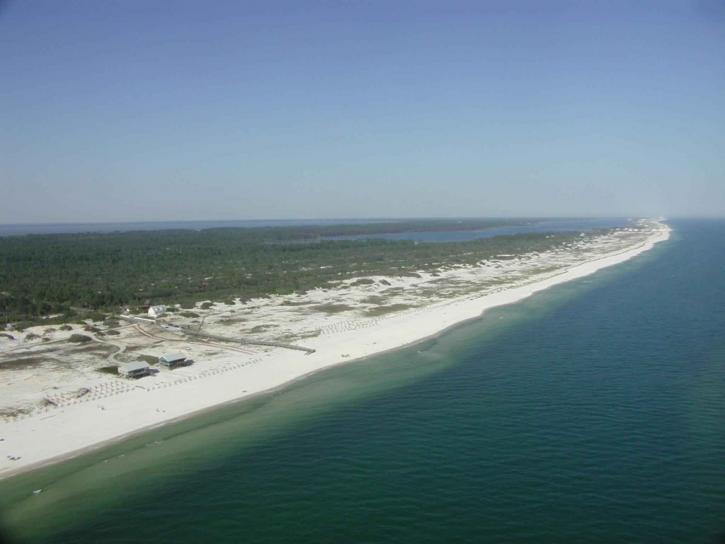
Experience endless summers in Southern Alabama. While other folks in other parts of the country are shivering in snowstorms, snowbirds are soaking in the sun and tranquil turquoise waters along Gulf Shores and Orange Beach. The 32 miles of pristine beachfront on the Alabama coastline is a haven for water sportsmen. And there are even more land activities on and just minutes away from the beaches. From fishing to boating and hiking to biking, there really is never a dull moment for vacationers or season dwellers.
Gulf Shores and Orange Beach are two of Alabama’s top winter destinations because of their varied accommodations and, of course, warmer weather. This area has also been referred to as the “New Florida” for snowbirds. While not as long as the Sunshine State’s shoreline, Alabama’s coastline offers two prime assets. It’s not as busy and congested, and it’s more affordable than Florida. Other than that, RVers can still enjoy the same activities, white sands, and salty air!
Although there is an ongoing debate on its origins, Mobile, Alabama, lays claim to the first celebration of Mardi Gras. The first festival was reportedly started by Frenchman Nicholas Langlois in 1703 when Mobile was the capital of French Louisiana. Fast forward to today, and Mardi Gras is a multi-week-long extravaganza. Like downtown New Orleans, downtown Mobile transforms into a wonderland of sorts, filled with the sights and sounds of live music, parades, parties, and other frivolities.
If your RV travels include scoping out local happenings, you won’t want to miss this annual shindig. While in town, make it a point to stop by the Mobile Carnival Museum and get the lowdown on the rich history behind this legendary event and the city’s unique ties to its beginnings.
From Birmingham to Montgomery and places near and far, Alabama has been the backdrop to decades of monumental events in the black community. An Advance Local Media article from 2020 mentions, “Montgomery alone had more slave depots than churches at the dawn of the Civil War in 1861. Many men and women helped the Rev. Martin Luther King Jr. as he rose to national prominence on Alabama soil. The Lowndes County Freedom Organization was the precursor of the national Black Panther Party.”
There are a number of museums throughout the state that highlight the triumphs and tribulations of black history through exhibits, artwork, presentations, and educational seminars. For example, the Legacy Museum in Montgomery features a comprehensive history of the nation, focusing on the legacy of slavery. And the Birmingham Civil Rights Institute in Birmingham depicts the struggles of the Civil Rights Movement in the 1950s and 1960s. Other moving museums and sites that preserve and interpret black history include:
National Voting Rights Museum, Selma
Freedom Rides Museum, Montgomery
Rosa Parks Library and Museum, Montgomery
National Memorial for Peace and Justice, Montgomery
The amazing sites don’t just stop above the ground. Alabama has some pretty out-of-this-world places right below your feet. Cathedral Caverns State Park is home to the Bat Cave or what is now referred to as Cathedral Caverns because of its cathedral-like appearance.
Visitors to the state park can take a guided tour of the majestic underground, which features one of the largest stalagmites in the world (“Goliath”), measuring 45 feet tall and 243 feet in circumference. Other fascinating natural cave formations include the “caveman” perched atop a flowstone wall, a “frozen” waterfall, and a large stalagmite forest.
RVers can stay overnight or longer as the park has a camping section. And if anyone gets tired of cave exploration, there are miles of hiking trails throughout the park and even gem mining.
Don’t Forget to Bring Your Most Trusted Passenger on Your RV Trip to Alabama
Of course, this list is only scratching the surface of possible places to experience on your next RV journey into Alabama. There are plenty more cities, big and small, to explore, historical landmarks to learn about, thrilling attractions to get the heart pumping, and natural wonders to build up your sense of wanderlust. Alabama is a state all its own waiting to be discovered.
All you have to do is pack up the RV and point your rig south. And don’t forget to buckle in your Coach-Net roadside assistance. With Coach-Net’s full suite of RV protection products, you can have peace-of-mind protection for a carefree journey. Coach-Net provides unlimited towing, jumpstart, fuel delivery, locksmith, tire assistance, winching, and technical support.
Get even more valuable benefits with the premier plan. Besides 24/7, all-inclusive roadside assistance, it includes concierge services, global emergency travel services, tire discounts, camping discounts, and so much more. Learn more about Coach-Net’s dynamic roadside assistance programs.
About The Author: Natalie Henley
Levi Henley and his wife, Natalie, have been full-time RVers for over 5 years. They have also been Coach-Net customers for the same amount of time. They travel and work camp around the U.S. in their 26-foot Itasca Sunstar motorhome with their two cats. They write for multiple RV-related publications and recently co-wrote “Seasonal Workamping for a Living: How We Did It.” You can follow their adventures on the road at henleyshappytrails.com
Swain W. ~ “Service was excellent and follow up was fantastic. It means a lot to be taken care of when you are down. Very happy with everyone’s performance I would not have known what to do or who to call if I had not had Coach-Net. You all were excellent.”
Over the years we’ve seen more and more RV enthusiasts not putting their RVs away for the winter or even heading South for warmer temperatures, rather using their rigs for winter activities. I remember some chilly nights at -20 degrees in Fargo ND, a weeklong trip with my own personal “Ski Chalet” in the Rocky Mountains of Colorado, and every February we drag out several motorhomes to use as “green rooms” for bands at the Winter Dance Party in Clear Lake IA!
Whatever your type of winter camping, making sure your furnace is operating at the utmost efficiency is important. Let’s take a look at the different types of heaters used in the RV Market:
RV Heater Types
Forced Air Ducted
For years, Suburban, Dometic, and Atwood Hyrdoflame were the main brands available and they all worked in a similar manner. The thermostat would be set to the desired temperature and when the ambient temperature inside the rig gets to that setting it would create a closed circuit and send the 12-volt power to the module board of the furnace calling for heat. The furnace would start the blower motor which exhausted any old air in the intake, burner assembly, and exhaust port. It also pushed air over the burner assembly to the vents drawing interior air for circulation. As the air flowed over the burner assembly it raised a sail switch in the round shroud and once this switch lifted high enough, it would create a close circuit sending 12-volt power back to the module board indicating there was enough airflow to open the gas valve and start the spark sequence. A forced-air–ducted vent furnace typically has an exterior mount and can only be accessed for service from the outside.
Once the burner was lit, air moving over the burner assembly was heated and distributed through the coach by either flexible ductwork under cabinets or under furniture or by a plenum under the floor to floor vents similar to a residential design.
Forced Air Direct Discharge
This design operated the same as the vented version but is used in smaller units without vents and the air is supplied directly from the vents on the furnace itself. It has a much more compact design and can be accessed from inside the rig.
Heat Pump
Another option for heat that has been a source of confusion for many RVers is a heat pump option that is labeled “Electric Heat” on a thermostat. Most heat pumps operate through the roof air conditioner and in simple terms, the unit runs backward and draws BTUs out of the outside air through the coils and evaporator to provide heat inside. These models only are efficient down to about 55 degrees outside temperatures and only supply mild supplemental heat from the 60-65 degree ambient temperature range. The confusing part is the label on the thermostat makes it look like it’s an electric heater that can be used any time you are plugged into shoreline power!
Almost every year I get a call from the group at the Winter Dance Party complaining the heaters don’t work in the units sitting outside as green rooms. In every case they ran the propane out using the forced air heater and switched it to “Elec Heat” and it just blows cold air. That’s because it is 0 degrees outside and there are NO available BTUs for the heat pump! However, it is a good source of free heat in that 55-65 degree range to top off the inside of your coach if you are plugged into shoreline power and not paying extra for it!
Heat Strip
Some roof air conditioners have a heat strip feature that does work on 120-volt power which heat a thin wired strip around the perimeter of the shroud inside the roof air conditioner, however, it is not typically enough to keep the rig warm.
In-Floor Heating Systems
Several models have been introduced over the years including Aqua Hot which has an onboard boiler that heats a liquid solution and routes it around the rig to heat the interior and water heater. I have also seen a few electrical versions of a wired-in-floor system using pads with coils but these are usually an aftermarket installation.
Making Your Forced Air Type More Efficient
There’s not a lot of maintenance required with forced air models either vented or non-vented however, there are things you need to understand to prevent issues.
Proper 12-volt House Battery Power
Even though they run on propane, your furnace needs at least 10.5 volts of DC power to the module board for it to open the gas valve and light. The deceiving part is the fan will run all the way down to 4-5 volts so it seems to have power, just won’t light? Most often the issue is a sulfated battery that can’t keep up even when plugged into shoreline power with all the other appliances running as it seems they are fully charged, but drop off fast if sulfated. I constantly get the question, my furnace will not run and my batteries are good? The only way you can tell your batteries are holding a full charge and providing the amp hours designed is to charge them properly, hook them up to a 24 amp draw machine, and count the hours! Since this is almost never done, hooking up a digital meter only tells you the current charge, not the efficiency. If the batteries are sulfated, they will start off at 12.6 volts but drop fast and a low battery will not provide the power needed to get the airflow out of the fan and raise the sail switch, therefore the gas valve will not open and the unit will not light. If your fan is running, but your furnace does not light, hook up a portable booster to verify it has enough power. If it still does not light, read on.
Low LP Pressure
All LP appliances need 11” of water column pressure to operate properly and this is provided by the regulator at the LP cylinder. If you know you have proper 12-volt power and hear the click of the gas valve opening and the spark trying to light and it does not light, the chance is you have low LP pressure. This can be tested at the furnace by a certified technician, or you can do a quick test by turning on a stove burner and watching the flame. It should be a steady blue one. Turn on a second and then a third and notice the flame. Then turn on another LP appliance such as a water heater or refrigerator and notice the flame. Sometimes appliances work fine for a while then stop. This could be a situation where it is the only appliance working and there is enough LP pressure and 12-volt power for one but when the water heater or refrigerator kicks on at the same time, there isn’t enough of one or the other? This little test will simulate several appliances drawing at the same time.
Sufficient Air Flow
Not only does the sail switch need to be raised at the fan motor shroud, but there must be good airflow out of the direct discharge as well as the vents. If you have rugs over the vents or anything blocking the airflow, it will create back up in the furnace could affect the sail switch but most likely create a rise in temperature building up and the high limit switch will shut the unit off. This is a temperature sensor at the far end of the burner assembly as a safety feature. Keep all vents open and free-flowing.
Maintenance
Even though I mentioned earlier there is very little maintenance required, it’s important to make sure there is good airflow in and out of the outside intake/exhaust vents as well as the interior air return. Spiders and mud daubers love propane and heat and will plug the holes needed to bring fresh air into the burner chamber and exhaust outside.
Make sure they are clean and the air is flowing freely. Sometimes it might be necessary to install a screen over the vent to prevent the build-up of foreign material! If your exhaust vent has an abundance of black soot or what looks like a potential extremely hot situation that has created a burned effect, get it looked at by a certified technician.
Also check inside to make sure there isn’t a build-up of pet hair, dust, or other items that can get drawn into the air return for proper circulation.
About the author:
Dave Solberg: Managing Editor, RV Repair Club
For the last 25 years, Dave has conducted RV maintenance and safety seminars, developed dealer and owner training programs, written RV safety and handyman articles authored an RV handbook reference guide, and logged over 100,000 miles on the road in an RV.
RV Repair Club is your go-to online resource for enthusiasts who want quality RV maintenance, repair and upgrade information – a community where passionate RVers can come together to gather knowledge and share their experiences.
Jim G. ~ “The young lady who assisted us was very kind, she listened to our needs and passed along the specific RV information to the service provider. The service provider used was local to us and very good. The service was efficiently, safely, and expertly given.”
There are so many places to explore while you’re RVing. As an RVer, the open road is your oyster, and you and your traveling crew can explore as much as you want, whatever you want, at your leisure. And while the list of must-experience sites is endless, there are some key RV Event Bucket List items worth traveling to in your RV, like the ones listed below.
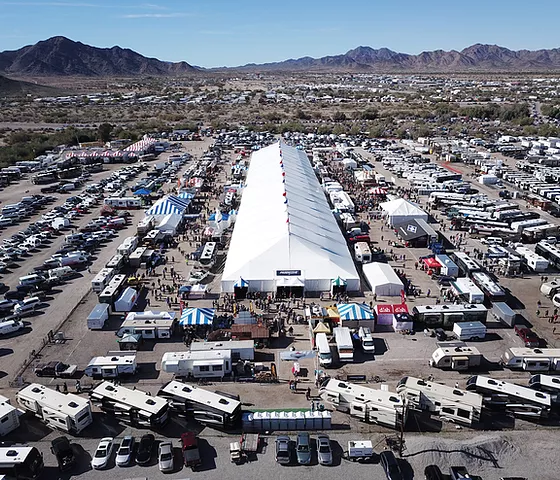
Known as the “The Largest Gathering of RVers in the World,” the Quartzsite Sports, Vacation, and RV Show draws as many as one million folks every year in January. For the past 40 years, this otherwise sleepy town has offered vendors space for rock, gem, and mineral shows, flea markets, and the Quartzsite Sports, Vacation & RV Show.
The Quartzsite Big Tent is particularly of interest to hundreds of thousands of RVers, full-time and part-time. Hundreds of vendors gather under this behemoth to sell all sorts of outdoor and RV-related products and services, ranging from the latest gadgets to repairs and upgrades. It’s an RV shopper’s dream come true!
In addition to the shopping opportunities, folks opt to dry camp around the event for days and participate in all sorts of social gatherings and workshops geared towards RV living. It’s definitely a mecca for RV enthusiasts.
Quartzsite is located just 20 miles east of the California border on Interstate 10. Show dates for the next few years are listed below:
“Seasoner” fans will delight in the opportunity to see NASCAR events up close! Many NASCAR race car events offer camping options for RVers. Depending on the venue, folks can choose among multiple camping areas across the facility, including full hookup sites, grassy areas for dry camping, and camping right in the middle of the racetrack interior field! RVers can also opt for season passes as part of their camping package.
Races take place all over the U.S. between February and November, but the largest and most popular events include the Daytona 500, Coca-Cola 600, Cook Out Southern 500, and Indy 500, to name a few.
“Whether it’s a dream of artistic expression, a yearning to connect with others in a fractured society, or simply a desire to live a more meaningful and authentic life, Burning Man is the place where dreams can and do come true.”
-burningman.org
Burning Man is a multi-day celebration that occurs in the Black Rock Desert in Nevada around Labor Day. The event focuses on the spirit of community and creativity in the form of art, self-expression, and self-reliance. The event is unlike any on the planet, and to truly understand the concept of Burning Man, you simply have to go and experience it for yourself. To an outsider, it can be summed up as a culmination of psychedelic costumes, out-of-this-world art installations, a variety of performances, and of course, lots of partying.
Tickets to the event start at around $500. Folks are encouraged to bring a hefty supply of water and food in their rigs. It is a complete boondocking experience in the desert, so be prepared for extreme heat and the possibility of dust storms.
The Land of Enchantment truly lives up to its name every year at the Albuquerque International Balloon Fiesta. This unique event is said to be the world’s most photographed event and the largest hot air ballooning event.
Nearly 750,000 visitors, many RVers, attend the Albuquerque, New Mexico event that happens for nine days during the first full week of October. Spectators gather to witness hundreds of special shaped balloons glow at night and almost simultaneously ascend in the early morning. It’s quite a magical (or, more appropriately, “enchanting”) sight to behold.
In addition to the awe-inspiring balloon shows, folks can see the balloons up close and meet the flight crew as attendees are allowed to walk around the launch field. Opportunities to assist the flight crews with set-up and experience a private hot air balloon ride are also available.
The 9-day event itinerary is packed with concerts, a chance to shop a variety of vendors, social gatherings, and a wide variety of activities for all ages. RV camping can be reserved on-site at the event or at nearby campgrounds. The event also offers bus transportation to and from the festival.
This coming year, the Albuquerque International Balloon Fiesta is slated for October 1-9, 2022.
Travel To These and More RV Event Bucket List Locations with Peace Of Mind
Whether you are RVing in the deserts of Nevada or New Mexico or in the middle of a NASCAR race track, it’s essential to be equipped with 24/7, all-inclusive roadside assistance when you’re on the road away from home. That’s a promise that Coach-Net can offer for RVers. They can also promise other valuable benefits such as Concierge Services, Global Emergency Travel Services, Tire Discounts, Camping Discounts, and so much more.
“If you own an RV, you owe it to yourself to have the protection you need when you need it most.”
-coach-net.com
If you haven’t already, give Coach-Net a call or join now and breathe easier knowing that Coach-Net has you and your family covered!
About The Author: Natalie Henley
Levi Henley and his wife, Natalie, have been full-time RVers for over 5 years. They have also been Coach-Net customers for the same amount of time. They travel and workcamp around the U.S. in their 26-foot Itasca Sunstar motorhome with their two cats. They write for multiple RV-related publications and recently co-wrote “Seasonal Workamping for a Living: How We Did It.” You can follow their adventures on the road at henleyshappytrails.com
Mike S. ~ “I am very pleased I chose Coach-Net! When I needed you, you were there for me!”
Getting behind the wheel to drive an RV can be nerve-wracking. There are a lot of extra things to think about in order to safely get from point A to point B, and you definitely don’t want to do anything to hurt your home-on-wheels, let alone your family.
Fortunately, there are steps you can take to keep both your family and your rig as safe as possible. Choosing not to follow closely, avoiding driving in heavy rain or high winds, and making sure your RV is not overloaded (and is loaded properly) are some of the more important considerations.
Another consideration? Making sure you choose an RV-friendly route.
An RV-friendly route is one that avoids super steep grades, which can be difficult for a big rig to climb and could cause you to lose control on the descent. Such a route should also avoid low-clearance bridges that might swipe off the top of your trailer or motorhome.
Not sure how to make sure you avoid these things? Here are our top tips for doing just that.
Begin with an RV Trip Planning Tool
First, we recommend purchasing and using RV Trip Wizard to plan all of your travel routes. This handy tool will alert you of hazards such as low-clearance bridges. It also has a feature that allows you to see elevation changes, as well as how steep a climb is.
Other features of this wonderful tool include a huge database of campgrounds and campsites, the ability to calculate when fuel stops will be needed and add them into the trip, and even a way to figure out exactly what a particular trip is going to cost.
Use an RV-specific GPS
An RV-specific GPS is another great way to ensure you don’t run into any steep grades or low-clearance bridges. You could choose to purchase a GPS device made specifically for RVs, or you might just download an RV GPS for your smartphone.
As far as devices go, we recommend a Garmin RV GPS. These awesome gadgets tend to give the most accurate information, something that can save you from a lot of frustration and even potentially hazardous situations.
Prefer an app? For this we like the RV Life app. This app pairs with the RV Trip Wizard tool, and even lets you transfer routes directly from one to the other.
Either way you go, your new RV GPS should put you on roads without road hazards, and either option will allow you to download routes, something that is crucial when driving through the middle of nowhere.
Pick Up a Truckers’ Road Atlas
Because driving through the middle of nowhere happens often when RVing, and because technology isn’t always reliable, it’s a good idea to have a hard copy of a Truckers’ Atlas on hand. These hefty books are chock-full of great travel information, including how steep grades are and whether there are any low-clearance bridges along a given route.
Being able to cross check your GPS against this book—or use it as a backup should the GPS give out on you—might just be a lifesaver.
Grad the Mountain Directory Books or App
Another great option is to use the Mountain Directory books, ebooks, or app. These offer super easy-to-read info on each and every grade in the country. The information is incredibly accurate, making this another excellent cross-reference—and if you get a hard copy of the book, it can also be a good backup to the GPS.
Look into LowClearances.com
Want to make sure you’ve covered all your bases? LowClearances.com is another great resource. This website provides information on over 7000 low-clearance bridges in the US. Their database can be added to nearly any GPS device and is compatible with a number of navigation apps, meaning you can plug all of these bridges into whatever GPS you use and rest assured you won’t run into something you can’t fit under.
Keep an Eye Out for Signs
Obviously, you will also want to pay attention to what the signs are telling you as you drive down the road. Construction work and traffic accidents can change the layout of a road pretty quickly, meaning that while it’s unlikely you will run into trouble if you’re using the tools mentioned above, it is still possible. Signs should let you know of these changes so you can stop and find another route before it’s too late.
By putting these tools to use, paying attention to signage, and knowing the height of your rig and what it can handle in terms of grades, you should be able to choose a route that is safe and comfortable for you. Of course, it’s also a good idea to have roadside assistance ready and waiting to help you should something go wrong.
Why not grab these tools, sign up for roadside assistance, and start planning your next trip today?
About the author: Chelsea Gonzales
Chelsea has the amazing opportunity to take part in full-time RV living and traveling with her tiny tribe. She homeschools her five-year-old son as they travel, and takes full advantage of their unique situation by using the entire world as her son’s classroom. A group of total Disney fanatics, Chelsea and her family often find themselves in the Orlando area in order to visit the Disney parks, but they have also visited over 25 of the 50 states with plans to see many more along the way. No matter where her travels take her, Chelsea enjoys riding bikes, gazing at beautiful sunsets, finding new coffee shops, Irish dancing, and sitting around a campfire with her family.
Ramon O. ~ “The follow up calls were great and you can tell that the agents on the phone really cared and made sure and followed through on my service request. The first person who took my car was very reassuring and let me know that I would be taken care of. Great customer service”