Winter RVing: Space Heaters And RVs

Tags

, , , , , , , ,

Winter RVing can be a beautiful, quiet, and fantastic time to go camping. If you decide to go RVing in colder weather, you may find out just how good or not good most RV insulation is. Even with the furnace keeping your rig at a toasty temperature, place your hand on the wall of many RVs, and you will be able to feel the cold pressing in.

Due to this lack of thick insulation, it takes a ton of energy to keep an RV warm in the winter. RVers are faced with two energy choices in colder weather, electricity or propane. Rather than run out of propane quickly, many RVers attempt to forgo running their furnace to heat their rig with space heaters instead. Space heaters can be a great tool to supplement your RV furnace heating. However, there are some considerations and safety practices one should follow.

30 Amp RVs

The biggest issue with space heaters and RVs is the amount of power required to make them work. Your average fan or ceramic heater that you can pick up cheaply at big box stores has two settings. The low setting uses about 700 watts when running, and the high setting uses 1500 watts.

If your 30 amp RV tries to run more than 3,600 watts (or slightly less due to voltage variance among RV parks), it will start tripping breakers in your RV or at the power pedestal of the park. You can probably do the quick math to realize that a 30 amp rig simply canโ€™t handle more than two space heaters on the high setting.

To add to that, your RV fridge and other electronics all pull power too, so running two space heaters day in and day out can push the system. Running an RV electrical system at its upper capacity, especially an older rig, can cause heat to build up in the wires posing a potential fire risk.

Bottom Line: If you plan to use a space heater in your 30 amp RV, itโ€™s safest to limit it to one.

50 amp RVs

If your RV has a 50 amp system, you have a little more leeway as to how much you can run. Without going into a lot of details, a 50 amp rig has two 50 amp arms on its system. In other words, you have two 50 amp circuits in your rig totaling 12,000 possible running watts at 120 volts.

In theory, a 50 amp rig could handle about 6 or 7 space heaters and still run the other electrical appliances like the fridge, etc. Most RVers would stay comfortable in a moderately cold environment using just a couple of space heaters. A 50 amp RV can quite easily handle space heaters as a supplemental heat source from an electrical standpoint.

Other Electrical Concerns

Regardless of your RVโ€™s electrical capacity, most RV plugs are wired to a 15 amp breaker. So letโ€™s say your RV kitchen has four wall sockets on one breaker. You can only plug one space heater on high into any one of those sockets. If you plug in a second, that will start tripping the breaker as a 15 amp breaker can only handle 1,800 watts at 120 volts.

Another thing to consider is your power bill. If you stay at a park monthly that charges for electricity, running a 1500 watt space heater several hours a day will significantly increase your power bill. In other words, whether it be propane or electricity, it takes power to heat your rig, and someone must pay for that power.

Other Potential Problems

Close Quarters: In general, RVs are pretty small spaces, and it may be challenging to keep space heaters far enough away from flammable material like bedding and furniture to use them safely.

Frozen Pipes: Some RVs have enclosed underbellies and use some of the warm air from the propane RV furnace to keep the plumbing from freezing when winter RVing. Relying solely on space heaters in freezing temps could result in frozen pipes.

General Safety Concerns

In general, the safest heating method is to use the heat pump setting on your RV air conditioner (if equipped) when outdoor temperatures are above 40 degrees Fahrenheit and your RVโ€™s propane furnace when itโ€™s below 40 degrees. However, if you wish to supplement your heating with a space heater, following the tips below will result in the safest experience.

1. Buy the right size heater. Thereโ€™s no need to have a heater intended to heat a warehouse in an RV.

2. Buy a space heater with covers or guards to prevent burns.

3. Make sure the heater is at least three feet from all objects.

4. Pets can easily knock them over, or children can get burned on them, so place space heaters out of their reach.

5. Never leave a space heater turned on when going to bed or leaving the room or RV.

6. Ensure your space heater has tip-over protection and overheat protection. These features will shut the heater off in the event of malfunction by tipping or getting too hot.

7. Only electric or vented fuel-fired heaters should be used. They do make small propane heaters that can be used inside, and there are also many stories of rigs going up in flames due to improper use or going to bed with them running.

8. Plug space heaters directly into an outlet. Donโ€™t use extension cords or power strips. Almost ALL power strips are not wired to handle the load of a space heater.

9. Though the majority of this article concerns electrical space heaters, it should be mentioned that one should never use gas heaters intended for outdoor only use. This can result in carbon monoxide poisoning and death.

Stay Safe When Winter RVing

Winter RVing can be a fantastic experience, and you can find some good tips for a comfortable and safe experience on the Coach-Net ~ Travel and Adventure Blog. When it comes to any questions, concerns, safety information, or help, remember that your Coach-Net roadside assistance comes with  24/7 Protect.

Whether you need advice from an RV technician who can guide you through many common technical and operational issues or roadside and campsite assistance when youโ€™re on the road away from home, our extensive provider network throughout the United States and Canada is available whenever and wherever you need it. Learn More


About The Author: Levi Henley

Levi Henley and his wife, Natalie, have been full-time RVers for over 5 years. They have also been Coach-Net customers for the same amount of time.ย  They travel and work camp around the U.S. in their 26-foot Itasca Sunstar motorhome with their two cats.ย  They write for multiple RV-related publications and recently co-wrote โ€œSeasonal Workamping for a Living: How We Did It.โ€ You can follow their adventures on the road atย henleyshappytrails.comย 

RV Protect

Gary E. ~ โ€œCoach-Net is the resource we trust when mechanical surprises arise!โ€

Planning an Epic RV Road Trip in 2022

Tags

, , , , , ,

The euphoria of going on a road trip with family or friends is incomparable. A road trip allows you to travel leisurely, enjoy the journey, and choose remote locations to visit if thatโ€™s what you prefer. However, the success of the trip is largely reliant on adequate planning and preparation.ย  You can comfortably travel in any season if you are well prepared and suitably equipped for the trip.

Basic Steps to Planning Your Road Trip

  • Confirm your destination: If youโ€™re traveling with young kids or itโ€™s your first road trip, itโ€™s preferable to avoid traveling to remote areas or where hiking is required. Prepare for traffic blocks, road work, and poor weather conditions.
  • Select a route: Once you choose your route, start budgeting and saving money for your trip. Look for off-season deals and discounts.
  • Schedule pit stops: Decide where you will take your gas, food, and bathroom breaks. Look for RV campsites where parking is available if you choose to rent an RV
  • Pack your bags: Make a list of essential things to carry and what to avoid. List things to keep handy: gadgets, medicines and protective gear.
  • Miscellaneous checks pre-travel: Ensure your travel insurance, health insurance, accommodation, and other bookings are in order. Store important contact numbers and download related apps to your phone.


Checking Your Vehicle Before Your Trip

You should always conduct a complete vehicle audit before you embark on your road trip. This includes checking the wheels, tire pressure, brakes, water levels, and oil. 

  • Tire pressure: Ensure the tires of your outdoor vehicle are inflated to the ideal pressure level. For guidance on the suggested pressure level, check the sticker on the driverโ€™s side door or the inner end of the fuel filler.
  • Tread depth: All modern โ€œP,โ€ โ€œLTโ€ and medium commercial tires have integral wear indicators built into the tread. These indicators are molded into several locations around the tread grooves. When the tread ribs become worn to the point where theyโ€™re adjacent to an indicator, itโ€™s time for a new tire.
  • Engine oil: The dipstick test will protect you against engine breakdowns due to low oil levels.
  • Coolant levels: If your coolant level is low, you could have a leak so be sure to check all radiator and heater hoses.  To add coolant, if needed, be sure to check your owners manual to ensure it is done correctly.
  • Window washer fluid: For an unobstructed view while driving, ensure the washer fluid of your vehicle is at a good level. Use fluid specifically designed for cold weather to prevent the fluid from freezing if your road trip is during the winter.
  • Vehicle lights: Make sure all your vehicle lights, including turn signals, are working well, to avoid confusing or blinding other drivers and creating mishaps.
  • Roadside assistance: You should always be prepared for the unexpected. A Coach-Net membership helps to ensure you have help if your RV suffers a breakdown during your trip.


Essential Items to Include in Your Packing

  • Important documents and vehicle papers: These include your vehicle registration documents and manual, roadside assistance info and relevant contact number, your driver’s license and travel insurance.
  • Navigator and battery pack: GPS can guide your direction and help check you are within the required speed limit. It can also help you find the nearest gas and service stations. A battery pack can meet the re-charging needs of your phone, music player, and camera.
  • First-aid kit and torch: A basic first-aid kit should always be in your vehicle during your road trip. Minor wounds and small medical needs can be immediately met with a stash of bandages and antiseptic creams. A quality flashlight or lantern is important to have handy, especially for when your vehicle stalls in the dark and you need to inspect your engine.
  • Miscellaneous vehicle necessities: Items needed for maximum comfort and efficiency during your road trip include hands-free phone packs, wheel wedges, windscreen covers, travel pillow, and sunglasses. Keep loose coins in your vehicleโ€™s glove box to accommodate road toll and parking fees.
  • Entertainment: Build a fun music playlist that is enjoyable for all on the road trip. Travel games like I-Spy work well for long road trips with kids.

Author: Tim Setterfield

RV Protect

Karl P. UT ~ย  โ€œKurt from Quality Tire was exceptional. He came and pulled both sets of back tires. The inside tires on both sides of our motor home had 0 pressure. Both Valve stems had been damaged for some reason. He replaced the valve stems on both tires, checked and filled all 6 tires to correct pressure. He was a pleasant and pleasurable person to work with. We were called by Coach-Net several times to make sure everything went as it was supposed to. Thank you to all the Coach-Net Representatives and to Kurt from Quality tire. It took something that was a pain and made it a pleasure.โ€

Leveling And Stabilizing Are Important For More Than Comfort

Tags

, , , , , , , ,


Levelers, stabilizers, leveling jacks, scissor jacks, chocks, there are almost as many names for devices that level and stabilize as there are products available. However, these products play an important part in not only leveling and stabilizing your rig but also helping with structural integrity and proper appliance performance!

Leveling Jacks

Most RV owners are familiar with leveling jacks and there are have been several brands over the years. HWH and Power Gear were the big names in hydraulic leveling jacks in the 1990s and 2000s and were powerful enough to lift the tires off the ground of a 22,000 lb diesel pusher.

Lippert Components Inc (LCI) has purchased Power Gear as well as several lighter weight leveling jack providers such as Kwikee that had an electric system and have several of their own LCI brands. The important thing to remember about whatever type of leveling jack you have or are going to install is that they are doing more than just leveling your rig for a comfortable night’s sleep.

In my early days at Winnebago, we tested chassisโ€™, welded foundations, and finished motorhomes on sine wave test tracks as well as computerized pads to determine what type of stress would be applied to various components in an unlevel situation or excess road vibration. At the time we were testing various slide room mechanisms and did over 14,000 extensions and retractions and what we found was in an unlevel condition, not only does the chassis/floor twists but the sidewall does as well and the room has resistance and eventually had created issues with operation. With that, all units with a slide room had leveling jacks as standard equipment.

Back when HWH was โ€œTHEโ€ hydraulic leveling jack provider they designed a joystick extension and retraction pad that would only allow a bilateral extension procedure. The photo above is from a 2003 Winnebago Brave and you can see the top and bottom levers would control the front and back jacks. You would push those from center to activate and the center lever extended and retract the jacks in the direction you pushed the lever and it would always extend two jacks in a bilateral direction only. This meant if you pushed the lever forward, the two front jacks would extend, down meant the two back jacks would extend, and side to side following suit. This was designed to reduce the stress of extending one jack on an uneven spot and twisting the chassis. The system also had a pressure-sensitive feature so as you extended the two jacks in whatever direction, they both would come down and if one hit the ground before the other, it would pause until the other hit the ground and raise the coach evenly. This eliminated any twisting in the chassis and ultimately in the sidewall, slide rooms, and other areas of structural importance.

While developing a training program, we put one front tire of a standard chassis on a 12โ€ car ramp to show the twist that occurs on a chassis. We saw that the compartment doors and entrance doors popped open. Yes, this is extreme however imagine what just a slight unlevel condition of 3-4โ€ would do in a campground to the structure of your rig! I have gotten numerous photos of rigs that have the sidewall material shifted from the trim over the years.

So the importance of leveling is keeping the structural integrity of the chassis, flooring, and sidewall in a level plane which will allow the slide rooms to operate without stress and limit the stress on the sidewall to roof structure as well.

One last note on leveling the rig, your absorption refrigerator needs to be level to allow the coolant solution to flow back down to the boiler assembly through the zig-zag tubing. We have covered that many times before.

Stabilizing

Even after all that work of leveling your rig, it might not be stable which means a rock and roll situation that is much more than just annoying! Tires are inflated with air to provide a smooth cushion while driving but are not meant for providing stability when stationary. The four-point leveling jacks do provide superior stabilization, however, most of the other systems could use some assistance. For instance, if you have scissor jacks, they help level smaller rigs and keep them from tipping front to back but provide poor stabilization.

In fact, without additional support and wheel chocking, these can be damaged easily. Most trailer owners add some type of leg support for stability or even wheel stabilizers.

5th wheels pose a larger problem with the long overhead in the front that can get a little spongy and even cause some issues with structural integrity.

These are photos of a unit that has shifted considerably and now has very expensive repairs needed. Itโ€™s best to level and stabilize the rig and many 5th wheel owners also add support to the kingpin with a tripod support.

Some even add some additional side-to-side support for the larger rigs.

In addition, every technical support rep and engineer that I have talked with recommends leveling and stabilizing the rig before extending and retracting the slide room. If the rig is out of level and not stabilized, the chassis will shift, the floor will twist, and the sidewall will twist meaning you are trying to extend a square room in a twisted hole and will have resistance.


About the author: Dave Solberg: Managing Editor, RV Repair Club

For the last 25 years, Dave has conducted RV maintenance and safety seminars, developed dealer and owner training programs, written RV safety and handyman articles, authored an RV handbook reference guide and logged over 100,000 miles on the road in an RV.

RV Repair Club

RV Repair Club is your go-to online resource for enthusiasts who want quality RV maintenance, repair and upgrade information โ€“ a community where passionate RVers can come together to gather knowledge and share their experiences.

Learn more about RV Repair Club.

RV Protect
๏ปฟ

Martin Colin. ~ โ€œPolite respectful helpful and reassuring. Just what you need when your RV is stuck in the mud on a wet and rainy Friday eveningโ€

Coach-Net Camping: Jake Fossen

Tags

, , ,

Jake Fossen is our Regional Account Executive in the Coach-Net family. Recently, during the sales team’s yearly meeting where they discuss plans and goals for the year to come, Jake came down from Lake Havasu City, Arizona, and spent his evenings in Coach-Net’s Entegra RV at Lake Grapevine.


I just completed my first RV trip ever!! I was lucky enough to be able to stay in Coach-Netโ€™s Entegra, while in town for meetings on 10/4 thru 10/6. I decided to come out early on the weekend and enjoy the RV lifestyle at The Vineyards Campground at Grapevine Lake.

The campground was beautiful, and although it was only 15 minutes from Downtown Dallas and Arlington, I had a waterfront spot that was surrounded by trees and felt completely โ€œaway from it allโ€.

It was my first time ever RVing, so I was unsure what to expect, but I was able to learn how to set up the RV, and break it down. I was even able to drive the RV back to its storage location, and felt like I got the full experience.

I loved my time in the RV. It was so much better than being in a hotel. My favorite part was sitting outside, and watching Monday Night Football on the outside television while enjoying a few beverages. The weather at night was perfect, and it was great to be outside.

Next time I go, I would love to have my family with me, and go somewhere like Lake Grapevine, where we can pull out boat up right next to camp, wake up early, and get the early morning butter for wakeboarding!! If we canโ€™t work that out, anywhere with a campfire and a bottle of Pinot Noir will do the trick!

I’m so grateful to work in an industry where we sell memories, quality time with friends and family, and fun!


RV Protect

Dickie N.ย ~ย โ€œOne phone call to Coach-Net and they took over to remedy the RV problem. Very impressive service!โ€

Propane Saving Tips For Colder Weather RVing

Tags

, , , , , , , ,

As the colder end of fall approaches and winter starts arriving, an RV can be a very cozy camping option. However, keeping one warm can go through quite a bit of propane. So why does an RV propane heater use so much propane, and how can one make propane last as long as possible during their short-term or long-term winter RVing trips? Follow these propane-saving tips below to help you stay toasty in your rig and go easier on your wallet this winter.

How an RV Propane Furnace Works

Your RVโ€™s propane furnace is a pretty simple device. Propane is burned to heat air which is forced through the ductwork of the floor by an electric fan. Openly burning propane in an enclosed space without ventilation is generally quite deadly due to carbon monoxide gas. For this reason, the propane in an RV furnace burns in a tube and heating element that vents directly outside your RV. The air in your RV is blown over the heating element to heat it.

This necessary ventilation carries as much as 30%-50% of the heat generated by burning propane and blows it outside. That means you need to burn up to twice as much fuel to get the same amount of BTUs worth of heat inside your rig as you would if you were just burning propane inside.

This may sound like a design flaw, but ventilation is necessary for the warm, dry, and safe air being blown throughout your RV. Even though you should have your propane system and furnace inspected periodically, there is no way to modify this efficiency. The best ways to save on propane involve keeping the heat in your RV as long as possible or using other safe methods to heat your rig.

1. Close Your Gaps

Check around slides, windows, doors, and any other potential gaps and close them off. You may find that some gaps need repairing, while other areas may just require you to add a bit of insulating material. For example, my motorhome gets cold drafts from the air vents. In cold weather, I stop this draft by placing a cloth in the air filter intake of the engine. The trick is remembering to remove the cloth before starting the engine up.

One way to find gaps is to go around with a temperature gun in your RV and look for cold areas. If a particular area is colder than the rest of the rig, there is a reason. Sometimes itโ€™s because cold air is seeping in, which means warm air is escaping too.

2. Insulate

A well-insulated RV will hold heat longer which will reduce the time your furnace has to run. Many of the same tricks people use in the summer to help keep their RV cool will also help in the winter. For example, placing those square insulating pillows in the roof vents can help a lot, considering warm air rises and vents are a significant source of heat loss.

In addition to vents, windows could always use a little extra insulation. There are several ways to do this but many use Reflectix material on the windows, just like in the summertime. To prevent condensation from forming behind it, we like to put our insulation on the outside of the windows.

Reflectix is bubble wrap with foil on either side. It is pretty inexpensive and can be cut to size.

In addition to window insulation and roof vent insulation, adding heavy curtains and carpets to your RV can help retain heat. The bottom line is the longer the heat stays in your RV, the less your furnace must run, which saves you on propane.

3. Use Supplemental Heating

If your RV air conditioner has a heat pump setting, you can use that electrical heat source to save a lot of propane. Thereโ€™s a catch, though. Typically RV heat pumps donโ€™t work well once outside temperatures drop below 40 degrees.

Another option is to use a portable electric heater to help take the chill out of the air. Itโ€™s not recommended to use one if you are not actively able to keep an eye on your rig, though typical portable heaters have a few safety concerns to consider.

  • They take 1,500 watts of power to run, so a 30 amp RV shouldnโ€™t run more than one on high.
  • They should have three feet of clearance around them.
  • Itโ€™s not recommended to run them while sleeping.
  • Relying solely on portable heaters and not running your furnace when it is below freezing can prevent warm air from reaching your pipes in some models, which puts your plumbing at risk of freezing.

Using a heating blanket with temperature settings while sleeping can help you keep the temperature much lower while remaining cozy. They also make heated fitted sheets, so the warmth comes from the mattress itself.

4. Layer up Inside

Keeping the thermostat in your RV as low as comfortably possible will cut down on the time your furnace must kick on each day. That being said, if you bundle up while inside your RV, you can probably stand to keep it colder. This doesnโ€™t mean you have to suffer while winter RVing. Thick PJs, comfortable sweaters, and thick wool socks or slippers are all acceptable RV wear.

A propane-saving trick for comfort is only to kick up the heat when you need it. For example, if you keep the thermostat at 65 degrees all day and bundle up, you are going to eat up all that propane savings by kicking it up to 75 for fifteen minutes while you take a shower. So you can get out, dry off and get back into some cozy clothes before dropping the temp back down.

Propane Saving Tips in a Nutshell

Propane saving tips arenโ€™t all that complicated. Before heading out on your winter, RVing adventures just make sure you donโ€™t have any gaps that let the cold air in, insulate your vents, windows, and floors, and keep the thermostat as low as you can comfortably stand it. Additionally, use supplemental heating sources like heat blankets and safely use space heaters to assist your RV furnace.

Do you know what else isnโ€™t complicated? Feeling safe in your winter travels because you have Coach-Netโ€™s 30+ years of experience providing roadside assistance and peace of mind to its members and RV technical assistance just a phone call away. So donโ€™t forget to join or renew your membership before hitting the road today.


About The Author: Levi Henley

Levi Henley and his wife, Natalie, have been full-time RVers for over 5 years. They have also been Coach-Net customers for the same amount of time.  They travel and workcamp around the U.S. in their 26-foot Itasca Sunstar motorhome with their two cats.  They write for multiple RV-related publications and recently co-wrote โ€œSeasonal Workamping for a Living: How We Did It.โ€ You can follow their adventures on the road at henleyshappytrails.com 

RV Protect

Stuart O. ~ โ€œAll aspects of the issue were handled very well. I felt like Coach-Net really understood the urgency of our situation and handled it appropriately.โ€

Avoiding Low Clearance Bridges & Steep Grades In Your RV

Tags

, , , , ,

Getting behind the wheel to drive an RV can be nerve-wracking. There are a lot of extra things to think about in order to safely get from point A to point B, and you definitely donโ€™t want to do anything to hurt your home-on-wheels, let alone your family.

Fortunately, there are steps you can take to keep both your family and your rig as safe as possible. Choosing not to follow closely, avoiding driving in heavy rain or high winds, and making sure your RV is not overloaded (and is loaded properly) are some of the more important considerations.

Another consideration? Making sure you choose an RV-friendly route.

An RV-friendly route is one that avoids super steep grades, which can be difficult for a big rig to climb and could cause you to lose control on the descent. Such a route should also avoid low-clearance bridges that might swipe off the top of your trailer or motorhome.

Not sure how to make sure you avoid these things? Here are our top tips for doing just that.

Begin with an RV Trip Planning Tool

First, we recommend purchasing and using RV Trip Wizard to plan all of your travel routes. This handy tool will alert you of hazards such as low-clearance bridges. It also has a feature that allows you to see elevation changes, as well as how steep a climb is.

Other features of this wonderful tool include a huge database of campgrounds and campsites, the ability to calculate when fuel stops will be needed and add them into the trip, and even a way to figure out exactly what a particular trip is going to cost.

Use an RV-specific GPS

An RV-specific GPS is another great way to ensure you donโ€™t run into any steep grades or low-clearance bridges. You could choose to purchase a GPS device made specifically for RVs, or you might just download an RV GPS for your smartphone.

  • As far as devices go, we recommend a Garmin RV GPS. These awesome gadgets tend to give the most accurate information, something that can save you from a lot of frustration and even potentially hazardous situations.
  • Prefer an app? For this we like the RV Life app. This app pairs with the RV Trip Wizard tool, and even lets you transfer routes directly from one to the other.

Either way you go, your new RV GPS should put you on roads without road hazards, and either option will allow you to download routes, something that is crucial when driving through the middle of nowhere.

Pick Up a Truckersโ€™ Road Atlas

Because driving through the middle of nowhere happens often when RVing, and because technology isnโ€™t always reliable, itโ€™s a good idea to have a hard copy of a Truckersโ€™ Atlas on hand. These hefty books are chock-full of great travel information, including how steep grades are and whether there are any low-clearance bridges along a given route.

Being able to cross check your GPS against this bookโ€”or use it as a backup should the GPS give out on youโ€”might just be a lifesaver.

Grad the Mountain Directory Books or App

Another great option is to use the Mountain Directory books, ebooks, or app. These offer super easy-to-read info on each and every grade in the country. The information is incredibly accurate, making this another excellent cross-referenceโ€”and if you get a hard copy of the book, it can also be a good backup to the GPS.

Look into LowClearances.com

Want to make sure youโ€™ve covered all your bases? LowClearances.com is another great resource. This website provides information on over 7000 low-clearance bridges in the US. Their database can be added to nearly any GPS device and is compatible with a number of navigation apps, meaning you can plug all of these bridges into whatever GPS you use and rest assured you wonโ€™t run into something you can’t fit under.

Keep an Eye Out for Signs

Obviously, you will also want to pay attention to what the signs are telling you as you drive down the road. Construction work and traffic accidents can change the layout of a road pretty quickly, meaning that while itโ€™s unlikely you will run into trouble if youโ€™re using the tools mentioned above, it is still possible. Signs should let you know of these changes so you can stop and find another route before itโ€™s too late.

By putting these tools to use, paying attention to signage, and knowing the height of your rig and what it can handle in terms of grades, you should be able to choose a route that is safe and comfortable for you. Of course, itโ€™s also a good idea to have roadside assistance ready and waiting to help you should something go wrong.

Why not grab these tools, sign up for roadside assistance, and start planning your next trip today?


About the author: Chelsea Gonzales

Chelsea has the amazing opportunity to take part in full-time RV living and traveling with her tiny tribe. She homeschools her five-year-old son as they travel, and takes full advantage of their unique situation by using the entire world as her sonโ€™s classroom. A group of total Disney fanatics, Chelsea and her family often find themselves in the Orlando area in order to visit the Disney parks, but they have also visited over 25 of the 50 states with plans to see many more along the way. No matter where her travels take her, Chelsea enjoys riding bikes, gazing at beautiful sunsets, finding new coffee shops, Irish dancing, and sitting around a campfire with her family.

You can join her adventures through her blog, Wonder Wherever We Wander.

RV Protect

๏ปฟ

Ramon O. ~ โ€œThe follow up calls were great and you can tell that the agents on the phone really cared and made sure and followed through on my service request. The first person who took my car was very reassuring and let me know that I would be taken care of. Great customer serviceโ€

Fall For These Majestic Waterfalls In Tennessee On Your Next Road Trip

Tags

, , , , ,

“There’s no better place to find yourself than sitting by a waterfall and listening to its music.”

โ€• Roland R Kemler

With over 500 waterfalls, many located in the eastern part of the state, Tennessee is a perfect place for RVers to camp near and scout out these natural wonders. So the next time your RV travels take you through the land of country music, barbecue, whiskey, and more, be sure to step away from the bustling cities.  Instead, stay awhile at these parks and explore some of the state’s most amazing majestic waterfalls.

Fall Creek Falls State Park

Located between Spencer and Pikeville, Fall Creek Falls State Park is a paradise of more than 20,000 acres featuring cascades, gorges, waterfalls, and streams. One of the highest waterfalls in the eastern United States at 256 feet, Fall Creek Falls is the namesake of the state park and its most famous waterfall. Visitors can access this sheer-drop waterfall and other waterfalls like Piney Falls, Cane Creek Falls, and Cane Creek Cascades utilizing the park’s almost 50 miles of hiking trails.ย 

RVers wanting to stay a while and explore more of Fall Creek Falls State Park’s hidden treasures have five separate camping areas to choose from within the park. Other fun activities include rock climbing, a treetop agility course known as the Canopy Challenge Course, boating, interpretive programs, biking, fishing, swimming, birding, and golf.

Ruby Falls

The vacation destination Lookout Mountain, just minutes from downtown Chattanooga, has a few gems to experience above and below the surface. Ruby Falls is a 145-foot high waterfall located 1,120 feet beneath the mountain. Soon after the accidental discovery of the falls in the 1930s, the cavern became a tourist destination. Today, folks from all over the world flock to see the tallest and deepest underground waterfall open to the public in the United States.

The tour of Ruby Falls lasts about an hour. It takes ticket-holders 260 feet down in a glass-front elevator to the cavern trail that winds around unique cave formations leading up to the thundering falls. The cavern stays a consistent 60 degrees Fahrenheit throughout the year so bring a sweater if that sounds chilly.

While RV parking is available, it is limited, and the drive up the mountain is rather steep. However, there are RV parks located in and around Chattanooga.

Burgess Falls State Park

Burgess Falls State Park in Sparta, Tennessee, is a day-use park known for its many outdoor activities (like hiking, fishing, and bird watching) set to the backdrop of dense forests, rocky cliffs, and the Falling Water River. Now a designated Tennessee State Natural Area, the river and surrounding land served various purposes through the ages, including hunting grounds for Native Americans and a hydroelectric power source for nearby Cookeville.

Perhaps the most sought-after features of the park are its four waterfalls. The River Trail on the Service Loop Road leads to the top of the waterfalls cascading down from over 250 feet into a large pool, the most spectacular one being the Burgess Falls. This waterfall plunges more than 130 feet into the gorge.

South Cumberland State Park

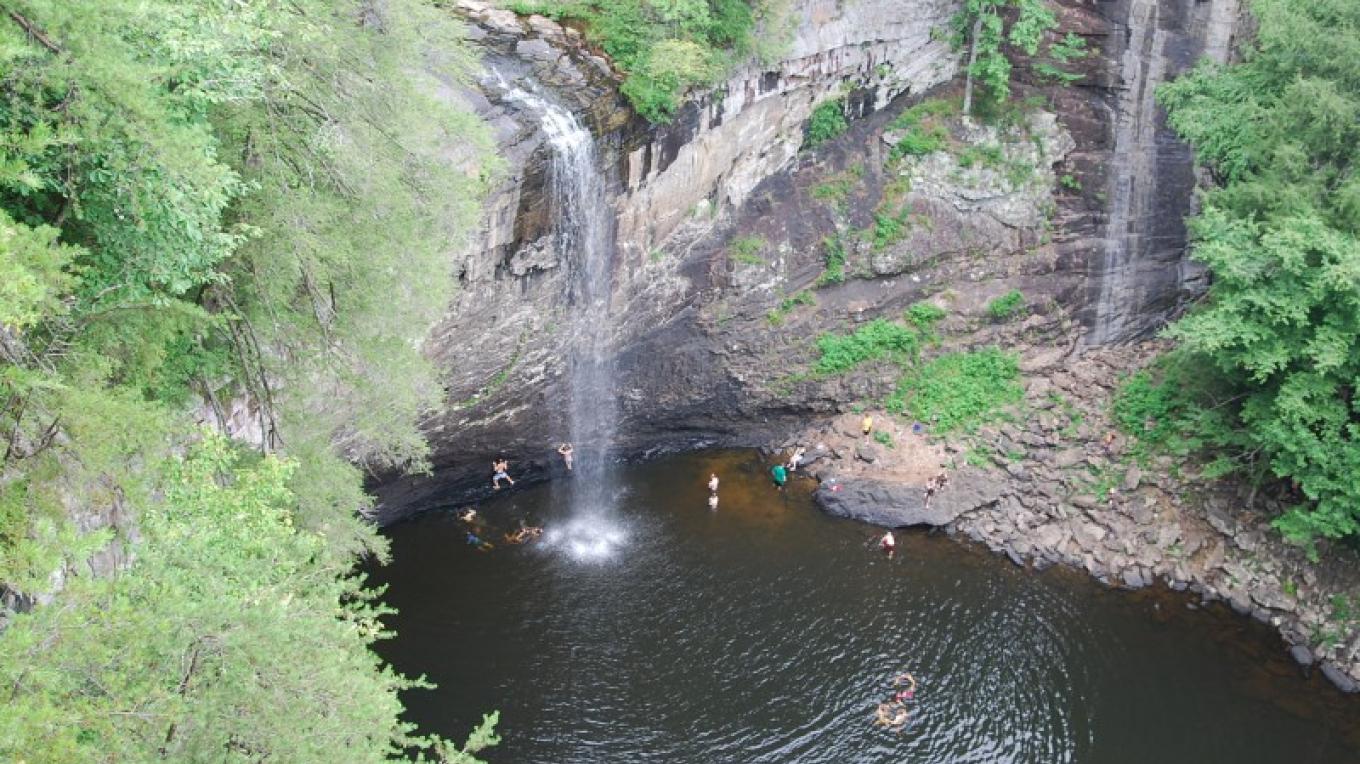
Day-use visitors and overnight campers can get up close and personal to the Foster Falls in South Cumberland State Park. Beginning at the Foster Falls Visitor Center in Sequatchie, Tennessee, a moderately challenging hike leads to the waterfall that drops from 60 feet into a gorge. The refreshing water is perfect for swimming year-round, save winter.ย 

South Cumberland State Park offers all kinds of outdoor activities, including hiking, hunting, cave tours, rock climbing, fishing, interpretive programs and events, wildlife viewing, and primitive tent and RV camping.

Cummins Falls State Park

Another popular swimming hole is in Cummins Falls State Park. This day-use park can be found nine miles north of Cookeville on the Blackburn Fork State Scenic River.

The Cummins Falls drops down from a height of 75 feet. The first portion of the falls plunges 50 feet into a shallow pool, and the second portion cascades 25 feet into a larger, deeper pool.  Any visitor wanting  to enter the gorge or visit the base of the waterfall must now obtain a permit from the park.

A Word of Caution Regarding Waterfalls

Not to strip away the fun of waterfalls, but venturing to one of these natural beauties comes with a word of caution. Trauma surgeon Jonas Karlsson, MD, offers advice based on his experiences treating patients with fatal or nearly fatal injuries around waterfalls.

1. Wear sturdy hiking shoes or boots.

2. Stay on developed trails. Do not stray from observation decks and platforms.

3. Pay attention to warning signs and rules posted near waterfalls.

4. Never climb on or around waterfalls.

5. Never jump off waterfalls or dive into plunge pools.

6. Supervise children and pets carefully.

7. Never play in the stream or river above a waterfall, or try to take photos at the top of a waterfall.

-Gathered from Waterfall Safety

Waterfalls Aren’t the Only Thing You Can Fall Forโ€ฆ

Fall for the protection, security, and peace of mind that Coach-Net’s Premier Motorized Plan brings to RVers everywhere. You can rest easy knowing that Coach-Net has you covered with its 24/7, all-inclusive roadside assistance, Concierge Services, Global Emergency Travel Services, Tire Discounts, Camping Discounts, and so much more. When you sign up for our roadside assistance program before you set off, you’ll have the help you need whenever you need it. So get Coach-Net and get on with your Tennessee waterfall adventures!


About The Author: Natalie Henley

Levi Henley and his wife, Natalie, have been full-time RVers for over 5 years. They have also been Coach-Net customers for the same amount of time.  They travel and workcamp around the U.S. in their 26-foot Itasca Sunstar motorhome with their two cats.  They write for multiple RV-related publications and recently co-wrote โ€œSeasonal Workamping for a Living: How We Did It.โ€ You can follow their adventures on the road at henleyshappytrails.com 

RV Protect

Mike S. ~ โ€œI am very pleased I chose Coach-Net! When I needed you, you were there for me!โ€

Great Gifts that RVers Will Love

Tags

, , , , ,

Looking for a gift for your favorite RV traveler that wonโ€™t break the bank or overextend payload? All the gifts on this list match three important requirements: they are small, lightweight, and relatively inexpensive.

Black Diamond Spot 350 Headlamp: Provides hands-free light while working under your rig or checking on your campsite after dark. Available in red, black, blue, and aqua.

Motorola Talkabout 200 2 Way Radio: Relying on cell phones to help your partner park the trailer? That doesnโ€™t always work in remote areas. A pair of rechargeable walkie talkies can really come in handy, and itโ€™s a good idea to purchase a set that isnโ€™t just a kidsโ€™ toy. 

Kidde Code One Fire Extinguisher: Most RVs come equipped with a single fire extinguisher. Double your safety factor by keeping an extra one at the other end of your rig.

Adventure Medical Kits Mountain Series Hike Medical Kit: This model is compact, weighs less than 8 ounces, and is extremely well organized. The sections open like flower petals, making it easy to find what you need when every moment counts.

Ambient Weather Temperature/Humidity Monitor: The Ambient monitor will take readings from sensors that you place in three di๏ฌ€erent areas of your RV, as well as providing information about the temperature and humidity outdoors. Critical for avoiding interior condensation and keeping pets safe.

SUAOKI Solar LED Lamp: The SUAOKI lamp is extremely lightweight, collapsible, and can be charged by USB as well as the solar panel.

Keurig K-Mini Co๏ฌ€ee Maker: This single serve co๏ฌ€ee maker is less than 5 inches wide to maximize your counter space.

Plastic Bag Holder: Hangs from a hook, lightweight, and keeps all those plastic grocery bags corralled. Available in a variety of fun fabric options.

RV Devotional Book: Need some grace while on the road? Grace on a Rambling Road: Devotions for RV Travelers includes 60 entries that connect the Scriptures with stories of life on the road, mediations on nature, prayers, and life applications.

Sky Jo Game: Sky Jo is easy to learn and quick to play. Perfect for ages 7 and up on those rainy days.

Mainstays Oversized Picnic Blanket: This useful and fun 60โ€™ x 70โ€™ blanket has a waterproof exterior and folds up to form a carrying bag with attached handles and pocket. Vibrant colors and big enough for family outings.

Duraflame Fatwood Fire Starters: These are designed to work with wood or charcoal.

Fun Outdoor Tablecloth: Ready to replace that ratty old tablecloth? This one comes in a fun camping themed pattern. Plastic clips will help keep everything secure on those windy days.


*From time-to-time, we have guest bloggers post on our site. The views, opinions and positions expressed within these guest posts are those of the authors. Coach-Net did not receive compensation for this post.


About the Author: Nancy Bell Kimsey is a lifelong outdoor enthusiast whose hiking and camping experiences have ranged from backpacking and family tent camping to adventuring in a fiberglass travel trailer. She moved to North Carolina to attend Wake Forest University and remained in the Tar Heel State throughout her career as an educator. She is a contributing writer for several camping publications and the author of Grace on a Rambling Road: Devotions for RV Travelers.

Nancy Bell Kimsey
RV Protect

Martina N. ~ โ€œFriendly and fast service! Highly recommended especially for new RV owners!โ€

Camping With Coach-Net: Brooke At Lake Lewisville

Tags

, , , ,

Brooke is one of our awesome Inside Account Executives! She, her husband and 3 daughters were able to take a long weekend together in Rosie the Airstream for the first time on Lake Lewisville. They fished, road bikes, and spent time with friends who came along! Here’s her experience!


My family and I went camping on Lake Lewisville this spring, and it was our first time to enjoy the company Airstream, Rosie. It was a great location for our family since we have 3 little girls that love to be out in nature and there was a perfect tree for them to climb, lots of room to play, and even a little play area for them to enjoy. It was only about 45 minutes from our house but it still seemed like we were out in the โ€œwoodsโ€ which was perfect.

We were able to head out and set up the Airstream Friday afternoon and enjoyed a nice, long weekend and back to our normal week relaxed and refreshed.

My husband and I rented an RV a couple of summers ago, so this wasnโ€™t our first time out camping. We went to San Marcos with the RV we rented from Outdoorsy and it was a great experience. It was so nice to enjoy some time away from โ€œcity lifeโ€ and get out away from it all to relax with friends and family.

This camping experience was great for our girls. The only time they came inside the Airstream was to sleep. The stayed outside and enjoyed bike riding, riding their scooters, playing with friends, roasting sโ€™mores, and a million other things! Including playing in the mud ๐Ÿ˜Š

Setup & take down was super easy. We didnโ€™t face any โ€œchallengesโ€ which made the trip even more enjoyable.

We are already discussing our next trip; we just must decide where we would like to go next. We love going to the river down in San Marcos, so that is top of our list. The campsite is always so nice, clean, and the people are super friendly.

We are still new to the RVing experience but canโ€™t wait to continue enjoying the experience, meeting new people, and exploring new places.


RV Protect

Dickie N. ~ โ€œYou had us on the road within two hours on Christmas day! The follow up by Coach-Net to assure we were taken care of was great! Thank you!โ€

Saved in Vinton, Louisiana

Tags

, , , , ,

It had been a long couple of months. In the midst of the COVID pandemic, our family had inadvertently turned what was supposed to be a 4 week road trip into an entire summer on the road. We ended up circling the United States on our journey, making our way as far east from California as Washington DC. It had been a summer filled with some incredible adventures, and time well spent considering summer activities back in California were largely suspended. Having just spent some extended time in the south and in New Orleans, our family was en route west to California from Louisiana. We had hoped to make it as far as Austin, Texas during our long drive that day.

Cruising along Interstate 10, my husband noticed a tow truck in his side mirror, flashing his lights. We slowed a bit, and the tow truck driver pulled alongside us, pointing towards the rear of our Coachmen Mirada motorhome. Weโ€™d had people flag us down a couple times in our travels, and always for storage compartment door having inadvertently flung open. We knew that would be highly uncommon while cruising straight at highway speeds, but decided to pull off the highway at the next exit to take a better look. After pulling off into a gas station in Vinton, Louisiana, we realized what the helpful tow truck driver had been point to. One of our rear dualie tires on the right side of the coach was flat.

Just like that, we found ourselves stranded on the border of Louisiana and Texas in 110ยฐ heat. Justin took a few laps around the RV, and I began calling for roadside assistance. 

It was hot. The kids were grumpy. We were seemingly in the middle of nowhere. (No offense to the wonderful people of Vinton, Louisiana. Itโ€™s obviously not โ€œnowhereโ€ to you, but in that moment, it felt that way to us!)

Thankfully, our family had multiple avenues to explore in terms of finding assistance. We had roadside assistance coverage through AAA and State Farm for our personal auto, and figured we had our bases covered. Out of habit, we pursued the same channels weโ€™d have used if our Honda Odyssey had gotten a flat, with Justin calling AAA while I called State Farm.

Trying to get RV roadside assistance through automobile channels was a terrible idea. Even trying to get the State Farm and AAA agents to properly identify the vehicle make and model in their systems was a process, and it became clear they had no frame of reference on how to support us. As we sat on the phone frustrated, Justin noticed the sticker on our windshield for Coach-Net. Having just bought the Mirada earlier in the year with one year of Coach-Net roadside included, we hadnโ€™t yet used roadside assistance, and had completely forgotten about it as an option.

Right out of the gate with Coach-Net, it was clear this was a different experience. The Coach-Net agent was both helpful and friendly, immediately identifying both our coach and tire size, and promptly began working to identify an available mobile repair technician in the area to assist. 

While Justin was on the phone with Coach-Net, I wandered the area around the gas station. As luck would have it, I discovered a sign literally right across the street from the gas station that read โ€œRV Park 500ftโ€ with an arrow pointing right. I headed over to investigate, and stumbled upon our border oasis, complete with 50A hookups and an outdoor pool with not only one, but TWO waterslides. It was almost as if it magically appeared just for us that day!

We pulled out of the gas station and crawled our way to the RV park, feeling blessed to hook up and get both A/C units cranking while we waited for the repair tech. In the sweltering humid heat of the southern summer, this pool was like a mirage for the kids and I, who immediately jumped in to cool off.

Being in rural Louisiana in the height of summer, it took a few hours to find a local tire shop with the right tire and an available tech to change the flat roadsides (or poolside, as it were). We were back up and running with our new tire not long after the tech arrived, but the kids were having so much fun at the pool by then that we decided to stay put and enjoy our spot in Vinton, continuing on our journey to Austin the next morning. DOUBLE WATER SLIDES FOR THE WIN!

Vinton, Louisiana will live forever in family lore following our detour. If thereโ€™s anything our time on the road has taught our family, itโ€™s that sometimes the unexpected adventures are the most memorable!


About The Author: Allison Gagnon

The Gagnon family is a fun-loving, adventure-seeking, outdoor-exploring, RV-obsessed family of six. They are on a quest to visit all 63 National Parks in the United States, and have a passion for exploring the countryโ€™s natural treasures and adventuring with their four children while they are still young. These adventures are made possible, in part, via travel in their 36-foot Coachmen Mirada motorhome. Having already visited 52 National Parks, theyโ€™ve found a sweet spot in the delicate balance between living a full, and sometimes, hectic life at home and finding respite in outdoor adventures with every chance they get. You can follow along on their journey at www.gagnonsgone.com


RV Protect

Martina N. ~ โ€œFriendly and fast service! Highly recommended especially for new RV owners!โ€