Get Inspired and Be Entertained on Your Next RV Trip to Alabama

Tags

, , , , , , , ,

Whether you winter in the Gulf Shores, go RVing to popular events, or take a road trip to historical markers, Alabama has all sorts of fun and unique locations to explore. The following are just a smidgen of the many areas, celebrations, and landmarks sprinkled throughout the state. Find your sweet spot of adventure in Sweet Home Alabama the next time you RV through the South.

Gulf Shores and Orange Beach

Experience endless summers in Southern Alabama. While other folks in other parts of the country are shivering in snowstorms, snowbirds are soaking in the sun and tranquil turquoise waters along Gulf Shores and Orange Beach. The 32 miles of pristine beachfront on the Alabama coastline is a haven for water sportsmen. And there are even more land activities on and just minutes away from the beaches. From fishing to boating and hiking to biking, there really is never a dull moment for vacationers or season dwellers.

Gulf Shores and Orange Beach are two of Alabama’s top winter destinations because of their varied accommodations and, of course, warmer weather.  This area has also been referred to as the “New Florida” for snowbirds. While not as long as the Sunshine State’s shoreline, Alabama’s coastline offers two prime assets. It’s not as busy and congested, and it’s more affordable than Florida. Other than that, RVers can still enjoy the same activities, white sands, and salty air!

Mardi Gras

Although there is an ongoing debate on its origins, Mobile, Alabama, lays claim to the first celebration of Mardi Gras. The first festival was reportedly started by Frenchman Nicholas Langlois in 1703 when Mobile was the capital of French Louisiana. Fast forward to today, and Mardi Gras is a multi-week-long extravaganza. Like downtown New Orleans, downtown Mobile transforms into a wonderland of sorts, filled with the sights and sounds of live music, parades, parties, and other frivolities.

If your RV travels include scoping out local happenings, you won’t want to miss this annual shindig. While in town, make it a point to stop by the Mobile Carnival Museum and get the lowdown on the rich history behind this legendary event and the city’s unique ties to its beginnings.

Museums Dedicated to Black History

From Birmingham to Montgomery and places near and far, Alabama has been the backdrop to decades of monumental events in the black community. An Advance Local Media article from 2020 mentions, โ€œMontgomery alone had more slave depots than churches at the dawn of the Civil War in 1861. Many men and women helped the Rev. Martin Luther King Jr. as he rose to national prominence on Alabama soil. The Lowndes County Freedom Organization was the precursor of the national Black Panther Party.โ€

There are a number of museums throughout the state that highlight the triumphs and tribulations of black history through exhibits, artwork, presentations, and educational seminars. For example, the Legacy Museum in Montgomery features a comprehensive history of the nation, focusing on the legacy of slavery. And the Birmingham Civil Rights Institute in Birmingham depicts the struggles of the Civil Rights Movement in the 1950s and 1960s. Other moving museums and sites that preserve and interpret black history include:

  • National Voting Rights Museum, Selma
  • Freedom Rides Museum, Montgomery
  • Rosa Parks Library and Museum, Montgomery
  • National Memorial for Peace and Justice, Montgomery
  • Selma to Montgomery National Historic Trail
  • Civil Rights Memorial, Montgomery

Cathedral Caverns

The amazing sites don’t just stop above the ground. Alabama has some pretty out-of-this-world places right below your feet. Cathedral Caverns State Park is home to the Bat Cave or what is now referred to as Cathedral Caverns because of its cathedral-like appearance.

Visitors to the state park can take a guided tour of the majestic underground, which features one of the largest stalagmites in the world (“Goliath”), measuring 45 feet tall and 243 feet in circumference. Other fascinating natural cave formations include the “caveman” perched atop a flowstone wall, a “frozen” waterfall, and a large stalagmite forest.

RVers can stay overnight or longer as the park has a camping section. And if anyone gets tired of cave exploration, there are miles of hiking trails throughout the park and even gem mining.

Don’t Forget to Bring Your Most Trusted Passenger on Your RV Trip to Alabama

Of course, this list is only scratching the surface of possible places to experience on your next RV journey into Alabama. There are plenty more cities, big and small, to explore, historical landmarks to learn about, thrilling attractions to get the heart pumping, and natural wonders to build up your sense of wanderlust. Alabama is a state all its own waiting to be discovered.

All you have to do is pack up the RV and point your rig south. And don’t forget to buckle in your Coach-Net roadside assistance. With Coach-Net’s full suite of RV protection products, you can have peace-of-mind protection for a carefree journey. Coach-Net provides unlimited towing, jumpstart, fuel delivery, locksmith, tire assistance, winching, and technical support.

Get even more valuable benefits with the premier plan. Besides 24/7, all-inclusive roadside assistance, it includes concierge services, global emergency travel services, tire discounts, camping discounts, and so much more. Learn more about Coach-Net’s dynamic roadside assistance programs.


About The Author: Natalie Henley

Levi Henley and his wife, Natalie, have been full-time RVers for over 5 years. They have also been Coach-Net customers for the same amount of time.ย  They travel and work camp around the U.S. in their 26-foot Itasca Sunstar motorhome with their two cats.ย  They write for multiple RV-related publications and recently co-wrote โ€œSeasonal Workamping for a Living: How We Did It.โ€ You can follow their adventures on the road atย henleyshappytrails.comย 

RV Protect

Swain W.ย ~ย โ€œService was excellent and follow up was fantastic. It means a lot to be taken care of when you are down. Very happy with everyoneโ€™s performance I would not have known what to do or who to call if I had not had Coach-Net. You all were excellent.โ€ย 

RV Heater Types, Maintenance, & Troubleshooting

Tags

, , , , , , , , , ,

Over the years weโ€™ve seen more and more RV enthusiasts not putting their RVs away for the winter or even heading South for warmer temperatures, rather using their rigs for winter activities. I remember some chilly nights at -20 degrees in Fargo ND, a weeklong trip with my own personal โ€œSki Chaletโ€ in the Rocky Mountains of Colorado, and every February we drag out several motorhomes to use as โ€œgreen roomsโ€ for bands at the Winter Dance Party in Clear Lake IA!

Whatever your type of winter camping, making sure your furnace is operating at the utmost efficiency is important. Letโ€™s take a look at the different types of heaters used in the RV Market:

RV Heater Types

Forced Air Ducted

For years, Suburban, Dometic, and Atwood Hyrdoflame were the main brands available and they all worked in a similar manner. The thermostat would be set to the desired temperature and when the ambient temperature inside the rig gets to that setting it would create a closed circuit and send the 12-volt power to the module board of the furnace calling for heat. The furnace would start the blower motor which exhausted any old air in the intake, burner assembly, and exhaust port. It also pushed air over the burner assembly to the vents drawing interior air for circulation. As the air flowed over the burner assembly it raised a sail switch in the round shroud and once this switch lifted high enough, it would create a close circuit sending 12-volt power back to the module board indicating there was enough airflow to open the gas valve and start the spark sequence. A forced-airโ€“ducted vent furnace typically has an exterior mount and can only be accessed for service from the outside.

Once the burner was lit, air moving over the burner assembly was heated and distributed through the coach by either flexible ductwork under cabinets or under furniture or by a plenum under the floor to floor vents similar to a residential design.

Forced Air Direct Discharge

This design operated the same as the vented version but is used in smaller units without vents and the air is supplied directly from the vents on the furnace itself. It has a much more compact design and can be accessed from inside the rig.

Heat Pump

Another option for heat that has been a source of confusion for many RVers is a heat pump option that is labeled โ€œElectric Heatโ€ on a thermostat. Most heat pumps operate through the roof air conditioner and in simple terms, the unit runs backward and draws BTUs out of the outside air through the coils and evaporator to provide heat inside. These models only are efficient down to about 55 degrees outside temperatures and only supply mild supplemental heat from the 60-65 degree ambient temperature range. The confusing part is the label on the thermostat makes it look like itโ€™s an electric heater that can be used any time you are plugged into shoreline power!

Almost every year I get a call from the group at the Winter Dance Party complaining the heaters donโ€™t work in the units sitting outside as green rooms. In every case they ran the propane out using the forced air heater and switched it to โ€œElec Heatโ€ and it just blows cold air. Thatโ€™s because it is 0 degrees outside and there are NO available BTUs for the heat pump! However, it is a good source of free heat in that 55-65 degree range to top off the inside of your coach if you are plugged into shoreline power and not paying extra for it!

Heat Strip

Some roof air conditioners have a heat strip feature that does work on 120-volt power which heat a thin wired strip around the perimeter of the shroud inside the roof air conditioner, however, it is not typically enough to keep the rig warm.

In-Floor Heating Systems

Several models have been introduced over the years including Aqua Hot which has an onboard boiler that heats a liquid solution and routes it around the rig to heat the interior and water heater. I have also seen a few electrical versions of a wired-in-floor system using pads with coils but these are usually an aftermarket installation.

Making Your Forced Air Type More Efficient

Thereโ€™s not a lot of maintenance required with forced air models either vented or non-vented however, there are things you need to understand to prevent issues.

Proper 12-volt House Battery Power

Even though they run on propane, your furnace needs at least 10.5 volts of DC power to the module board for it to open the gas valve and light. The deceiving part is the fan will run all the way down to 4-5 volts so it seems to have power, just wonโ€™t light? Most often the issue is a sulfated battery that canโ€™t keep up even when plugged into shoreline power with all the other appliances running as it seems they are fully charged, but drop off fast if sulfated. I constantly get the question, my furnace will not run and my batteries are good? The only way you can tell your batteries are holding a full charge and providing the amp hours designed is to charge them properly, hook them up to a 24 amp draw machine, and count the hours! Since this is almost never done, hooking up a digital meter only tells you the current charge, not the efficiency. If the batteries are sulfated, they will start off at 12.6 volts but drop fast and a low battery will not provide the power needed to get the airflow out of the fan and raise the sail switch, therefore the gas valve will not open and the unit will not light. If your fan is running, but your furnace does not light, hook up a portable booster to verify it has enough power. If it still does not light, read on.

Low LP Pressure

All LP appliances need 11โ€ of water column pressure to operate properly and this is provided by the regulator at the LP cylinder. If you know you have proper 12-volt power and hear the click of the gas valve opening and the spark trying to light and it does not light, the chance is you have low LP pressure. This can be tested at the furnace by a certified technician, or you can do a quick test by turning on a stove burner and watching the flame. It should be a steady blue one. Turn on a second and then a third and notice the flame. Then turn on another LP appliance such as a water heater or refrigerator and notice the flame. Sometimes appliances work fine for a while then stop. This could be a situation where it is the only appliance working and there is enough LP pressure and 12-volt power for one but when the water heater or refrigerator kicks on at the same time, there isnโ€™t enough of one or the other? This little test will simulate several appliances drawing at the same time.

Sufficient Air Flow

Not only does the sail switch need to be raised at the fan motor shroud, but there must be good airflow out of the direct discharge as well as the vents. If you have rugs over the vents or anything blocking the airflow, it will create back up in the furnace could affect the sail switch but most likely create a rise in temperature building up and the high limit switch will shut the unit off. This is a temperature sensor at the far end of the burner assembly as a safety feature. Keep all vents open and free-flowing.

Maintenance

Even though I mentioned earlier there is very little maintenance required, itโ€™s important to make sure there is good airflow in and out of the outside intake/exhaust vents as well as the interior air return. Spiders and mud daubers love propane and heat and will plug the holes needed to bring fresh air into the burner chamber and exhaust outside.

Make sure they are clean and the air is flowing freely. Sometimes it might be necessary to install a screen over the vent to prevent the build-up of foreign material! If your exhaust vent has an abundance of black soot or what looks like a potential extremely hot situation that has created a burned effect, get it looked at by a certified technician.

Also check inside to make sure there isnโ€™t a build-up of pet hair, dust, or other items that can get drawn into the air return for proper circulation.


About the author:

Dave Solberg: Managing Editor, RV Repair Club

For the last 25 years, Dave has conducted RV maintenance and safety seminars, developed dealer and owner training programs, written RV safety and handyman articles authored an RV handbook reference guide, and logged over 100,000 miles on the road in an RV.

RV Repair Club

RV Repair Club is your go-to online resource for enthusiasts who want quality RV maintenance, repair and upgrade information โ€“ a community where passionate RVers can come together to gather knowledge and share their experiences.

Learn more about RV Repair Club.

RV Protect

Jim G. ~ โ€œThe young lady who assisted us was very kind, she listened to our needs and passed along the specific RV information to the service provider. The service provider used was local to us and very good. The service was efficiently, safely, and expertly given.โ€ 

3 Things to Consider When Exploring or Relocating to City Life in an RV

Tags

, , , , ,

More than a million Americans live full-time in RVs, according to the RV Industry Association, with spikes in related internet searches proving just how popular the lifestyle is becoming. However, camping out and exploring nature isnโ€™t the only option with an RV, as exploring and even relocating to a big city is equally as rewarding. From the importance of having a solid plan in place to making adjustments (both physically and mentally), hereโ€™s what you should know before heading out on the road.

Have A Solid Plan

When planning to explore big cities with your RV, having a solid plan in place before hitting the road is essential in order to make sure things go as smoothly as possible, and knowing the best places to park in your chosen city is a great way to start. Because driving your RV around a city isnโ€™t advised, planning to park in an RV park or parking lot that’s close to public transportation can be a great way to explore without worrying about having to navigate through stressful city traffic with a large and bulky vehicle. 

Finances are another key element that will require planning ahead as well when exploring a city with your RV. Dining out and exploring a cityโ€™s cuisine is a great way to explore, though doing this is known to be a costly endeavor in most major cities, with past travelers spending an average of $37 on meals for just one day in New York City. Taking advantage of coupon books is always a great idea (and may even be available through your chosen RV park), though creating and sticking to a budget for the trip and cooking from the RV can also be a lifesaver when staying on track. 

It Can Be An Emotional Hurdle

If you find that you particularly enjoy a certain city, relocating for an extended period of time is definitely a possibility, though itโ€™s necessary to keep in mind that the adjustment can be difficult if youโ€™ve already set down roots in a more rural setting. If youโ€™re relocating with the kids, the effect that relocating can have on their mental health can be challenging to navigate, especially if they have a group of friends they enjoy spending time with or if they find delight in being surrounded by nature. Maureen Heely, the author of The Emotionally Healthy Child, notes that โ€œchildren are young and new to the world, and changing their โ€˜safe spaceโ€™ is a big deal.โ€ Thankfully, you can support your family through the move by ensuring they have a way to keep in touch with their friends and favorite activities. Finding a family-friendly campground that has plenty to do, and spending quality time as a family through exploring the city can also help make the adjustment easier mentally, too.

Be Ready To Make Adjustments

Whether youโ€™re simply exploring a major city or youโ€™re relocating for an extended period of time, youโ€™re likely going to have to make some major adjustments if youโ€™re not used to such an environment. For example, cities are known to be loud, with people living in cities are regularly exposed to noise above 85 decibels from sources like traffic, airports, and subways, making it enough to cause hearing loss over time. Depending on where youโ€™re parked, you may even lose sleep over it at the beginning of your stay. Thankfully, investing in standard earplugs or noise-canceling headphones will help in making the adjustment successfully, especially in moments when the noise may become overbearing.

Exploring major cities in an RV might sound impossible, though it can be done successfully with a little planning beforehand. By creating a budget and knowing where to park โ€” as well as how to handle the struggles of relocation, you and your family are sure to enjoy any city to the fullest extent possible.


Author: Alicia Rennoll

RV Protect

Dwight D. ~ โ€œYou are wonderful. The service and reps are fabulous.  THANK YOU!!  I AM GOING TO TO GET BOTH MY KIDS A PLAN FOR THEIR BIRTHDAYS.โ€

Winter RVing in New Mexico: Discover the Outdoors in a Wonderland of Enchantment

Tags

, , , , , ,

What are your RV plans this winter?ย  If you havenโ€™t already committed to winterizing your rig and are open to winter travel, then you and your traveling crew might be interested in venturing to the Land of Enchantment. While quite brutal in the summer months, New Mexico turns into a Winter Wonderland of sorts, offering a…

  • Wellness retreat basking in tranquil desert scenery immersed in a soothing hot spring.
  • Family adventure in the snow.
  • Quiet getaway of fishing with the gang.
  • Different kind of sledding experience.

Whatever your winter escape, you just might find it in the Wonderland of Enchantment.

Soak in Hot Springs in Jemez Springs

Imagine soaking in this hot spring surrounded by desert beauty. Source

New Mexico is a haven for hot springs as this region of the nation experiences a good deal of geothermal activity. Jemez Springs, located just an hour from Albuquerque and 1.5 hours from Santa Fe, offers primitive and developed hot springs. 

RVers wanting some much-needed rest and relaxation in these hot springs can choose from a number of RV campgrounds and resorts around the area and then spend days hot spring hopping.

Some hot springs around Jemez Springs can be accessed in their natural state along hiking trails. Others are a part of luxurious resorts. The following is a sample of commercial and natural hot spring locations in and around the town.

Resorts/Spas:

Primitive:

Safety Note: Always stick to known and used hot springs as water temperatures in natural hot springs can reach dangerous levels. It is a good idea to contact the forest service or any agency with jurisdiction over these and other hot springs for up-to-date safety information.

Go Birdwatching at Bosque del Apache

Mid-November thru mid-February is peak traffic at the refuge and peak season for wildlife viewers and photographers. Source

Many RVerโ€™s love wildlife viewing, especially when it comes to birdwatching and photography.  Bosque del Apache National Wildlife Refuge is a bird photographerโ€™s playground, particularly in the fall and winter, when the area offers the highest bird numbers.

The refuge straddles the Rio Grande valley in Socorro County and is home to almost 350 species of birds. In the winter, bird watchers will spot Snow Geese, Sandhill Cranes, dabbler ducks, Black-throated and Sage Sparrows, Bald Eagles, and Ferruginous Hawks.

RV and wildlife enthusiasts can get their fill of birdwatching every day. There is a nearby RV park aptly named Bosque Birdwatchers RV Park.

Snowshoe in Taos

Winter hiking is more like snowshoeing in these parts of New Mexico. Source

If you arenโ€™t an experienced skier or would like a slower-paced journey into a winter wonderland, perhaps snowshoeing is more your speed. Taos Ski Valley is a perfect location for RVers wanting to experience a unique and fun way to enjoy the outdoors and winter camping. 

An overnight parking area is sectioned off for RVers and provides a short walk to the lifts. Folks can either bring their own equipment or rent shoes and poles from the venue. Plus, visitors can access a list of on-location trails based on their skill level, from novice to expert.

Ice Fish at Eagle Nest Lake

Try alpine lake fishing at Eagle Nest Lake. Source

Aside from camping, snowmobiling, cross-country skiing, and snowshoeing, Eagle Nest Lake State Park offers visitors ice fishing through the winter.ย ย  Eagle Nest Lake is at an elevation of 8,300 feet situated amongst New Mexico’s highest mountain, Wheeler Peak.

The alpine lake is stocked with trout, salmon, perch, and pike. A fishing license is required, and it’s advised to check in with the Department of Game and Fish beforehand to make sure the lake is fully-frozen and thick enough.

Sled down a Snowy-like Slope

From a distance, it looks like real snow. Source

Perhaps the most unique-to-New Mexico winter activity is something folks around these parts enjoy year-round, sledding. Only, instead of snow, the powdery white gypsum of the White Sands National Park helps propel sledders down the gentle slopes. Visitors can be found gliding down or trekking back up the dunes along the loop portion of Dunes Drive using plastic snow saucers. With the bundled-up families playing in the close to freezing temperatures, it can easily be mistaken for a snowy day somewhere up north.

White Sands National Park is open daily year-round, save Christmas Day. Winter hours are from 7 AM to 6 PM. While RV camping and other lodging options are not permitted in the national park, there are many options nearby in Alamogordo and Las Cruces, making for a relatively short commute.

Roadside Assistance in New Mexico, No Matter What You’re Driving

While you consider your options for your winter in New Mexico, consider your current roadside assistance program. At Coach-Net, we’re committed to improving your RV experience by being your connection to carefree RVing. Coach-Net RV Technical & Roadside Assistance is a service program specializing in the unique needs of RVers at an affordable price.

But Coach-Net doesn’t stop coverage with RVs. Many of their programs include all personal vehicles you own, rent, borrow or lease. So no matter if it’s a motorcycle or a motorhome, they’ve got you covered!

Their baseline 24/7, all-inclusive roadside assistance program comes in handy for those unexpected moments should you:

  • Have a roadside breakdown,
  • Need assistance with a flat tire,
  • Run out of fuel,
  • Lock your keys in your vehicle,
  • Or any other type of disablement.

When you need help, they are a phone call away. So join now and get expert assistance anytime you need it!


About The Author: Natalie Henley

Levi Henley and his wife, Natalie, have been full-time RVers for over 5 years. They have also been Coach-Net customers for the same amount of time.  They travel and workcamp around the U.S. in their 26-foot Itasca Sunstar motorhome with their two cats.  They write for multiple RV-related publications and recently co-wrote โ€œSeasonal Workamping for a Living: How We Did It.โ€ You can follow their adventures on the road at henleyshappytrails.com 

RV Protect

Thomajan C.ย ~ย โ€œWe are incredibly grateful to Coach-Net for helping us. Should an event like this ever happen to us again, Coach-Net will be our first call.โ€

The RV Event Bucket List: Festivals and Events Worth Traveling to in your RV

Tags

, , , , , , , , , ,

There are so many places to explore while you’re RVing.ย  As an RVer, the open road is your oyster, and you and your traveling crew can explore as much as you want, whatever you want, at your leisure.ย  And while the list of must-experience sites is endless, there are some key RV Event Bucket List items worth traveling to in your RV, like the ones listed below.

Quartzsite Sports, Vacation & RV Show

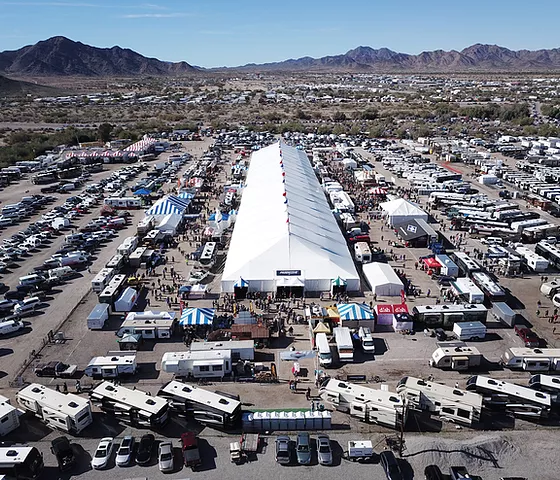
Known as the “The Largest Gathering of RVers in the World,” the Quartzsite Sports,  Vacation, and RV Show draws as many as one million folks every year in January.  For the past 40 years, this otherwise sleepy town has offered vendors space for rock, gem, and mineral shows, flea markets, and the Quartzsite Sports, Vacation & RV Show.

The Quartzsite Big Tent is particularly of interest to hundreds of thousands of RVers, full-time and part-time. Hundreds of vendors gather under this behemoth to sell all sorts of outdoor and RV-related products and services, ranging from the latest gadgets to repairs and upgrades. It’s an RV shopper’s dream come true!

In addition to the shopping opportunities, folks opt to dry camp around the event for days and participate in all sorts of social gatherings and workshops geared towards RV living. It’s definitely a mecca for RV enthusiasts.

Quartzsite is located just 20 miles east of the California border on Interstate 10.  Show dates for the next few years are listed below:

  • January 22nd-30th, 2022
  • January 21st-29th, 2023
  • January 20th-28th, 2024
  • January 18th-26th, 2025

NASCAR Camping

โ€œSeasonerโ€ fans will delight in the opportunity to see NASCAR events up close!  Many NASCAR race car events offer camping options for RVers.  Depending on the venue, folks can choose among multiple camping areas across the facility, including full hookup sites, grassy areas for dry camping, and camping right in the middle of the racetrack interior field! RVers can also opt for season passes as part of their camping package.

Races take place all over the U.S. between February and November, but the largest and most popular events include the Daytona 500, Coca-Cola 600, Cook Out Southern 500, and Indy 500, to name a few.

Burning Man

“Whether it’s a dream of artistic expression, a yearning to connect with others in a fractured society, or simply a desire to live a more meaningful and authentic life, Burning Man is the place where dreams can and do come true.”

-burningman.org

Burning Man is a multi-day celebration that occurs in the Black Rock Desert in Nevada around Labor Day. The event focuses on the spirit of community and creativity in the form of art, self-expression, and self-reliance. The event is unlike any on the planet, and to truly understand the concept of Burning Man, you simply have to go and experience it for yourself. To an outsider, it can be summed up as a culmination of psychedelic costumes, out-of-this-world art installations, a variety of performances, and of course, lots of partying.

Tickets to the event start at around $500. Folks are encouraged to bring a hefty supply of water and food in their rigs. It is a complete boondocking experience in the desert, so be prepared for extreme heat and the possibility of dust storms.

Albuquerque Balloon Fiesta

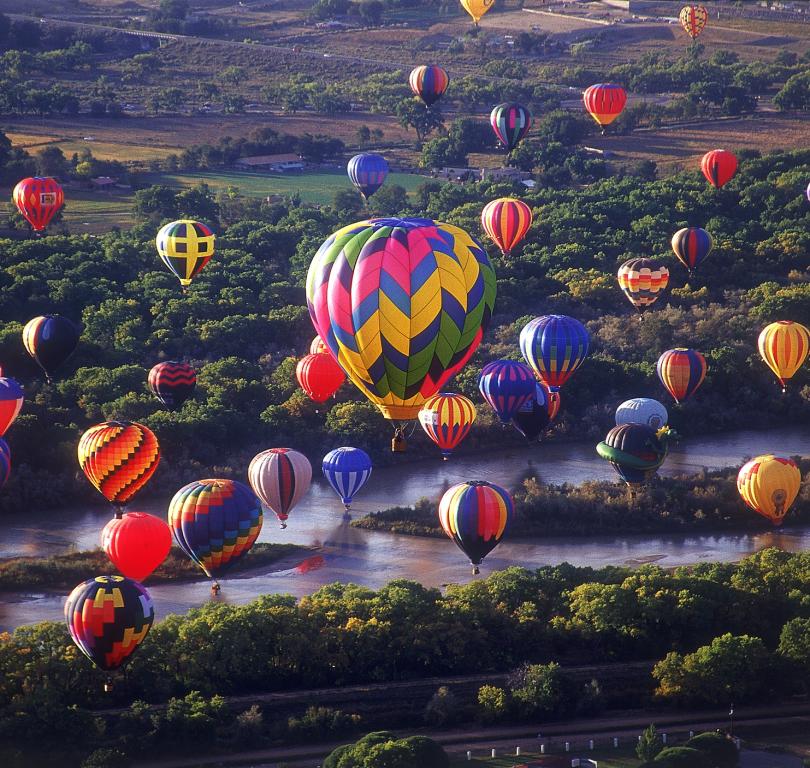
The Land of Enchantment truly lives up to its name every year at the Albuquerque International Balloon Fiesta. This unique event is said to be the world’s most photographed event and the largest hot air ballooning event.

Nearly 750,000 visitors, many RVers, attend the Albuquerque, New Mexico event that happens for nine days during the first full week of October. Spectators gather to witness hundreds of special shaped balloons glow at night and almost simultaneously ascend in the early morning. It’s quite a magical (or, more appropriately, “enchanting”) sight to behold.

In addition to the awe-inspiring balloon shows, folks can see the balloons up close and meet the flight crew as attendees are allowed to walk around the launch field. Opportunities to assist the flight crews with set-up and experience a private hot air balloon ride are also available.

The 9-day event itinerary is packed with concerts, a chance to shop a variety of vendors, social gatherings, and a wide variety of activities for all ages. RV camping can be reserved on-site at the event or at nearby campgrounds. The event also offers bus transportation to and from the festival.

This coming year, the Albuquerque International Balloon Fiesta is slated for October 1-9, 2022.

Travel To These and More RV Event Bucket List Locations with Peace Of Mind

Whether you are RVing in the deserts of Nevada or New Mexico or in the middle of a NASCAR race track, itโ€™s essential to be equipped with 24/7, all-inclusive roadside assistance when you’re on the road away from home. Thatโ€™s a promise that Coach-Net can offer for RVers. They can also promise other valuable benefits such as Concierge Services, Global Emergency Travel Services, Tire Discounts, Camping Discounts, and so much more.

โ€œIf you own an RV, you owe it to yourself to have the protection you need when you need it most.โ€

-coach-net.com

If you havenโ€™t already, give Coach-Net a call or join now and breathe easier knowing that Coach-Net has you and your family covered!


About The Author: Natalie Henley

Levi Henley and his wife, Natalie, have been full-time RVers for over 5 years. They have also been Coach-Net customers for the same amount of time.  They travel and workcamp around the U.S. in their 26-foot Itasca Sunstar motorhome with their two cats.  They write for multiple RV-related publications and recently co-wrote โ€œSeasonal Workamping for a Living: How We Did It.โ€ You can follow their adventures on the road at henleyshappytrails.com 

RV Protect

Mike S. ~ โ€œI am very pleased I chose Coach-Net! When I needed you, you were there for me!โ€

RV Oven And Stove Top Maintenance and Troubleshooting

Tags

, , , , , ,

When I was traveling full time in a Winnebago motorhome training dealers across the country, the stovetops and ovens were pretty simple and there were only a couple of models, Magic Chef, and Atwood. But just like everything else in the RV industry dozens of models have come and gone over the years and today, there are dozens of brands available such as Furrion, Recpro, Suburban, and Dometic which now owns Atwood which also owns Wedgewood, and many more.

A major shift in the industry that I have noticed in the past decade is the use of more residential appliances and furnishing especially since the slide rooms provide more space for the larger items such as residential refrigerators and electric stovetops and ovens although they take an enormous amount of electricity so the old propane models are still the majority that I have seen.

For this article, we will focus on the propane model stovetop and oven combination. The first step in any appliance maintenance and troubleshooting is to understand the operation and lighting sequence. Your main LP regulator at the LP container will reduce the pressure supplied to the rig to 11โ€ of the water column. Most RV stovetops and ovens have an internal regulator that will reduce that down to 10โ€ of water column to a manifold. This manifold has the control knob attached to it and in the case of the stovetop, delivers LP to the burner assembly. The rate of flame or temperature is regulated by the operator turning the knob to the desired height. In the case of the oven, the temperature is set at the knob and a thermostat regulates the flow of LP to the desired temperature to the burner tube.

The oven pilot must be lit before the burner assemble will light. Typically pressing the oven knob in will supply lp to the pilot assembly which must be lit manually and stay lit for at least 30 seconds until the flame reaches and heats the thermocoupler. This pushes a magnet in which is a safety feature in case the flame goes out. The thermostat senses temperature and some models have a temperature bulb in the back of the oven called a mini bulb. Once the thermocouple senses a flame, LP flows to the burner assembly and is lit by the pilot light. If the flame and the pilot light go out, the magnet drops and shut off LP to the oven. The thermostat senses temperature from the temperature bulb in the back of the oven.

For the stovetop, simply press in and turn the knob and turn the ignitor if your model has one, or manually light the burner with a long match or butane stick lighter. Keep in mind the burner assembly does not have a thermocoupler so the LP will continue to flow if the knob is open and there is no flame! I have leaned against a knob in units and smelled the distinct rotten egg smell in the past! Make sure the knob is in the off and locked position when not in use.

Stovetop Maintenance

Compared to other appliances, there is little maintenance required with an LP stovetop/oven combination other than keeping it clean. Some stovetop models have a sealed burner assembly which means the metal cover comes all the way around the burner so food can not spill over into the burner area. Periodically inspect the burner orifice to ensure nothing is spilled over and clogging which can affect performance or even start on fire.

Troubleshooting The Stove Top

If the stovetop will not light with the piezo or spark assist, verify there is LP coming to the burner by trying to light it manually with a butane lighter. If it lights, the piezo is either defective or has a cracked ceramic case which will send the spark through the crack rather than to the burner. Visually inspect the piezo for spark attempt.

If the burner does not light manually and has no LP flowing to the burner check another burner to verify LP flow. If there is LP flow to another burner, check the supply tube to the affected burner and clean. If not, check to make sure the knob is actually opening on the stovetop and the valve is on at the LP container. Often times there is an in-line shut-off valve to LP appliances that should also be checked. If all these steps are verified, check another LP appliance to verify the main regulator is working properly. If it is, there is an issue with the LP supply line to the stovetop. Some models have an air shutter that can be adjusted. Check with your ownerโ€™s manual. It is also a good idea to check connections for leaks with an approved LP leak solution. Do not use soap and water as some detergents can cause corrosion to the metal.

If the burner lights, but the flame is yellow and โ€œjumpingโ€ the LP pressure is too high and needs to be tested and adjusted by a certified technician with a water column tester first at the stovetop regulator and then the main LP regulator at the container.

If the burner lights but the flame is too small, verify the knob is actually turning to the higher position first, then check for insufficient pressure again by a certified technician. If other burners are working correctly, clean the supply tube or replace the knob/valve.

Troubleshooting The Oven

If the pilot does not light, check for leaks at the pilot supply tube, check LP pressure at the oven regulator, and then the main LP container regulator. Inspect and clean the pilot assembly to ensure LP is flowing to the pilot. If the pilot lights but does not stay lit after 30 seconds verify the thermocoupler is positioned properly and the flame is reaching it.

If the pilot stays lit but the oven will not light, verify LP flow to the burner assembly and adjust the air shutter if applicable. Also, have LP pressure tested by a certified technician with a water column tester.

If the oven lights, but has low flame and low temperature, test LP pressure at the regulator and burner assembly. Low pressure at the burner assembly would indicate a valve not opening.

If the oven has low temperatures or uneven heat it may be as simple as poor air circulation inside the oven. There must be at least 1โ€ space on all sides from items cooking inside the oven. There are also ventilation holes at the bottom that can get clogged with food drippings and must be cleaned out as well as the top vents. Do not cover the bottom of the racks with aluminum foil to catch drippings! Check your ownerโ€™s manual for specifics to your model.

Intermittent Operation of Both

If the stovetop and or oven work for a short period of time but then fail, it could either be insufficient LP pressure or low 12-volt power. This is what we call โ€œgremlinsโ€ during troubleshooting as they sometimes can not be replicated in the service department! All LP appliances need 12-volt DC power to open gas valves and run the thermostats. This power is supplied by the deep cycle house batteries which are also supplying other appliances and items like lights and fans. If the batteries are sulfated or the converter/charger can not keep up, the battery bank drains down and will shut off the LP supply at the valve. Typically this only happens with the oven as it has the thermocoupler and thermostat.

If your main LP container regulator is getting weak, it might be able to supply enough pressure (11โ€ WC) to the stovetop/oven regulator however if the water heater or refrigerator kicks in, the regulator might not be able to provide enough LP pressure to all the appliances? This would require using a pressure tester and turning on several appliances at once to verify proper pressure during extreme use situations.


About the author: Dave Solberg: Managing Editor, RV Repair Club

For the last 25 years, Dave has conducted RV maintenance and safety seminars, developed dealer and owner training programs, written RV safety and handyman articles, authored an RV handbook reference guide and logged over 100,000 miles on the road in an RV.

RV Repair Club

RV Repair Club is your go-to online resource for enthusiasts who want quality RV maintenance, repair and upgrade information โ€“ a community where passionate RVers can come together to gather knowledge and share their experiences.

Learn more about RV Repair Club.

RV Protect
๏ปฟ

Thomas P.ย ~ย โ€œYour agents were exceptional! Service was great from beginning to end!โ€

Coach-Net Camping: Halloween At Ray Roberts Lake State Park

Tags

, , , , , , ,

Ever since Coach-Net purchased an RV for it’s employees to use, my parents have been asking me to take them on a camping trip. Both sets of my grandparents had RV’s at one point or another, so needless to say, they were excited when I let them know I’d take them out on the company Airstream over Halloween weekend!

However, they’re not too adventurous, so we stayed relatively close and booked a 2-night stay at Ray Roberts Lake State Park, which is only about a 45 min drive from us.

The drive wasn’t too bad. It’s not exactly scenic, but once we got off the highway, it was nice to drive through some of the winding roads surrounded by large ranches. It’s always great to get out of the city and into the country a bit. We did have some high winds and I could feel its effect on towing the trailer. This wasn’t too much of an issue, especially with the sway bars we had connected to the trailer, however, it did still make me a little nervous given that it was my 2nd time taking it out.

Once we arrived at camp, we got the Airstream backed onto the pad, leveled it out, and chocked up the wheels. As I went to hook up the water and electrical, I had a difficult time finding the 30 amp power chord. So, I called my friend and Coach-Net’s Learning Program Manager, Joseph Kaminski to see if he could help me locate the chord over the phone. Well, it turns out that as I was getting ready to leave, I unplugged the power chord and left it at the office assuming there was a second one in the back on the Airstream. What a bone-headed move. Thankfully, Joseph offered to bring it to me! This meant he drove all the way back to the office, picked up the chord, and drove through traffic to drop it off at my campsite. (Well over an hour and a half drive time) He’s the real MVP of our trip! Now that the biggest hiccup was over, we continued to enjoy our weekend! We spent the evening around the campfire, cooking hot dogs and burgers and listening to classic rock jams it was time to hit the hay.

The next day we spent an hour or so in the morning fishing. I didn’t have much luck that day but I did get 1 pretty aggressive bite, I just missed it. (Texas fishing for ya) After breakfast, we went on a hike/walk through some of the designated trails. My dad wasn’t a huge fan of the “taking a hike” idea but he pushed through like a champ after my mom nudged him a few times.

We spent most of the afternoon hanging outside of the Airstream watching college football on a TV we hooked up to the RV. This was accompanied by some brats my dad proudly cooked over the fire he paired with some kind of mustard dip concoction he came up with. Soon after the brats, when Texas Tech was losing to OU by 21, one of us took a big nap to rest up before dinner.

We spent the rest of the afternoon/evening around the campfire, cooking dinner in the Airstream, eventually roasting up some s’mores (which the wife was happy about) and busting out a bottle of the good stuff. A perfect way to end the night.

Sunday morning, we packed up our gear, cleaned up the campsite, and rolled out! To top a great weekend off, we stopped for lunch at a Babes Chicken Dinner House right down the street. We’ve done this several times after camping, at this point it’s becoming a tradition and I’m okay with that.

My parents are already thinking about renting an RV for their next adventure and heading to the same spot! Dad keeps telling mom that’s how they’re going to retire but she’s not having any of that. We’ll definitely be booking another RV trip with them (hopefully this time in separate RVs)! It was great to get away, spend time with family, and have nothing on the to-do list for the weekend. It very may well be the best way to vacation.


Tire Discounts

Lance C. ~ โ€œMy first experience with Coach-Net service, and wow was I ever pleased!โ€

What to Do with Your RV in Winter

Tags

, , , , ,

The cold weather is here and winter itself is just around the corner. If you havenโ€™t already, now is the time to figure out what to do with your RV this winter.

Many people believe there is really only one option when it comes to RVs and wintertime, but that isnโ€™t actually the case. Yes, the most common option of storing the rig is one choice, and itโ€™s a fine choice for many. That said, there are a few other options out there, and there might be a better one for you.

Of course, in order to know whether thereโ€™s a better option for you and your RV this winter, you need to know what those options are. Thatโ€™s what this article is for!

Below weโ€™ve outlined the top five ways RV owners handle their rigs in the winter months, as well as some tips for each option. Read on to learn more.

Store Your RV

As mentioned above, the first and most obvious option is to store your RV for winter. This is a great option if you’re happy with your current RV setup, plan to RV next summer, and/or have access to a place to store the rig. That said, there is some work involved, and for some, storing for the winter can be a relatively large financial investment.

Hereโ€™s what you need to know about storing your RV for the winter:

  • You will need to winterize your RV. This involves emptying the rig of all water and running RV through the water lines. Learn more about winterization here.
  • Storage options include storing on your land, a friend’s land, or paying for an indoor or outdoor storage spot. There are pros and cons to each and all should be considered.
  • If storing outdoors, we recommend using an RV cover or even building an RV shelter if possible.

Take Your Rig South

The next option is to take your rig down south to keep on camping and avoid the cold weather altogether. Obviously, this is really only an option if you are retired or able to work remotely. That said, if you are in a position to move south for the winter, it can be an awesome option, especially if you arenโ€™t a fan of cold weather.

Hereโ€™s what you need to know about taking your RV south for winter:

  • The best warm weather winter destinations are Florida, south Texas, Arizona, and southern California.
  • RV sites in these places tend to fill up quickly. Grab your site(s) as soon as possible.
  • If you prefer boondocking, we recommend heading to Arizona or southern California where there are tons of amazing boondocking options.
  • Even the warmest destinations can be cold occasionally. Be prepared for some chilly weather no matter where you go.

Rent Your Motorhome or Trailer in the South

Want to avoid winterization and storage but canโ€™t head south yourself? Why not send your RV south without you? Thatโ€™s right, some RV owners choose to send their RVs to RV rental companies in the south to be rented out on consignment. This allows you to make a few bucks off of your rig rather than paying to store it, but it does require that youโ€™re comfortable with sending your RV out with other campers.

Hereโ€™s what you need to know about sending your RV south to be rented:

  • You will want to find a reputable rental company to rent your RV out. Be sure to go over all details carefully, and donโ€™t leave without a signed contract.
  • Remove all personal items and valuables from your rig. If you arenโ€™t okay with losing it forever, it shouldnโ€™t be in your RV when itโ€™s rented out.
  • When considering this option, think about the cost and time involved in transporting the RV to and from its final destination. Also, factor in the wear and tear that the RV will accumulate when being rented.

Embrace the Winter Weather and Go Camping

Cold weather doesnโ€™t mean you canโ€™t camp at all, it just means youโ€™ll have to be more prepared than youโ€™d usually be. If you love camping and donโ€™t want to stop for the winter, then donโ€™t! Instead, make the proper preparations and get out there and enjoy the RV life.

Hereโ€™s what you need to know about camping in winter weather:

  • Depending on how cold your area gets, you might want to winterize the water system and camp without running water for the coldest months.
  • Make sure you always have full propane tanks when you head out.
  • Using space heaters (when you have access to electricity) can save on propane and help reduce condensation in the RV.
  • DampRid will also help reduce damaging condensation.
  • A work light placed under your rig can help keep tanks from freezing.
  • More winter camping tips can be found here.

As you can see, there are a few good options when it comes to dealing with your RV in the winter. Which option will you choose?

May contain affiliate links.


About the author: Chelsea Gonzales

Chelsea has the amazing opportunity to take part in full-time RV living and traveling with her tiny tribe. She homeschools her five-year-old son as they travel, and takes full advantage of their unique situation by using the entire world as her sonโ€™s classroom. A group of total Disney fanatics, Chelsea and her family often find themselves in the Orlando area in order to visit the Disney parks, but they have also visited over 25 of the 50 states with plans to see many more along the way. No matter where her travels take her, Chelsea enjoys riding bikes, gazing at beautiful sunsets, finding new coffee shops, Irish dancing, and sitting around a campfire with her family.

You can join her adventures through her blog, Wonder Wherever We Wander.

RV Protect

๏ปฟ

Mikhail P. ~ โ€œUnbelievable service… First-time caller and what a great impression I got. We’re new RV’ers and I am so comforted by your presence and commitment to customer service.โ€

Tips for a Successful National Park Day Trip

Tags

, , , , , ,

Some of the greatest places to go in an RV are our countryโ€™s national parks. These places are absolutely beautiful and are filled with amazing sights, sounds, and smells, as well as plenty of opportunities to learn.

In some cases, it is possible to camp right inside the parks. Other times, you might have to find boondocking or a campground outside the gates. Either way, youโ€™re definitely going to want to leave the campsite to explore the amazing things around you each day. Before you do though, there are some steps youโ€™ll want to take and things youโ€™ll want to know in order to ensure a successful day in the park.

Here are our top tips for visiting national parks during your RV adventures.

Make Reservations

First, it is important to note that due to the pandemic and the significant rise in park attendance in many places, some national parks have started requiring reservations in order to enter. Before you plan a trip to any park, check to see if a reservation is required during the time you plan to visit, and if it is, snag one as soon as you possibly can.

Check the Weather

For the most part, your national parks adventures will likely take place in the great outdoors. This means you will want to know what to expect from the weather and arrive well prepared. Keep in mind that many national parks see extreme weather and temperatures, and the temperature can fluctuate wildly throughout the day (sometimes based simply on where you are in the park), making layers of clothing necessary.

Look at the Park Website

Always check the park website before you visit. The site will give you information on road closures, current restrictions, hours of operation, and much more. Knowing these things before you go could potentially save your whole day.

Pack Food and Water

Most national parks are huge. While some do have restaurants on-site, these are few and far between. For this reason, we highly recommend packing plenty of snacks and even a picnic meal for your day of exploring.

Additionally, be sure to pack enough water. A gallon a day per person is the standard recommendation, but you may need more or less depending on your activity level and the weather.

We recommend one of these to hold water as you hike.

Fill Up Your Gas Tank

As mentioned above, national parks can be huge. As is the case with restaurants, some parks have gas stations, but even in those parks, the stations are pretty scarce. For this reason, it is imperative that you fill up your gas tank before heading into the park. You might be surprised by just how much driving you end up doing!

Start at a Visitor Center

We highly recommend beginning any visit to a national park at the visitor center. This will allow you to get oriented, and in some cases, there will be a video about the park to give you a better understanding of what it is. Rangers will be available to help you pick things to see and places to hike. Additionally, youโ€™ll be able to get a schedule of programs and pick up Junior Ranger books for the kids.

Take Advantage of Programs

Speaking of ranger programs and Junior Rangers, we also recommend that you make a point of checking out what all the park has to offer in terms of programs. Kids love the Junior Ranger program; those with dogs will like the BARK Ranger program; the talks, hikes, and presentations offered by rangers are always fantastic; and all of that is only a small sample of what you might find at any given park.

Never Approach or Feed Animals

You will probably see lots of signs throughout the park reminding you not to feed or approach animals. Take this seriously. The animals in national parks are wild, meaning they are unpredictable. On top of that, feeding them can actually make them very sick. Finally, animals that become unafraid of people pose a threat and will often be put down. This is definitely not something anyone wants to see.

Arrive Early and Stay Late

Sunrises, sunsets, and night skies in the national parks are often absolutely incredible. During your visit to a park, try to arrive early enough to catch a sunrise one day, and stay late enough to do some stargazing on another.

Donโ€™t Count on Cell Reception

Finally, it is important to be aware that cell reception is non-existent in the vast majority of national parks. If youโ€™ll be camping in the park, donโ€™t plan on getting any work done while there. Youโ€™ll also want to avoid using a GPS that requires any cell signal. Instead, download directions before you arrive.

Use these tips to plan your national park day trip and youโ€™ll be all set to have an amazing time!

May contain affiliate links.


About the author: Chelsea Gonzales

Chelsea has the amazing opportunity to take part in full-time RV living and traveling with her tiny tribe. She homeschools her five-year-old son as they travel, and takes full advantage of their unique situation by using the entire world as her sonโ€™s classroom. A group of total Disney fanatics, Chelsea and her family often find themselves in the Orlando area in order to visit the Disney parks, but they have also visited over 25 of the 50 states with plans to see many more along the way. No matter where her travels take her, Chelsea enjoys riding bikes, gazing at beautiful sunsets, finding new coffee shops, Irish dancing, and sitting around a campfire with her family.

You can join her adventures through her blog, Wonder Wherever We Wander.

RV Protect

Lawrence K. ~ โ€œFirst time using this service and it was worth every penny, thank you!โ€

Effective Ways to Keep Your RV Safe

Tags

, , ,

The dream of owning an RV is already the reality of nearly 11 million American households according to the Washington Post.  Sadly as RV ownership increases, so too does the number of security concerns associated with RV living. Regardless of whether you live in your RV or use it as an occasional camping vehicle, security should always be a top priority. Just like house burglaries have increased over the past few years, an increasing number of RV owners also find themselves having to contend with theft and other security concerns. Here are a few ways to help ensure your RV and its contents are as safe as possible regardless of where you are.

Develop Good Safety Habits

One of the simplest ways to protect your RV is by developing good safety habits. This includes always locking your doors anytime you leave the RV as well as at night when you are sleeping. The same applies to your windows. While an open window can let in some fresh air, it can also provide a thief with easy access to your RV. Even if the windows arenโ€™t fully removed to gain entrance, items that are near the window can easily be pulled through. Make sure all your windows are closed when you are not near your RV and close any curtains/blinds as well to protect your property from peeping eyes. Also, make a point of checking all exterior storage compartments to ensure that they are locked.

Invest in a Smart Security System

IoT home safety devices have been used with great success to support especially aging and disabled individuals in their homes. The same technologies can be used to protect your RV as well. As long as you have a reliable internet connection you can install a smart wireless alarm system that makes use of a WiFi connection to operate. There are systems available to suit just about every budget. While a basic system may only consist of a security camera and door/window sensors, a more advanced system can also include a remote viewing functionality and motion detection lights. If you want to protect your RV with a smart security system be sure to conduct a decent amount of research and weigh up all your options before parting with any money. You may also want to have the system installed by an accredited service provider instead of attempting it yourself.

Always Research Your Campsite

Unfortunately, not all RV campsites were created equal with some being at greater risk of break-ins and theft than others. It is therefore very important to research any campsites you might visit prior to leaving home.  Ideally, you want to choose campsites that are located in low-crime areas and that have acceptable security measures in place. Campsites that are very remote naturally have a higher chance of being targeted by criminals. Where possible, look for sites that arenโ€™t too far off the beaten track (unless they have super security measures in place), have controlled access, are well-lit, and have on-site security personnel. Do a Google search for the campsites you are considering and make a point of reading reviews on social media as well to get a good feel for a site from people who have actually been there. 

Owning an RV is undoubtedly a dream come true. By following a few basic safety guidelines you can ensure that your valuables are always safe regardless of where your travel may take you.


Author: Alicia Rennoll

RV Protect

Gary E. ~ โ€œPrompt, empathetic response to my call was followed by a courteous and careful driver all followed by a call to be sure our need had been met.โ€