• Home
  • Products
  • Join Now!
  • Renew
  • About Us
  • Member Login

Coach-Net

~ Travel and Adventure Blog

Coach-Net

Tag Archives: Travel Tips

Go RVing at Georgia’s Natural Wonders

28 Friday Jan 2022

Posted by Coach-Net in The Great Outdoors, Travel Destinations

≈ Leave a comment

Tags

Must See RV Destinations, RV Tips, RV travel, RV Travel Destinations, Travel Tips

Georgia’s self-proclaimed Seven Natural Wonders are visual marvels but initially narrowing them down to the magic number reportedly took some doing. The Peach State, after all, is among the most geographically and geologically diverse. It encompasses quiet beaches, soaring peaks of the Blue Ridge, swamplands, farmlands, marshlands, small towns, big cities, mountain villages, and coastal plains.

RVers are drawn to beautiful scenery, outdoor activities, exciting sights, and of course, camping, all of which are easily recognized in Georgia’s Natural Wonders. The following are just some of these natural masterpieces RVers ought to visit and take time exploring!

Amicalola Falls

Source

Tallest Cascading Waterfall in the Southeast

The 729-foot magnificent waterfall is the most treasured feature of the state park of its namesake. While the falls are only a short walk from the visitor’s parking lot, to reach the very top, hikers must ascend about 600 stairs and a mildly steep quarter-mile incline.

Visitors can explore the rest of the 829-acre state park for the day or opt to stay for a while at the lodge, cabins, or campground, featuring RV sites with electric and water hookups. Amicalola Falls State Park is a haven for hikers, with 10 trails spilling from the park. The most sought-after one, the 8.5-mile Approach Trail, runs from the park to Springer Mountain, the southern terminus of the famous Appalachian Trail.

But beyond trekking through the woods, the park offers many other outdoor activities and educational programs throughout the year. These include ziplining, the Birds of Prey Meet and Greet weekend program, GPS scavenger hunts, and much more.

Tallulah Gorge

Source

Spectacular Canyon in Eastern U.S.

The sublime two-mile-long and nearly 1,000-foot deep Tallulah Gorge is one of the most impressive canyons in Eastern U.S. Visitors can take in the site’s sheer depth, enormity, and picturesque views of the river and waterfalls from several vantage points:

  • Hiking rim trails to various overlooks.
  • Hiking the gorge floor (must have a permit).
  • Crossing a 200-foot long suspension bridge 80 feet above the rocky bottom. 

Tallulah Gorge State Park is a perfect place for RVers to set up camp in one of the many electric and water sites and explore the surroundings for days. Adventures abound for folks of all ages and skill sets, from hiking and mountain biking to swimming and fishing. In addition, Ranger Programs are offered throughout the year as an opportunity to educate the public on park features.

On rare occasions, visitors may be treated to an aesthetic water release.  With the help of its hydroelectric dam, “The aesthetic release restores the gorge’s historic brilliance by increasing the water flow to 200 cfs (cubic feet per second), over 5 times its current normal flow. By bringing the water flow back to more historic and natural levels, visitors get a rare chance to experience the park’s sites and sounds as visitors once did.”

-Atlanta Outdoor Club

Providence Canyon

Source

“Little Grand Canyon”

Dubbed “Georgia’s Little Grand Canyon,” Providence Canyon resulted from poor agricultural practices and is still changing due to continuous erosion of the sediments. The erosion gullies reach as deep as 150 feet, exposing the soil’s pink, orange, red, and purple hues. The canyon is also home to the rare Plumleaf Azaleas, which grow only in this region and bloom during July and August.

RV camping is not an option at Providence Canyon State Park, but there are nearby campgrounds. Visitors can come to the park for the day to hike, view wildlife, capture amazing landscape shots, and stay after dark to stargaze for a while. Backpacking is another popular activity. The park also offers astronomy and geology programs for eager learners to attend.

Okefenokee Swamp

Source

North America’s Largest Blackwater Swamp

The shallow, 438,000-acre Okefenokee Swamp straddles the Georgia–Florida line. A large portion of the swamp is protected by the Okefenokee National Wildlife Refuge and the Okefenokee Wilderness. It is home to numerous creatures, including alligators, turtles, raccoons, black bears, deer, ibis, herons, wood storks, and red-cockaded woodpeckers. And fish like warmouth, bluegill, catfish, chain pickerel, and bowfin thrive below the surface.

Stephen C. Foster State Park resides within the Okefenokee National Wildlife Refuge and the Okefenokee Wilderness and offers many amenities and activities from day-use to overnight visitors. Folks can opt for boat tours, canoe/kayak rentals, boat rentals, fishing, RV/tent camping, and lodging. Foster State Park is also a Certified Dark Sky Park by the International Dark-Sky, so stargazers will appreciate the view after sundown.

Visit These and More Natural Wonders With Carefree RVing

“We recently had a situation on I-90 near Coeur d’Lane, ID and needed assistance. Coach-Net promptly returned our call, understood the situation, and arranged for all necessary needs. Their assistance got help to us in just under 2 hours, and after another 2 hours, we were loaded and on our way for repairs…excellent communication and follow up. You have a customer for life!”

Charlie Z. (Facebook)

For a roadside assistance program that protects you on and off the road, choose Coach-Net. Coach-Net is your connection to carefree RVing with its full suite of RV protection products, including:

  • 24/7 RV Technical & Roadside Assistance
  • Tire & Wheel Protection
  • Service Agreement for New & Used RVs
  • Paint & Fabric Protection
  • Guaranteed Asset Protection

Learn how we can help you enjoy your travels even more with peace of mind. Contact Coach-Net!


About The Author: Natalie Henley

Levi Henley and his wife, Natalie, have been full-time RVers for over 5 years. They have also been Coach-Net customers for the same amount of time.  They travel and work camp around the U.S. in their 26-foot Itasca Sunstar motorhome with their two cats.  They write for multiple RV-related publications and recently co-wrote “Seasonal Workamping for a Living: How We Did It.” You can follow their adventures on the road at henleyshappytrails.com 

RV Protect

Karl P. UT~ “Kurt from Quality Tire was exceptional. He came and pulled both sets of back tires. The inside tires on both sides of our motor home had 0 pressure. Both Valve stems had been damaged for some reason. He replaced the valve stems on both tires, checked and filled all 6 tires to correct pressure. He was a pleasant and pleasurable person to work with. We were called by Coach-Net several times to make sure everything went as it was supposed to. Thank you to all the Coach-Net Representatives and to Kurt from Quality tire. It took something that was a pain and made it a pleasure.”

Share this with your friends:

  • Share on Facebook (Opens in new window) Facebook
  • Share on X (Opens in new window) X
  • Share on Pinterest (Opens in new window) Pinterest
  • Print (Opens in new window) Print
  • Email a link to a friend (Opens in new window) Email
  • More
  • Share on Reddit (Opens in new window) Reddit
  • Share on Tumblr (Opens in new window) Tumblr

Like this:

Like Loading…

Tips for Picking the Perfect Campground

18 Tuesday Jan 2022

Posted by Coach-Net in Tips & Tricks

≈ Leave a comment

Tags

RV Campgrounds, RV Camping, RV Tips, RV travel, Travel Tips

One of the most important things you can do to make sure your next RV trip goes off without a hitch is to book the best campground for you. Where you stay can really make all the difference in the world, so paying attention to details when choosing a campground is a must.

That said, most people don’t book campgrounds every day, and many don’t know what to look for in an RV park. That’s why we’re here. The tips below will help you pick the perfect campground for you, your travel party, and your camping style.

Consider Your Camping Type

Some people visit RV parks simply to have a place to park while they see the sights. On the flip side of that, there are those who camp purely to escape into nature with no intention of ever leaving the campground.

It’s important to know what you want to get out of your camping experience. Obviously, those looking for a nature escape won’t want an RV park that is mostly concrete, and those who merely want a place to park probably won’t want to be out in the countryside, far away from everything.

Know How Long You’ll be There

How long you’ll be staying in a particular place might make a difference when choosing a campground. You see, some campgrounds are geared toward more stationary RVers, offering long-term rates but fewer amenities. Meanwhile, there are campgrounds that are focused purely on transient guests. Of course, there are some that offer a mix of long-term and transient sites.

Know what you’re looking for and don’t be afraid to call and ask about weekly, monthly, seasonal, and annual rates if need be.

Be Sure Your Whole Party Will Be Welcomed

Some campgrounds welcome kids with open arms, offering playgrounds and even kiddie pools. Other campgrounds allow kids but aren’t particularly welcoming towards them, and then there are those who don’t allow children at all.

Pets are another thing to consider, as some parks invite them to stay, while others don’t want them on their grounds at all, and still, others do allow them but have very specific rules to be followed.

Check out the rules for children, pets, and party size to make sure your whole family is welcome in the park you are considering.

Pay Attention to Location

Location is incredibly important. If you are visiting an area to see a particular site or attraction, make sure that place is within a reasonable distance from the campground. Keep in mind that some cities are quite sprawling, so simply staying in the same city as the attraction may not be enough.

Another thing to watch out for? The part of town you’re in. While many campgrounds are in rural areas surrounded only by peace and quiet, some city RV parks might not be in the best areas. Try to do some research to make sure the park you choose is in a safe place.

Research the Campsites

Once you know the location will work for you, you’ll want to do a bit of research on the campsites themselves:

  • If you require full hookups, make sure that option is available.
  • Need a super long site? Ensure the park has sites big enough for your rig.
  • You might also want to find out whether the sites have concrete pads, whether Wi-FI and cable TV are included, and—if you’ll be staying long-term—whether or not utilities are included in the rate you’ll be paying.

Check for Amenities

The campsites themselves are one thing, but the amenities included in your stay should also be taken into consideration. If you have kids and a playground is a must, check to see that one is available. Want a pool? A hot tub? What about a clubhouse? These are all things you can find if you are willing to search for the right campground, and we recommend taking the time to do so.

Read Reviews

Often, what a website says about a campground and what the place is actually like are two different things. For this reason, we recommend using the campground website for your initial research and then branching out to see what other campers think by reading reviews. This will give you a real feel of the place and help you know what to expect.

Some good sites for reading reviews include Campground Reviews, The Dyrt, and Campendium.

Join Camping Membership Clubs

Lastly, if you plan to camp often, we highly recommend joining some camping clubs. While you will still have to research each campground before you book it, joining a club will help narrow down your options while also giving you a discount on the included campgrounds. This makes camping more affordable, allowing you to go out more often.


About the author: Chelsea Gonzales

Chelsea has the amazing opportunity to take part in full-time RV living and traveling with her tiny tribe. She homeschools her five-year-old son as they travel, and takes full advantage of their unique situation by using the entire world as her son’s classroom. A group of total Disney fanatics, Chelsea and her family often find themselves in the Orlando area in order to visit the Disney parks, but they have also visited over 25 of the 50 states with plans to see many more along the way. No matter where her travels take her, Chelsea enjoys riding bikes, gazing at beautiful sunsets, finding new coffee shops, Irish dancing, and sitting around a campfire with her family.

You can join her adventures through her blog, Wonder Wherever We Wander.

RV Protect

Craig S. FL~ “I am extremely pleased with the service I received. Your representative kept in constant contact with me to make sure everything was going as planned. I never felt like I was in this by myself. Thank you!!!!”

Share this with your friends:

  • Share on Facebook (Opens in new window) Facebook
  • Share on X (Opens in new window) X
  • Share on Pinterest (Opens in new window) Pinterest
  • Print (Opens in new window) Print
  • Email a link to a friend (Opens in new window) Email
  • More
  • Share on Reddit (Opens in new window) Reddit
  • Share on Tumblr (Opens in new window) Tumblr

Like this:

Like Loading…

RV Heater Types, Maintenance, & Troubleshooting

05 Wednesday Jan 2022

Posted by Coach-Net in RV Newbie, Tech Tips, Tips & Tricks

≈ 3 Comments

Tags

RV Camping, RV Furnace, RV Furnace Troubleshooting, RV Heater, RV heater Troubleshooting, RV Life, RV tech tip, RV Tips, RV travel, tech tip, Travel Tips

Over the years we’ve seen more and more RV enthusiasts not putting their RVs away for the winter or even heading South for warmer temperatures, rather using their rigs for winter activities. I remember some chilly nights at -20 degrees in Fargo ND, a weeklong trip with my own personal “Ski Chalet” in the Rocky Mountains of Colorado, and every February we drag out several motorhomes to use as “green rooms” for bands at the Winter Dance Party in Clear Lake IA!

Whatever your type of winter camping, making sure your furnace is operating at the utmost efficiency is important. Let’s take a look at the different types of heaters used in the RV Market:

RV Heater Types

Forced Air Ducted

For years, Suburban, Dometic, and Atwood Hyrdoflame were the main brands available and they all worked in a similar manner. The thermostat would be set to the desired temperature and when the ambient temperature inside the rig gets to that setting it would create a closed circuit and send the 12-volt power to the module board of the furnace calling for heat. The furnace would start the blower motor which exhausted any old air in the intake, burner assembly, and exhaust port. It also pushed air over the burner assembly to the vents drawing interior air for circulation. As the air flowed over the burner assembly it raised a sail switch in the round shroud and once this switch lifted high enough, it would create a close circuit sending 12-volt power back to the module board indicating there was enough airflow to open the gas valve and start the spark sequence. A forced-air–ducted vent furnace typically has an exterior mount and can only be accessed for service from the outside.

Once the burner was lit, air moving over the burner assembly was heated and distributed through the coach by either flexible ductwork under cabinets or under furniture or by a plenum under the floor to floor vents similar to a residential design.

Forced Air Direct Discharge

This design operated the same as the vented version but is used in smaller units without vents and the air is supplied directly from the vents on the furnace itself. It has a much more compact design and can be accessed from inside the rig.

Heat Pump

Another option for heat that has been a source of confusion for many RVers is a heat pump option that is labeled “Electric Heat” on a thermostat. Most heat pumps operate through the roof air conditioner and in simple terms, the unit runs backward and draws BTUs out of the outside air through the coils and evaporator to provide heat inside. These models only are efficient down to about 55 degrees outside temperatures and only supply mild supplemental heat from the 60-65 degree ambient temperature range. The confusing part is the label on the thermostat makes it look like it’s an electric heater that can be used any time you are plugged into shoreline power!

Almost every year I get a call from the group at the Winter Dance Party complaining the heaters don’t work in the units sitting outside as green rooms. In every case they ran the propane out using the forced air heater and switched it to “Elec Heat” and it just blows cold air. That’s because it is 0 degrees outside and there are NO available BTUs for the heat pump! However, it is a good source of free heat in that 55-65 degree range to top off the inside of your coach if you are plugged into shoreline power and not paying extra for it!

Heat Strip

Some roof air conditioners have a heat strip feature that does work on 120-volt power which heat a thin wired strip around the perimeter of the shroud inside the roof air conditioner, however, it is not typically enough to keep the rig warm.

In-Floor Heating Systems

Several models have been introduced over the years including Aqua Hot which has an onboard boiler that heats a liquid solution and routes it around the rig to heat the interior and water heater. I have also seen a few electrical versions of a wired-in-floor system using pads with coils but these are usually an aftermarket installation.

Making Your Forced Air Type More Efficient

There’s not a lot of maintenance required with forced air models either vented or non-vented however, there are things you need to understand to prevent issues.

Proper 12-volt House Battery Power

Even though they run on propane, your furnace needs at least 10.5 volts of DC power to the module board for it to open the gas valve and light. The deceiving part is the fan will run all the way down to 4-5 volts so it seems to have power, just won’t light? Most often the issue is a sulfated battery that can’t keep up even when plugged into shoreline power with all the other appliances running as it seems they are fully charged, but drop off fast if sulfated. I constantly get the question, my furnace will not run and my batteries are good? The only way you can tell your batteries are holding a full charge and providing the amp hours designed is to charge them properly, hook them up to a 24 amp draw machine, and count the hours! Since this is almost never done, hooking up a digital meter only tells you the current charge, not the efficiency. If the batteries are sulfated, they will start off at 12.6 volts but drop fast and a low battery will not provide the power needed to get the airflow out of the fan and raise the sail switch, therefore the gas valve will not open and the unit will not light. If your fan is running, but your furnace does not light, hook up a portable booster to verify it has enough power. If it still does not light, read on.

Low LP Pressure

All LP appliances need 11” of water column pressure to operate properly and this is provided by the regulator at the LP cylinder. If you know you have proper 12-volt power and hear the click of the gas valve opening and the spark trying to light and it does not light, the chance is you have low LP pressure. This can be tested at the furnace by a certified technician, or you can do a quick test by turning on a stove burner and watching the flame. It should be a steady blue one. Turn on a second and then a third and notice the flame. Then turn on another LP appliance such as a water heater or refrigerator and notice the flame. Sometimes appliances work fine for a while then stop. This could be a situation where it is the only appliance working and there is enough LP pressure and 12-volt power for one but when the water heater or refrigerator kicks on at the same time, there isn’t enough of one or the other? This little test will simulate several appliances drawing at the same time.

Sufficient Air Flow

Not only does the sail switch need to be raised at the fan motor shroud, but there must be good airflow out of the direct discharge as well as the vents. If you have rugs over the vents or anything blocking the airflow, it will create back up in the furnace could affect the sail switch but most likely create a rise in temperature building up and the high limit switch will shut the unit off. This is a temperature sensor at the far end of the burner assembly as a safety feature. Keep all vents open and free-flowing.

Maintenance

Even though I mentioned earlier there is very little maintenance required, it’s important to make sure there is good airflow in and out of the outside intake/exhaust vents as well as the interior air return. Spiders and mud daubers love propane and heat and will plug the holes needed to bring fresh air into the burner chamber and exhaust outside.

Make sure they are clean and the air is flowing freely. Sometimes it might be necessary to install a screen over the vent to prevent the build-up of foreign material! If your exhaust vent has an abundance of black soot or what looks like a potential extremely hot situation that has created a burned effect, get it looked at by a certified technician.

Also check inside to make sure there isn’t a build-up of pet hair, dust, or other items that can get drawn into the air return for proper circulation.


About the author:

Dave Solberg: Managing Editor, RV Repair Club

For the last 25 years, Dave has conducted RV maintenance and safety seminars, developed dealer and owner training programs, written RV safety and handyman articles authored an RV handbook reference guide, and logged over 100,000 miles on the road in an RV.

RV Repair Club

RV Repair Club is your go-to online resource for enthusiasts who want quality RV maintenance, repair and upgrade information – a community where passionate RVers can come together to gather knowledge and share their experiences.

Learn more about RV Repair Club.

RV Protect

Jim G. ~ “The young lady who assisted us was very kind, she listened to our needs and passed along the specific RV information to the service provider. The service provider used was local to us and very good. The service was efficiently, safely, and expertly given.” 

Share this with your friends:

  • Share on Facebook (Opens in new window) Facebook
  • Share on X (Opens in new window) X
  • Share on Pinterest (Opens in new window) Pinterest
  • Print (Opens in new window) Print
  • Email a link to a friend (Opens in new window) Email
  • More
  • Share on Reddit (Opens in new window) Reddit
  • Share on Tumblr (Opens in new window) Tumblr

Like this:

Like Loading…

Avoiding Low Clearance Bridges & Steep Grades In Your RV

03 Wednesday Nov 2021

Posted by Coach-Net in RV Safety, Tips & Tricks

≈ 5 Comments

Tags

RV Life, RV navigation, RV Safety, RV Tips, RV travel, Travel Tips

Getting behind the wheel to drive an RV can be nerve-wracking. There are a lot of extra things to think about in order to safely get from point A to point B, and you definitely don’t want to do anything to hurt your home-on-wheels, let alone your family.

Fortunately, there are steps you can take to keep both your family and your rig as safe as possible. Choosing not to follow closely, avoiding driving in heavy rain or high winds, and making sure your RV is not overloaded (and is loaded properly) are some of the more important considerations.

Another consideration? Making sure you choose an RV-friendly route.

An RV-friendly route is one that avoids super steep grades, which can be difficult for a big rig to climb and could cause you to lose control on the descent. Such a route should also avoid low-clearance bridges that might swipe off the top of your trailer or motorhome.

Not sure how to make sure you avoid these things? Here are our top tips for doing just that.

Begin with an RV Trip Planning Tool

First, we recommend purchasing and using RV Trip Wizard to plan all of your travel routes. This handy tool will alert you of hazards such as low-clearance bridges. It also has a feature that allows you to see elevation changes, as well as how steep a climb is.

Other features of this wonderful tool include a huge database of campgrounds and campsites, the ability to calculate when fuel stops will be needed and add them into the trip, and even a way to figure out exactly what a particular trip is going to cost.

Use an RV-specific GPS

An RV-specific GPS is another great way to ensure you don’t run into any steep grades or low-clearance bridges. You could choose to purchase a GPS device made specifically for RVs, or you might just download an RV GPS for your smartphone.

  • As far as devices go, we recommend a Garmin RV GPS. These awesome gadgets tend to give the most accurate information, something that can save you from a lot of frustration and even potentially hazardous situations.
  • Prefer an app? For this we like the RV Life app. This app pairs with the RV Trip Wizard tool, and even lets you transfer routes directly from one to the other.

Either way you go, your new RV GPS should put you on roads without road hazards, and either option will allow you to download routes, something that is crucial when driving through the middle of nowhere.

Pick Up a Truckers’ Road Atlas

Because driving through the middle of nowhere happens often when RVing, and because technology isn’t always reliable, it’s a good idea to have a hard copy of a Truckers’ Atlas on hand. These hefty books are chock-full of great travel information, including how steep grades are and whether there are any low-clearance bridges along a given route.

Being able to cross check your GPS against this book—or use it as a backup should the GPS give out on you—might just be a lifesaver.

Grad the Mountain Directory Books or App

Another great option is to use the Mountain Directory books, ebooks, or app. These offer super easy-to-read info on each and every grade in the country. The information is incredibly accurate, making this another excellent cross-reference—and if you get a hard copy of the book, it can also be a good backup to the GPS.

Look into LowClearances.com

Want to make sure you’ve covered all your bases? LowClearances.com is another great resource. This website provides information on over 7000 low-clearance bridges in the US. Their database can be added to nearly any GPS device and is compatible with a number of navigation apps, meaning you can plug all of these bridges into whatever GPS you use and rest assured you won’t run into something you can’t fit under.

Keep an Eye Out for Signs

Obviously, you will also want to pay attention to what the signs are telling you as you drive down the road. Construction work and traffic accidents can change the layout of a road pretty quickly, meaning that while it’s unlikely you will run into trouble if you’re using the tools mentioned above, it is still possible. Signs should let you know of these changes so you can stop and find another route before it’s too late.

By putting these tools to use, paying attention to signage, and knowing the height of your rig and what it can handle in terms of grades, you should be able to choose a route that is safe and comfortable for you. Of course, it’s also a good idea to have roadside assistance ready and waiting to help you should something go wrong.

Why not grab these tools, sign up for roadside assistance, and start planning your next trip today?


About the author: Chelsea Gonzales

Chelsea has the amazing opportunity to take part in full-time RV living and traveling with her tiny tribe. She homeschools her five-year-old son as they travel, and takes full advantage of their unique situation by using the entire world as her son’s classroom. A group of total Disney fanatics, Chelsea and her family often find themselves in the Orlando area in order to visit the Disney parks, but they have also visited over 25 of the 50 states with plans to see many more along the way. No matter where her travels take her, Chelsea enjoys riding bikes, gazing at beautiful sunsets, finding new coffee shops, Irish dancing, and sitting around a campfire with her family.

You can join her adventures through her blog, Wonder Wherever We Wander.

RV Protect


Ramon O. ~ “The follow up calls were great and you can tell that the agents on the phone really cared and made sure and followed through on my service request. The first person who took my car was very reassuring and let me know that I would be taken care of. Great customer service”

Share this with your friends:

  • Share on Facebook (Opens in new window) Facebook
  • Share on X (Opens in new window) X
  • Share on Pinterest (Opens in new window) Pinterest
  • Print (Opens in new window) Print
  • Email a link to a friend (Opens in new window) Email
  • More
  • Share on Reddit (Opens in new window) Reddit
  • Share on Tumblr (Opens in new window) Tumblr

Like this:

Like Loading…

Leveling And Stabilizing Are Important For More Than Comfort

03 Wednesday Nov 2021

Posted by Coach-Net in Tech Tips

≈ 3 Comments

Tags

RV leveling, RV leveling Tips, RV Life, RV Stabilizing Jacks, RV tech tip, RV Tips, RV travel, tech tip, Travel Tips


Levelers, stabilizers, leveling jacks, scissor jacks, chocks, there are almost as many names for devices that level and stabilize as there are products available. However, these products play an important part in not only leveling and stabilizing your rig but also helping with structural integrity and proper appliance performance!

Leveling Jacks

Most RV owners are familiar with leveling jacks and there are have been several brands over the years. HWH and Power Gear were the big names in hydraulic leveling jacks in the 1990s and 2000s and were powerful enough to lift the tires off the ground of a 22,000 lb diesel pusher.

Lippert Components Inc (LCI) has purchased Power Gear as well as several lighter weight leveling jack providers such as Kwikee that had an electric system and have several of their own LCI brands. The important thing to remember about whatever type of leveling jack you have or are going to install is that they are doing more than just leveling your rig for a comfortable night’s sleep.

In my early days at Winnebago, we tested chassis’, welded foundations, and finished motorhomes on sine wave test tracks as well as computerized pads to determine what type of stress would be applied to various components in an unlevel situation or excess road vibration. At the time we were testing various slide room mechanisms and did over 14,000 extensions and retractions and what we found was in an unlevel condition, not only does the chassis/floor twists but the sidewall does as well and the room has resistance and eventually had created issues with operation. With that, all units with a slide room had leveling jacks as standard equipment.

Back when HWH was “THE” hydraulic leveling jack provider they designed a joystick extension and retraction pad that would only allow a bilateral extension procedure. The photo above is from a 2003 Winnebago Brave and you can see the top and bottom levers would control the front and back jacks. You would push those from center to activate and the center lever extended and retract the jacks in the direction you pushed the lever and it would always extend two jacks in a bilateral direction only. This meant if you pushed the lever forward, the two front jacks would extend, down meant the two back jacks would extend, and side to side following suit. This was designed to reduce the stress of extending one jack on an uneven spot and twisting the chassis. The system also had a pressure-sensitive feature so as you extended the two jacks in whatever direction, they both would come down and if one hit the ground before the other, it would pause until the other hit the ground and raise the coach evenly. This eliminated any twisting in the chassis and ultimately in the sidewall, slide rooms, and other areas of structural importance.

While developing a training program, we put one front tire of a standard chassis on a 12” car ramp to show the twist that occurs on a chassis. We saw that the compartment doors and entrance doors popped open. Yes, this is extreme however imagine what just a slight unlevel condition of 3-4” would do in a campground to the structure of your rig! I have gotten numerous photos of rigs that have the sidewall material shifted from the trim over the years.

So the importance of leveling is keeping the structural integrity of the chassis, flooring, and sidewall in a level plane which will allow the slide rooms to operate without stress and limit the stress on the sidewall to roof structure as well.

One last note on leveling the rig, your absorption refrigerator needs to be level to allow the coolant solution to flow back down to the boiler assembly through the zig-zag tubing. We have covered that many times before.

Stabilizing

Even after all that work of leveling your rig, it might not be stable which means a rock and roll situation that is much more than just annoying! Tires are inflated with air to provide a smooth cushion while driving but are not meant for providing stability when stationary. The four-point leveling jacks do provide superior stabilization, however, most of the other systems could use some assistance. For instance, if you have scissor jacks, they help level smaller rigs and keep them from tipping front to back but provide poor stabilization.

In fact, without additional support and wheel chocking, these can be damaged easily. Most trailer owners add some type of leg support for stability or even wheel stabilizers.

5th wheels pose a larger problem with the long overhead in the front that can get a little spongy and even cause some issues with structural integrity.

These are photos of a unit that has shifted considerably and now has very expensive repairs needed. It’s best to level and stabilize the rig and many 5th wheel owners also add support to the kingpin with a tripod support.

Some even add some additional side-to-side support for the larger rigs.

In addition, every technical support rep and engineer that I have talked with recommends leveling and stabilizing the rig before extending and retracting the slide room. If the rig is out of level and not stabilized, the chassis will shift, the floor will twist, and the sidewall will twist meaning you are trying to extend a square room in a twisted hole and will have resistance.


About the author: Dave Solberg: Managing Editor, RV Repair Club

For the last 25 years, Dave has conducted RV maintenance and safety seminars, developed dealer and owner training programs, written RV safety and handyman articles, authored an RV handbook reference guide and logged over 100,000 miles on the road in an RV.

RV Repair Club

RV Repair Club is your go-to online resource for enthusiasts who want quality RV maintenance, repair and upgrade information – a community where passionate RVers can come together to gather knowledge and share their experiences.

Learn more about RV Repair Club.

RV Protect


Martin Colin. ~ “Polite respectful helpful and reassuring. Just what you need when your RV is stuck in the mud on a wet and rainy Friday evening”

Share this with your friends:

  • Share on Facebook (Opens in new window) Facebook
  • Share on X (Opens in new window) X
  • Share on Pinterest (Opens in new window) Pinterest
  • Print (Opens in new window) Print
  • Email a link to a friend (Opens in new window) Email
  • More
  • Share on Reddit (Opens in new window) Reddit
  • Share on Tumblr (Opens in new window) Tumblr

Like this:

Like Loading…

Fall For These Majestic Waterfalls In Tennessee On Your Next Road Trip

26 Tuesday Oct 2021

Posted by Coach-Net in Travel Destinations

≈ 2 Comments

Tags

Road Trip Destination, RV Camping, RV Safety, RV travel, Tennessee Road Trip, Travel Tips

“There’s no better place to find yourself than sitting by a waterfall and listening to its music.”

― Roland R Kemler

With over 500 waterfalls, many located in the eastern part of the state, Tennessee is a perfect place for RVers to camp near and scout out these natural wonders. So the next time your RV travels take you through the land of country music, barbecue, whiskey, and more, be sure to step away from the bustling cities.  Instead, stay awhile at these parks and explore some of the state’s most amazing majestic waterfalls.

Fall Creek Falls

Fall Creek Falls State Park

Located between Spencer and Pikeville, Fall Creek Falls State Park is a paradise of more than 20,000 acres featuring cascades, gorges, waterfalls, and streams. One of the highest waterfalls in the eastern United States at 256 feet, Fall Creek Falls is the namesake of the state park and its most famous waterfall. Visitors can access this sheer-drop waterfall and other waterfalls like Piney Falls, Cane Creek Falls, and Cane Creek Cascades utilizing the park’s almost 50 miles of hiking trails. 

RVers wanting to stay a while and explore more of Fall Creek Falls State Park’s hidden treasures have five separate camping areas to choose from within the park. Other fun activities include rock climbing, a treetop agility course known as the Canopy Challenge Course, boating, interpretive programs, biking, fishing, swimming, birding, and golf.

Ruby Falls

Ruby Falls

The vacation destination Lookout Mountain, just minutes from downtown Chattanooga, has a few gems to experience above and below the surface. Ruby Falls is a 145-foot high waterfall located 1,120 feet beneath the mountain. Soon after the accidental discovery of the falls in the 1930s, the cavern became a tourist destination. Today, folks from all over the world flock to see the tallest and deepest underground waterfall open to the public in the United States.

The tour of Ruby Falls lasts about an hour. It takes ticket-holders 260 feet down in a glass-front elevator to the cavern trail that winds around unique cave formations leading up to the thundering falls. The cavern stays a consistent 60 degrees Fahrenheit throughout the year so bring a sweater if that sounds chilly.

While RV parking is available, it is limited, and the drive up the mountain is rather steep. However, there are RV parks located in and around Chattanooga.

Burgess Falls

Burgess Falls State Park

Burgess Falls State Park in Sparta, Tennessee, is a day-use park known for its many outdoor activities (like hiking, fishing, and bird watching) set to the backdrop of dense forests, rocky cliffs, and the Falling Water River. Now a designated Tennessee State Natural Area, the river and surrounding land served various purposes through the ages, including hunting grounds for Native Americans and a hydroelectric power source for nearby Cookeville.

Perhaps the most sought-after features of the park are its four waterfalls. The River Trail on the Service Loop Road leads to the top of the waterfalls cascading down from over 250 feet into a large pool, the most spectacular one being the Burgess Falls. This waterfall plunges more than 130 feet into the gorge.

Foster Falls

South Cumberland State Park

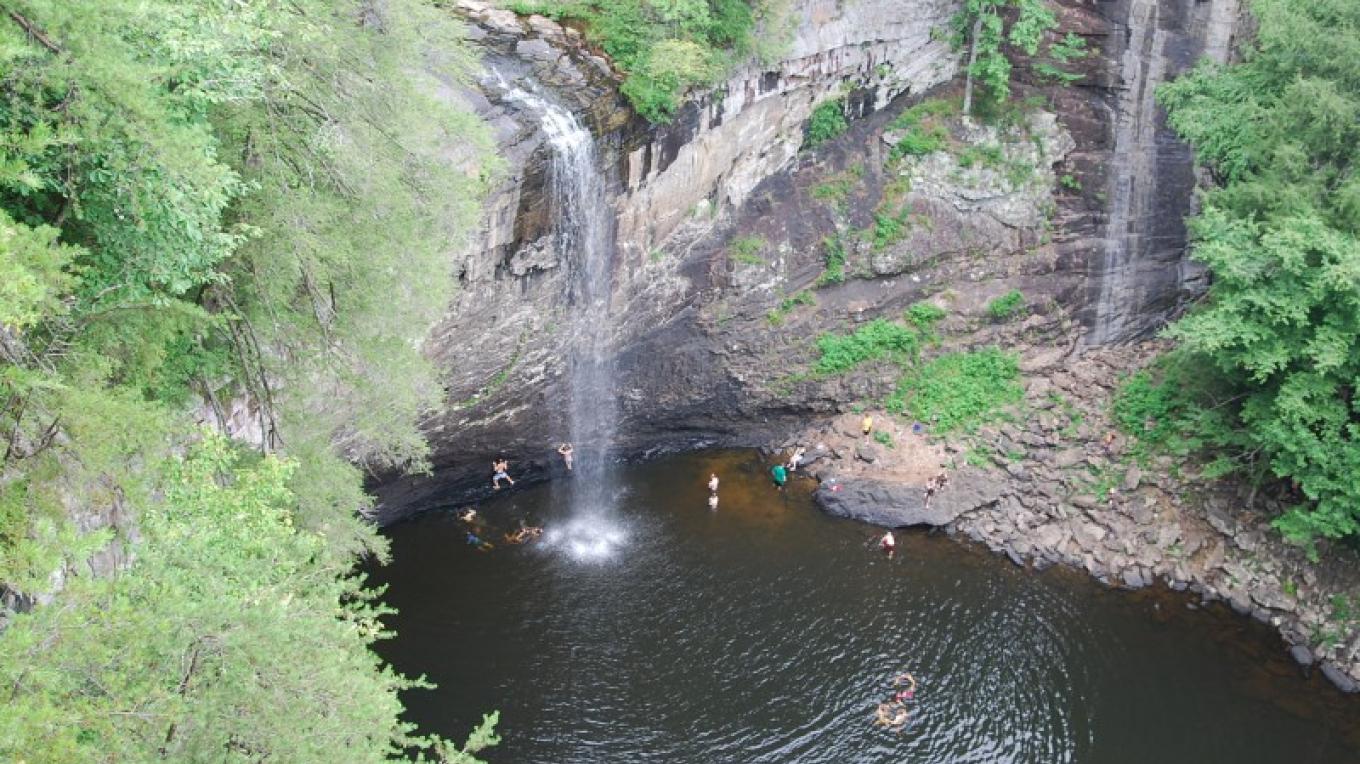
Day-use visitors and overnight campers can get up close and personal to the Foster Falls in South Cumberland State Park. Beginning at the Foster Falls Visitor Center in Sequatchie, Tennessee, a moderately challenging hike leads to the waterfall that drops from 60 feet into a gorge. The refreshing water is perfect for swimming year-round, save winter. 

South Cumberland State Park offers all kinds of outdoor activities, including hiking, hunting, cave tours, rock climbing, fishing, interpretive programs and events, wildlife viewing, and primitive tent and RV camping.

Cummins Falls

Cummins Falls State Park

Another popular swimming hole is in Cummins Falls State Park. This day-use park can be found nine miles north of Cookeville on the Blackburn Fork State Scenic River.

The Cummins Falls drops down from a height of 75 feet. The first portion of the falls plunges 50 feet into a shallow pool, and the second portion cascades 25 feet into a larger, deeper pool.  Any visitor wanting  to enter the gorge or visit the base of the waterfall must now obtain a permit from the park.

A Word of Caution Regarding Waterfalls

Not to strip away the fun of waterfalls, but venturing to one of these natural beauties comes with a word of caution. Trauma surgeon Jonas Karlsson, MD, offers advice based on his experiences treating patients with fatal or nearly fatal injuries around waterfalls.

1. Wear sturdy hiking shoes or boots.

2. Stay on developed trails. Do not stray from observation decks and platforms.

3. Pay attention to warning signs and rules posted near waterfalls.

4. Never climb on or around waterfalls.

5. Never jump off waterfalls or dive into plunge pools.

6. Supervise children and pets carefully.

7. Never play in the stream or river above a waterfall, or try to take photos at the top of a waterfall.

-Gathered from Waterfall Safety

Waterfalls Aren’t the Only Thing You Can Fall For…

Fall for the protection, security, and peace of mind that Coach-Net’s Premier Motorized Plan brings to RVers everywhere. You can rest easy knowing that Coach-Net has you covered with its 24/7, all-inclusive roadside assistance, Concierge Services, Global Emergency Travel Services, Tire Discounts, Camping Discounts, and so much more. When you sign up for our roadside assistance program before you set off, you’ll have the help you need whenever you need it. So get Coach-Net and get on with your Tennessee waterfall adventures!


About The Author: Natalie Henley

Levi Henley and his wife, Natalie, have been full-time RVers for over 5 years. They have also been Coach-Net customers for the same amount of time.  They travel and workcamp around the U.S. in their 26-foot Itasca Sunstar motorhome with their two cats.  They write for multiple RV-related publications and recently co-wrote “Seasonal Workamping for a Living: How We Did It.” You can follow their adventures on the road at henleyshappytrails.com 

RV Protect

Mike S. ~ “I am very pleased I chose Coach-Net! When I needed you, you were there for me!”

Share this with your friends:

  • Share on Facebook (Opens in new window) Facebook
  • Share on X (Opens in new window) X
  • Share on Pinterest (Opens in new window) Pinterest
  • Print (Opens in new window) Print
  • Email a link to a friend (Opens in new window) Email
  • More
  • Share on Reddit (Opens in new window) Reddit
  • Share on Tumblr (Opens in new window) Tumblr

Like this:

Like Loading…

Saved in Vinton, Louisiana

06 Wednesday Oct 2021

Posted by Coach-Net in The Great Outdoors

≈ 2 Comments

Tags

Coach-Net Blog, RV breakdown, RV Life, RV Roadside Assistance, RV travel, Travel Tips

It had been a long couple of months. In the midst of the COVID pandemic, our family had inadvertently turned what was supposed to be a 4 week road trip into an entire summer on the road. We ended up circling the United States on our journey, making our way as far east from California as Washington DC. It had been a summer filled with some incredible adventures, and time well spent considering summer activities back in California were largely suspended. Having just spent some extended time in the south and in New Orleans, our family was en route west to California from Louisiana. We had hoped to make it as far as Austin, Texas during our long drive that day.

Cruising along Interstate 10, my husband noticed a tow truck in his side mirror, flashing his lights. We slowed a bit, and the tow truck driver pulled alongside us, pointing towards the rear of our Coachmen Mirada motorhome. We’d had people flag us down a couple times in our travels, and always for storage compartment door having inadvertently flung open. We knew that would be highly uncommon while cruising straight at highway speeds, but decided to pull off the highway at the next exit to take a better look. After pulling off into a gas station in Vinton, Louisiana, we realized what the helpful tow truck driver had been point to. One of our rear dualie tires on the right side of the coach was flat.

Just like that, we found ourselves stranded on the border of Louisiana and Texas in 110° heat. Justin took a few laps around the RV, and I began calling for roadside assistance. 

It was hot. The kids were grumpy. We were seemingly in the middle of nowhere. (No offense to the wonderful people of Vinton, Louisiana. It’s obviously not “nowhere” to you, but in that moment, it felt that way to us!)

Thankfully, our family had multiple avenues to explore in terms of finding assistance. We had roadside assistance coverage through AAA and State Farm for our personal auto, and figured we had our bases covered. Out of habit, we pursued the same channels we’d have used if our Honda Odyssey had gotten a flat, with Justin calling AAA while I called State Farm.

Trying to get RV roadside assistance through automobile channels was a terrible idea. Even trying to get the State Farm and AAA agents to properly identify the vehicle make and model in their systems was a process, and it became clear they had no frame of reference on how to support us. As we sat on the phone frustrated, Justin noticed the sticker on our windshield for Coach-Net. Having just bought the Mirada earlier in the year with one year of Coach-Net roadside included, we hadn’t yet used roadside assistance, and had completely forgotten about it as an option.

Right out of the gate with Coach-Net, it was clear this was a different experience. The Coach-Net agent was both helpful and friendly, immediately identifying both our coach and tire size, and promptly began working to identify an available mobile repair technician in the area to assist. 

While Justin was on the phone with Coach-Net, I wandered the area around the gas station. As luck would have it, I discovered a sign literally right across the street from the gas station that read “RV Park 500ft” with an arrow pointing right. I headed over to investigate, and stumbled upon our border oasis, complete with 50A hookups and an outdoor pool with not only one, but TWO waterslides. It was almost as if it magically appeared just for us that day!

We pulled out of the gas station and crawled our way to the RV park, feeling blessed to hook up and get both A/C units cranking while we waited for the repair tech. In the sweltering humid heat of the southern summer, this pool was like a mirage for the kids and I, who immediately jumped in to cool off.

Being in rural Louisiana in the height of summer, it took a few hours to find a local tire shop with the right tire and an available tech to change the flat roadsides (or poolside, as it were). We were back up and running with our new tire not long after the tech arrived, but the kids were having so much fun at the pool by then that we decided to stay put and enjoy our spot in Vinton, continuing on our journey to Austin the next morning. DOUBLE WATER SLIDES FOR THE WIN!

Vinton, Louisiana will live forever in family lore following our detour. If there’s anything our time on the road has taught our family, it’s that sometimes the unexpected adventures are the most memorable!


About The Author: Allison Gagnon

The Gagnon family is a fun-loving, adventure-seeking, outdoor-exploring, RV-obsessed family of six. They are on a quest to visit all 63 National Parks in the United States, and have a passion for exploring the country’s natural treasures and adventuring with their four children while they are still young. These adventures are made possible, in part, via travel in their 36-foot Coachmen Mirada motorhome. Having already visited 52 National Parks, they’ve found a sweet spot in the delicate balance between living a full, and sometimes, hectic life at home and finding respite in outdoor adventures with every chance they get. You can follow along on their journey at www.gagnonsgone.com. 


RV Protect

Martina N. ~ “Friendly and fast service! Highly recommended especially for new RV owners!”

Share this with your friends:

  • Share on Facebook (Opens in new window) Facebook
  • Share on X (Opens in new window) X
  • Share on Pinterest (Opens in new window) Pinterest
  • Print (Opens in new window) Print
  • Email a link to a friend (Opens in new window) Email
  • More
  • Share on Reddit (Opens in new window) Reddit
  • Share on Tumblr (Opens in new window) Tumblr

Like this:

Like Loading…

Fulltime RVer Tips: 3 Great Web Applications For RV Trip Planning

27 Monday Sep 2021

Posted by Coach-Net in Tips & Tricks

≈ Leave a comment

Tags

RV Tips, RV travel, RV Travel Apps, tech tip, Travel Tips

My wife Natalie and I have been living in our RV full-time for over six years. We have put thousands of miles on our rig and have planned tons of trips in that time. As a result, we get asked about the best RV trip planning app out there. Honestly, we don’t use just one. There are several big contenders, and each of them has its strengths and weaknesses. So below, you will find the top three RV trip planning web apps we use and why.

RV Trip Wizard

RV Life produces RV Trip Wizard, and it is probably our main trip routing app. That is what puts it on top of the list. Many apps help you find RV parks, disbursed camping sites, and Walmarts, but not many of them will route you with RV-friendly directions. That is precisely where RV Trip Wizard shines.

Cost: $19/month or $49/year

Why We Love RV Trip Wizard

  • Safe Routing And Fuel Stops

Their site offers a free 7-day trial, and when you sign up, you are asked to input your RVs type, size, gas mileage, etc. RV Trip Wizard will use this information to choose the safest route for your rig. It will also use the fuel tank size and gas milage to tell you where you will need to fill up.

  • Time Estimates And Avoiding Tolls, Highways, Etc

Do you want to avoid highways or hate tunnels even when your RV will fit? RV Trip Wizard has many options to avoid different scenarios on your route. You can also allow Trip Wizard to estimate your travel time based on speed limit or choose an average speed that you typically travel.

  • Driving Radius Based On Mileage Or Time

The driving radius is a neat feature. You select a minimum, ideal, and maximum distance based on miles or driving time each day, and RV Trip Wizard will put that radius around your selected stopping location. This makes it easier to decide where your next stop will be. We used to have to measure each driving day manually on Google Maps before discovering this feature.

  • Trip Cost Estimate

You can input the average price of gas, campground stay, and daily food cost, and RV Trip Wizard will estimate the cost of your trip. Alternately, you can input the cost information for each stop to get an accurate estimate of how much your trip will cost.

  • Tons of Filters

Filter RV parks and campgrounds by type, amenities, price, rating, and more. There are tones of filters to narrow down the perfect RV park. It integrates with Campground Reviews, so you get real customer input without leaving the trip planning tool.

  • Points of Interest

RV Trip Wizard allows you to find and filter for different points of interest along your route from gas stations, dump stations, and Walmarts to area attractions.

  • Elevation

RV Trip Wizard shows you the elevation and estimated grades of your entire trip.

  • RV GPS

You can pull up your trips on the RV Life app to use it as an RV-safe GPS unit.

Here is a video of exactly how we use RV Trip Wizard to plan an RV Trip:

Allstays Pro

Allstays is a popular RV trip planning tool for RVers that doesn’t do routing. However, It provides many of the same filters as RV Trip Wizard for finding campsites, gas stops, and services.

Cost: About $35 a year

What It’s Good At

  • Walmart, Truck Stop, and Rest Stop Info

Allstays is good at listing a ton of information about truck stops and rest stops. It will tell you how many parking spaces and amenities are offered such as propane fills or an RV dump station. The same goes for rest areas. Do you need a rest area with an RV dump, WiFi, or any other services? Allstays will tell you.

In addition, when it comes to Walmarts, Cracker Barrels, and other such locations, Allstays will tell you how many RV parking spaces Cracker Barrels have. The description will list other RVers’ experiences at Walmarts with the date for reference.

Allstays is good at giving info on places like Walmarts, truck stops, and rest areas that other services don’t give.

  • Free Camping

Allstays isn’t our preferred boondocking spot finder, but it does have a rather large database of free or almost free campgrounds. Using Allstays, we have been able to find locations that provide full hookups that allow free camping. You can find some of these locations with RV Trip Wizard, but Allstays seems to have more.

What It’s Not Good At

There is only one issue that prevents Allstays from being used exclusively, and that is its lack of routing. You can find just about everything you need to plan an RV trip. However, you must use other map software like Google Maps to plan the route.

The following video shows how we have used a combination of Allstays and Google Maps to plan and route an RV trip.

Campendium

Campendium, like the other services mentioned in the article, will allow you to find RV parks, dump stations, etc. This is our go-to for boondocking, overnight parking spots, and dump station finds.

Cost: Free (ad-supported), or you can get extra perks and additional functionality by becoming a supporter for $20 a year.

What It’s Good At

  • Boondocking

As stated above, if you are looking for boondocking locations, overnight parking spots, and dump stations, Campendium is where to go.

Campendium is our favorite app for finding boondocking spots and overnight parking.

What It’s Not Good At

It doesn’t do routing, list gas stations, or Walmarts.

How We Use All Three

Putting these three services together, we can plan our route any way we like. We do routing and RV park searching in RV Trip Wizard. If we plan a gas stop at a travel center or are interested in more info about a rest area or Walmart, we head over to Allstays to find the info we need. Finally, if we are looking for a boondocking or free spot, we search the area on Campendium. RV Trip Wizard allows you to enter a stop via GPS location which both Allstays and Campendium give for their locations.

When it comes time to hit the road, RV Trip Wizard allows us to open our RV Life app on our phone, pull up the preplanned trip, and tap navigate. The app gives turn by turn RV safe directions and even shows little icons indicating stores and gas stations along the route.


About The Author: Levi Henley

Levi Henley and his wife, Natalie, have been full-time RVers for over 5 years. They have also been Coach-Net customers for the same amount of time.  They travel and workcamp around the U.S. in their 26-foot Itasca Sunstar motorhome with their two cats.  They write for multiple RV-related publications and recently co-wrote “Seasonal Workamping for a Living: How We Did It.” You can follow their adventures on the road at henleyshappytrails.com 

RV Protect

Bobby H. ~ “We experienced a tire blow out on our 40ft fifth wheel. The agent that helped us was very calming and helpful. The service was prompt and exactly as described. The service provider was very professional, prompt and helpful. We are very pleased with your service. This was the first time we have had a need in over two years. Now we are even more at ease while we travel knowing Coach-Net has our back.”

Share this with your friends:

  • Share on Facebook (Opens in new window) Facebook
  • Share on X (Opens in new window) X
  • Share on Pinterest (Opens in new window) Pinterest
  • Print (Opens in new window) Print
  • Email a link to a friend (Opens in new window) Email
  • More
  • Share on Reddit (Opens in new window) Reddit
  • Share on Tumblr (Opens in new window) Tumblr

Like this:

Like Loading…

4 Rockin’ Places to Go RVing in Nebraska

09 Thursday Sep 2021

Posted by Coach-Net in The Great Outdoors

≈ Leave a comment

Tags

Full Time RVing, Nebraska Camping, RV Camping, RV Life, RV travel, Travel Tips

“We get it. Some people will write Nebraska off and never give it another thought. Or another chance. But we also know that there are enlightened truth-seekers out there willing to take the time to find out what makes our beautiful state so appealing, charming, and disarming. Welcome enlightened truth-seekers!” – https://visitnebraska.com/

While often overlooked as a travel destination, Nebraska is a Midwestern hidden gem. It offers majestic landscapes, rich history of trailblazers, and dramatic natural wonders surrounding vibrant cities and culture. So the next time you cross through Nebraska on your RV journey, consider stopping a few days at some of these stunning and noteworthy natural and historical landmarks featuring unique rock formations.

Chimney Rock National Historic Site

Chimney Rock (Photo by Levi Henley)

The Chimney, Smokestack, Teepee, Wigwam…Chimney Rock National Historic Site, just outside the tiny town of Bayard, has been called many things throughout the centuries. The iconic rock formation that rises close to 480 feet above the North Platte River served as a landlocked beacon along the Oregon, California, and Mormon Trails during the 1800s. 

Accounts of Chimney Rock were recorded in the diaries and journals of early emigrants. They mentioned that the sight of the landmark made them “glad to see that they are going the right direction, and it spired to the heavens.”

While the spire is about 30 feet shorter than it was over 150 years ago, the landscape looks much the same way as it did during the western migration. Today, visitors can learn all about the area at the national historic site’s museum and even walk around a cemetery with graves dating back to the 19th century.

Folks wanting to make an overnight camping trip to this captivating site can stay just down the road at Chimney Rock Pioneer Crossing Campground. The park has the best panoramic views of Chimney Rock, surrounding rock formations, wildlife, and a big open sky.

Scotts Bluff National Monument

Scotts Bluff National Monument (Photo by National Park Service)

Continue your journey down the Oregon Trail at the next stop. About a 30-minute drive northwest of Chimney Rock National Historic Site via NE-92 W sits another significant portion of the California, Oregon, and Mormon Trails.  Towering 800 feet above the North Platte River, Scotts Bluff has served as a landmark for both Native Americans and westward-bound emigrants.

Visitors to this 3,000-acre national monument rich in geological, paleontological, and human history, can explore the visitor’s center and peruse its exhibits, go on a hike, drive the 1.6-mile Summit Road to catch a view from the top of Scotts Bluff or attend a ranger program.  All of this is available for free.  Plus, for your convenience, the local communities of Scottsbluff and Gering offer family-friendly campgrounds.

Indian Cave State Park

Indian Cave State Park (Photo by Nebraska Game and Parks)

On the opposite corner of Nebraska, to the southeast region, is the picturesque Indian Cave State Park. This over 3,000-acre camping, hiking, and boating paradise borders the mighty Missouri River and is nestled amongst a variety of hardwood trees, shrubs, and other flora.

The main geological feature of the state park is the Indian Cave. It features prehistoric Native American petroglyphs that can be viewed from a wooden boardwalk extending the length of the cave wall. 

Visitors can also enjoy an array of outdoor activities, including hiking, biking, boating, horseback riding, fishing, hunting, archery, wildlife viewing, picnicking, and camping. The state park hosts guided tours and special events for day-use visitors and campers throughout the year as well. 

For more information on this intriguing RV camping spot, check out outdoornebraska.gov.

Toadstool Geological Park and Campground

Toadstool Geographic Park (Photo by Visit Nebraska)

If you’re willing to travel off the beaten path down washboard roads and away from cell service, then this next adventure to the far northwest corner of Nebraska may be your next detour. The unique rock formations resembling mushrooms of Toadstool Geological Park are a part of what is referred to as the Nebraska Badlands.

Toadstool Geological Park is located in the Oglala National Grassland and includes a campground for those wanting to explore and hike the trails several days in a row. Day visitors and overnight campers can utilize a self–guided trail brochure to learn about the grasslands, geological formations, and fossil deposits.

There are three hiking trails to choose from with varying degrees of difficulty and range from 1 to 5 miles. The campground consists of six sites (long enough for rigs up to 30 feet, according to Always on Liberty’s review) with picnic tables and fire rings, and there are two vault toilets. Unfortunately, there is no water or hookups, so come prepared. The campground is open year-round with limited services from mid-November to early May. For more information on this geological anomaly or to learn more about RV camping there, visit the USDA Forest Service site.

(As with any camping venture, be leary of weather conditions, Traveling and camping at Toadstool Geographic Park and Campground during a storm or downpour is not advised, especially considering the entrance is a dirt road over 10 miles long.)

Wherever You Roam Coach-Net Can Help Your Traveling Home

Whether traveling through the Midwest or the Northeast, RV carefree using Coach-Net’s 24/7 RV Technical & Roadside Assistance. When you purchase a Coach-Net membership, help from a trusted RV expert is always just a phone call away. But that’s not the only benefit members can receive. Coach-Net offers many additional services, including Tire & Wheel Protection, Extended Service Agreement, RV Paint & Fabric Protection, Guaranteed Asset Protection, and more. For more information on how Coach-Net can provide peace of mind one RV adventure at a time, contact us today!

“As an RV owner, you owe it to yourself to have the protection you need when you need it most. You can rest easy knowing that Coach-Net has you covered.”

-Coach-Net


About The Author: Natalie Henley

Levi Henley and his wife, Natalie, have been full-time RVers for over 5 years. They have also been Coach-Net customers for the same amount of time.  They travel and workcamp around the U.S. in their 26-foot Itasca Sunstar motorhome with their two cats.  They write for multiple RV-related publications and recently co-wrote “Seasonal Workamping for a Living: How We Did It.” You can follow their adventures on the road at henleyshappytrails.com 

RV Protect

Mike S. ~ “I am very pleased I chose Coach-Net! When I needed you, you were there for me!”

Share this with your friends:

  • Share on Facebook (Opens in new window) Facebook
  • Share on X (Opens in new window) X
  • Share on Pinterest (Opens in new window) Pinterest
  • Print (Opens in new window) Print
  • Email a link to a friend (Opens in new window) Email
  • More
  • Share on Reddit (Opens in new window) Reddit
  • Share on Tumblr (Opens in new window) Tumblr

Like this:

Like Loading…

Fine-Tuning Your RV’s Climate

25 Wednesday Aug 2021

Posted by Coach-Net in RV Information

≈ Leave a comment

Tags

RV air conditioner, RV Life, RV roof air conditioner, RV tech tip, RV Tips, Travel Tips

Comfort is derived from a range of factors, but temperature is one of the most important. According to Thought Co, the ideal temperature for both comfort and productivity is around 71.5 fahrenheit – what’s interesting, however, is that this can change based on a range of factors including gender, weight and age. Furthermore, humidity plays an important role, and is once again a relative factor – everyone is different. In the RV environment, comfort is everything – there’s nothing worse than not being able to enjoy your space while out on the road. Creating the perfect climate starts with a thermostat fit for purpose.

Thermostat essentials

A smart thermostat is an efficient and economical way to monitor your RVs thermal environment. Smart thermostats use less energy and are capable of finely tuning the temperature they control, using machine learning to learn where your comfort zone is and then keeping things appropriate to that. As humidity and outside temperature rise and fall, they can adjust to make things a little more comfortable. What’s more, as an RV is often off-grid, you can have a greater control over how your smart thermostat works.

Fine-tuning humidity

Humidity is the other half of the climate question. Extremely arid or wet environments can enhance and magnify the heat conditions of the environment. The gold standard in managing this is through a dehumidifier. Road insurance company Progressive provides guidance in their LifeLanes magazine; a 30-pint dehumidifier is ideal for a mid-sized RV, and will help you to manage the humidity levels within the RV with relative ease. Again, humidity is relative – your comfort level will be specific to you. For the most part, humans enjoy a 40-60 percent humidity level before it starts to become uncomfortable.

Changing needs

The temperature of your RV should be cooler at night and warmer in the day, if required – this is basic guidance for effective and restful sleeping. Similarly, humidity might change as you need it; a skin condition will often benefit from higher humidity levels, but someone diagnosed with asthma may prefer more dry air. As always, you should make adjustments as they come. A good quality thermostat can underpin all of this by providing minute changes at the flick of a wrist, and by having presets for different times of the year or where you’re traveling too. Moving into a higher humidity area, like Florida, from somewhere more arid? You can program that into the thermostat and dehumidifier to react to your geographical changes and keep your environment running smoothly.

With that environment and climate in place, you can enjoy full comfort in your RV. You want it to be your oasis, a place of calm and peaceful collection after a day on the road. Climate is a huge part of that, and will always make you pleased to return to your mobile home.


Author: Alicia Rennoll

RV Protect

Dennis F. ~ “Jan went above and beyond my expectations! She checked on us hourly with such care until we had our coach towed to the shop. She deserves a medal for resolving our situation!”

Share this with your friends:

  • Share on Facebook (Opens in new window) Facebook
  • Share on X (Opens in new window) X
  • Share on Pinterest (Opens in new window) Pinterest
  • Print (Opens in new window) Print
  • Email a link to a friend (Opens in new window) Email
  • More
  • Share on Reddit (Opens in new window) Reddit
  • Share on Tumblr (Opens in new window) Tumblr

Like this:

Like Loading…
← Older posts
Newer posts →

Subscribe

To subscribe to our monthly enewsletter, visit the homepage www.Coach-Net.com

Coach-Net Members

Access your benefits and services by logging in to My Coach-Net

Categories

  • Favorite Recipes
  • Getting To Know You
  • Healthy Lifestyle
  • Holidays in your RV
  • Kids and Camping
  • National Parks
  • Roadside Assistance
  • RV Information
  • RV Newbie
  • RV Safety
  • Tailgating
  • Tech Tips
  • The Great Outdoors
  • Tips & Tricks
  • Travel Destinations
  • Traveling with your Pet
  • Uncategorized
  • We Love It. We Live It.

Archives

Follow Us

  • Facebook
  • X
  • Instagram
© Coach-Net. All Right Reserved. Unauthorized use and/or duplication of this material without express and written permission from this blog’s author and/or owner is strictly prohibited. Excerpts and links may be used, provided that full and clear credit is given to Coach-Net and with appropriate and specific direction to the original content.

Powered by WordPress.com.

Loading Comments...
%d